



For most of its existence, the recruiting funnel was designed for a world where hiring was event-driven, candidates entered through a single door, and humans owned every step of the process. None of those assumptions hold at the scale and complexity of modern enterprise recruiting.
Today, candidates surface through CRM nurture campaigns before a job requirement opens. They re-enter pipelines from talent pools built months earlier. They engage across digital channels before submitting a single application.
The teams responsible for moving them through the process are increasingly working alongside digital workers that operate at a speed and volume no human-only team can replicate.
The funnel did not disappear but what it describes has fundamentally changed.
Most organizations have responded by adding tools: sourcing automation here, an AI screening layer there, a scheduling agent bolted onto the interview stage.
Each addition promises efficiency. Few of them compound. The funnel remains a collection of optimized stages that do not speak to each other, operating on fragmented data and governed by no coherent architecture.
The result is strong performance metrics at one stage, invisible degradation at another, and executive-level reporting that cannot answer the questions that matter most.
- How accurately can we forecast hiring outcomes?
- Where does pipeline velocity actually break down?
- What is the true cost of a stage that looks healthy on paper but produces poor quality-of-hire downstream?
This blog explains the recruiting funnel as it was, traces the specific points where the traditional model fails modern recruiting realities, walks through each stage with updated metrics and AI implications.
What The Traditional Recruiting Funnel Gets Right And Where It Breaks
The traditional recruiting funnel gave the function something it had historically lacked, a structured way to think about candidate flow, measure conversion, and identify where volume was being lost.
It created a shared language between recruiters, hiring managers, and business leaders. When a TA leader could say "we converted 18% of applicants to screen and 42% of screens to interview," that was legible to the business. It made recruiting measurable in a way that gut-feel pipeline reviews never could.
The Linear Funnel Model
The traditional recruiting funnel organizes the hiring process into a linear sequence of stages, each one filtering candidates toward a hire decision. The specific labels vary by organization, but the logic is consistent:
- Awareness: Candidates learn the employer exists and is hiring
- Interest: They engage with the employer brand, job content, or outreach
- Application: They formally enter the process through a structured submission
- Screening: Human or automated review filters for baseline fit
- Interview: Qualified candidates are assessed through structured evaluation
- Offer: A hire decision is extended and negotiated
- Hire: The candidate accepts and begins onboarding
This linear model tells a sequential story about how candidates move through a process and where they drop out. For organizations with relatively stable, high-volume hiring patterns, it produced actionable insight.
Where The Linear Funnel Model Fails
The linear funnel was designed for event-based hiring, where a job requirement opens, candidates apply, humans evaluate them stage by stage, and the funnel closes at hire. It assumed a predictable entry point, a defined sequence of human-owned steps, and a clean data trail from source to start date.
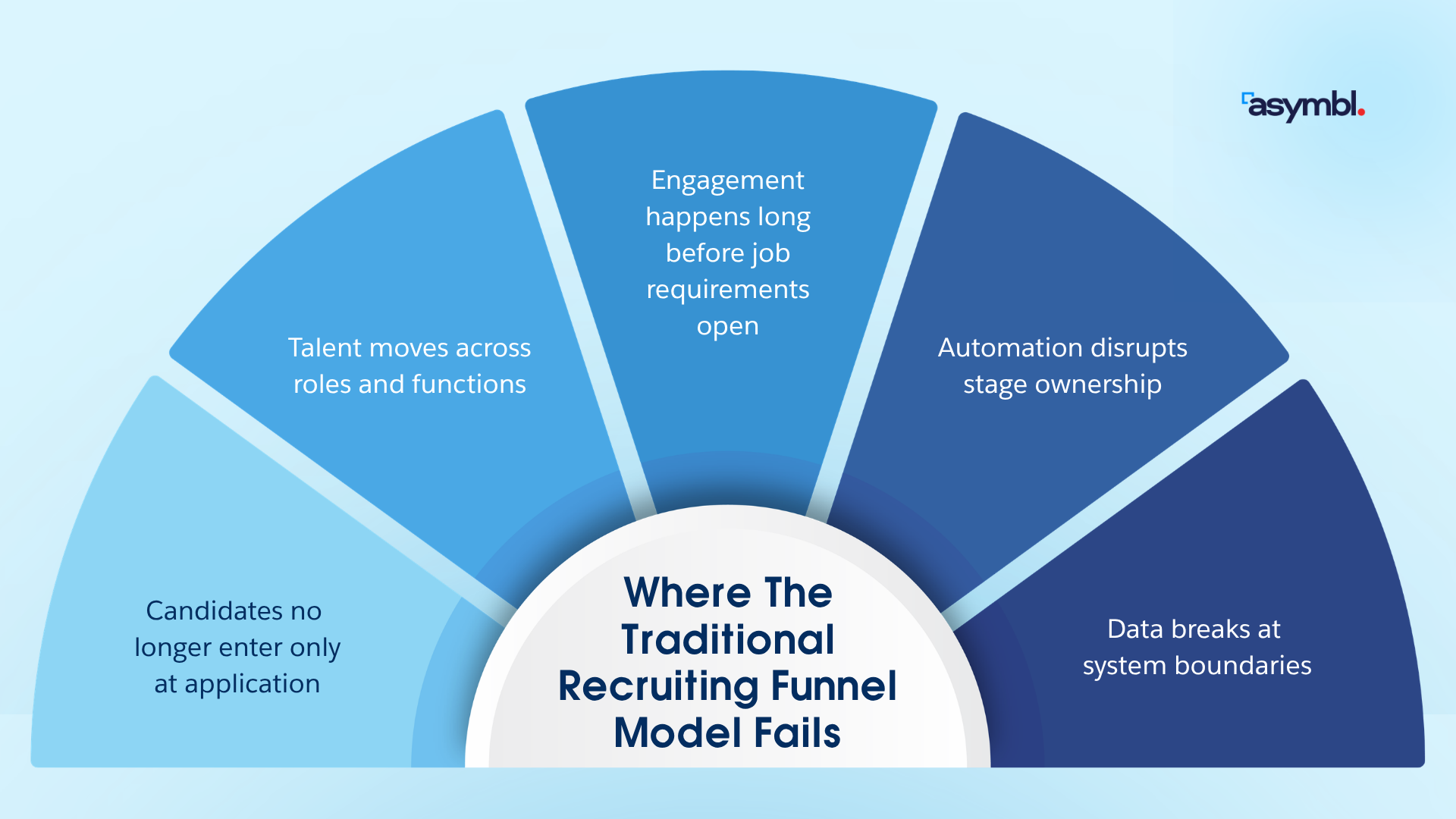
Modern recruiting operates on entirely different structural assumptions, and the gaps between those assumptions and the linear funnel model are where performance quietly degrades.
1. Candidates no longer enter only at application:
In organizations with mature talent relationship strategies, a significant portion of hires come from candidates who were identified, nurtured, and engaged well before a job requirement ever opened.
They entered the relationship through a campaign, an event, a referral, or a proactive sourcing motion. The funnel's assumption that the process begins at application ignores everything that happened before it, which is often where the highest-quality pipeline is built.
2. Talent moves across roles and functions:
A candidate who was qualified but not selected for one role may be the ideal fit for a different function six months later. The linear funnel treats each job requirement as an independent event, with no structural memory of prior engagement or evaluation.
This architectural gap forces recruiters to rebuild relationships and re-evaluate candidates the system already knows, turning prior investment into sunk cost rather than pipeline equity.
3. Engagement happens long before job requirements open:
Employer brand, content, and CRM outreach operate on a different timeline than active hiring cycles. A talent pool built today may not convert to hires for months.
The linear funnel has no mechanism for capturing or crediting that pre-requirement relationship work because its stage model begins at awareness of a specific job, not awareness of an employer over time.
4. Automation disrupts stage ownership:
The funnel was built around the assumption that humans own every step. For example, a recruiter sources, reviews, screens, and advances candidates through deliberate manual action.
When AI agents enter the picture, stage ownership becomes ambiguous. If an automated agent conducts an initial qualification conversation and advances a candidate to interview, at which stage did that candidate "move through," and who owns accountability for that decision? The linear funnel offers no governance model for hybrid execution.
5. Data breaks at system boundaries:
In most enterprise recruiting architectures, CRM engagement data lives in one system, application data in an ATS, interview feedback in a scheduling tool, and offer data somewhere else entirely. The funnel assumes a single, continuous data trail.
What most organizations actually have is a collection of partial records that break at every system handoff. Stage-level conversion rates, time-in-stage calculations, and source attribution all degrade when the underlying data is fragmented.
Taken together, these are not edge cases or implementation problems that better tooling will resolve. There are structural limitations that emerge from applying a linear, event-based model to a recruiting reality that is fundamentally relationship-based and increasingly hybrid in its execution.
The funnel still has value as a reporting lens. However, the operating model underneath it needs to be rebuilt around different assumptions like continuous pipeline, unified data, defined roles for both human and digital workers, and architecture that can hold context across the entire talent relationship.
The Recruiting Funnel
Understanding the recruiting funnel today requires more than a stage-by-stage walkthrough. Each stage carries its original logic, and that logic still applies.
What has changed is the operational reality surrounding each one, including how candidates behave within it, what signals actually matter, how AI is being applied, and where the architecture either holds or quietly breaks down.
1. Stage 1: Awareness And Attraction
The awareness stage was transactional by design. A job requirement was opened, a job was posted across a set of channels, and success was measured by how many candidates that posting generated.
Impressions, click-through rates, and applicants per posting were the primary signals. The employer's job was to be visible. The candidate's job was to find the posting and apply.
This model worked when the supply of qualified candidates was sufficient to absorb a passive distribution strategy. Post broadly, screen the inbound, and fill the role.
Employer brands no longer live in a job posting. It accumulates across every touchpoint a candidate has with an organization, through content, employee advocacy, community presence, and the quality of prior recruiting interactions.
Candidates form opinions about employers long before they encounter a specific job listing, and those opinions shape whether they engage when a relevant opportunity does appear.
Talent pools built and nurtured inside a CRM become a structural advantage at this stage. Organizations that maintain segmented, engaged communities of past applicants, event attendees, and sourced candidates do not start from zero when a requirement opens.
They already have a warm pipeline with documented context, prior engagement signals, and relationship history.
A cold application from a job board requires full evaluation from scratch. A warm candidate from a nurtured talent pool comes with prior engagement data, skills context, and a measurable relationship signal.
Those two types of inbound are not equivalent, but most funnel reporting treats them as if they are.
Key Metrics
- Talent pool growth rate over time
- Engagement rate across nurture campaigns and segments
- Warm pipeline ratio (nurtured candidates as a share of total qualified inbound)
- Campaign conversion rate from awareness touchpoint to application or expression of interest
- Source quality index, measuring downstream hire rate by originating channel, not just application volume
How AI Is Changing This Stage
Asymbl Recruiter Agents can expand the top of the funnel significantly, identifying candidates who match role profiles across professional networks, internal databases, and historical records at a speed and volume no human sourcing team can replicate.
Lookalike modeling applies the profile characteristics of successful past hires to surface candidates who share relevant attributes. Engagement scoring tracks behavioral signals across outreach sequences, distinguishing candidates who are passively receiving communications from those who are actively engaging.
It can segment talent pools by role family, skill cluster, or prior engagement history and deliver differentiated messaging that reflects those differences, rather than broadcasting a generic job alert to an undifferentiated list.
Automation at the awareness stage exposes fragmentation rather than solving it. When AI-driven sourcing operates on partial data, it surfaces candidates the organization already knows, at the cost of the context that would make that knowledge actionable.
This stage demands CRM-native architecture not as a preference but as a functional prerequisite for AI to add compounding value rather than duplicative volume.
2. Stage 2: Engagement And Qualification
The engagement and qualification stage was built around the resume as the primary unit of evaluation. Candidates submitted applications, recruiters reviewed resumes against job requirements, keyword matching filtered the pool, and manual screening calls confirmed basic eligibility.
Volume was the challenge. Speed was the pressure. The goal was to reduce a large inbound pool to a shortlist of candidates worth advancing.
Candidates interact with an organization across multiple touchpoints before, during, and after the application. They engage with outreach sequences, respond to messages, complete pre-application assessments, and carry a history of prior interactions that provides a signal beyond anything a resume can capture.
The resume remains a data point but it is an increasingly unreliable one. With AI-generated applications normalizing across high-volume pipelines, the resume as a proxy for candidate quality has weakened.
What matters more is the aggregate signal like engagement consistency, response quality, behavioral patterns across interactions, and historical evaluation context from prior pipeline stages.
Qualification at this stage has shifted from filtering based on stated credentials to extracting signals from the totality of candidate behavior and context. That is a fundamentally different kind of work, and it requires a different kind of architecture to support it.
Key Metrics
- Qualified applicant rate, measuring what proportion of total inbound meets substantive screening criteria
- Screening-to-interview conversion rate
- Candidate response latency across outreach and follow-up sequences
- Time from application to first meaningful recruiter contact
How AI Is Changing This Stage
Asymbl’s Recruiter Agent can conduct structured qualification conversations at scale, asking consistent questions, capturing responses, and scoring candidates against defined criteria without human intervention at the initial triage layer.
Resume parsing extracts structured information from unstructured documents with greater accuracy. Conversational qualification engages candidates asynchronously, reducing the friction of scheduling a synchronous screening call for basic eligibility assessment.
This is also where the division of labor between digital workers and human recruiters requires explicit design rather than assumption. Structured qualification, consistent questioning, and initial scoring are appropriate territory for digital execution.
Contextual evaluation, handling candidates who do not fit a standard template, and exercising judgment at decision inflection points require human involvement.
Without that boundary defined in advance, AI qualification either over-automates and eliminates candidates who deserved human review, or under-automates and fails to deliver the capacity relief it was deployed to provide.
3. Stage 3: Interview And Evaluation
The interview stage was, for most of its history, a logistics problem dressed up as an evaluation process.
Recruiters coordinated availability across multiple stakeholders, candidates navigated scheduling friction across time zones and calendars, interviewers collected feedback in inconsistent formats, and hiring managers synthesized a patchwork of inputs into a decision that was difficult to audit and impossible to compare systematically across candidates.
The interview was where the funnel slowed down, because coordination was the bottleneck.
Multi-interviewer alignment is increasingly complex. Cross-functional panels, remote participants, and compressed hiring timelines have increased the coordination burden without corresponding improvements in feedback quality or decision consistency.
Interviewers frequently enter conversations without a shared evaluation framework, collect feedback at different levels of specificity, and delay submission long enough to distort recall.
The evaluation quality problem is often more significant than the coordination problem, and it is less visible. Inconsistent feedback across interviewers introduces variance that makes it difficult to compare candidates fairly, identify genuine differentiators, or defend hiring decisions under scrutiny.
A structured interview process with defined competencies, consistent questions, and a shared scoring rubric produces more defensible decisions than an unstructured conversation followed by informal debrief.
Key Metrics
- Interview-to-offer ratio
- Interview cycle time, from first interview scheduled to hire decision
- Feedback completion rate and average submission latency
- Hiring manager alignment score across interviewer panels
How AI Is Changing This Stage
Asymbl Recruiter Agent meaningfully compresses the coordination overhead at this stage. Rather than a recruiter manually brokering availability across multiple parties, scheduling automation identifies open windows, sends invitations, handles rescheduling, and confirms logistics without human intervention at each step.
Interview summarization agents transcribe and synthesize interview recordings, extracting structured notes, identifying discussed topics, and surfacing evaluation signals from conversational content.
It reduces the burden on interviewers to produce detailed written feedback from memory and provides a more consistent record across candidates. Structured scoring frameworks, delivered digitally at the point of interview completion, improve feedback consistency and reduce the delay between conversation and documented evaluation.
4. Stage 4: Offer And Conversion
The offer stage is where pipeline misalignment earlier in the funnel becomes visible. A candidate who reaches an offer with misaligned compensation expectations, a competing offer already in hand, or eroding enthusiasm for the role is not a late-stage problem.
The conditions for that outcome were created much earlier, in how the role was positioned during sourcing, in what expectations were set during screening, in how long the process took between interview and decision.
Offer-stage drop-off is a lagging signal for earlier-stage failures. Organizations that diagnose it only at the offer stage are treating a symptom rather than the cause.
Key Metrics
- Offer acceptance rate
- Offer-to-start ratio, accounting for post-acceptance withdrawals
- Time-in-offer stage, from decision to accepted offer
- Candidate drop-off rate by stage in the offer process
How AI Is Changing This Stage
Automated generation of offer documents, populated from structured candidate and role records, reduces the administrative lag between decision and delivery.
Predictive acceptance scoring is an emerging capability, using longitudinal candidate data, engagement patterns, and historical offer outcomes to estimate the probability that a specific candidate will accept a specific offer before it is extended.
It depends entirely on unified data across the candidate relationship, from initial sourcing engagement through final evaluation. It cannot be built from requirement-level records that reset with each new hiring cycle.
Automated follow-up and nudge sequences keep candidate engagement warm during the offer decision window, reducing the silence that often contributes to drop-off in a competitive market.
Organizations that store engagement, evaluation, and offer history in fragmented systems cannot build the data foundation that makes predictive conversion scoring meaningful.
5. Stage 5: Post-Hire Feedback Loop
The traditional recruiting funnel ends at hire. The offer is accepted, the candidate clears onboarding, and the requirement closes. From a funnel reporting perspective, the work is complete. A conversion was recorded. A metric was satisfied.
This is where the linear funnel model creates its most consequential blind spot.
The quality of a hire is not determined at the moment of acceptance. It is determined by what happens in the months that follow, how quickly a new employee reaches productivity, how long they stay, and whether their actual performance matches the signals the recruiting process used to select them.
The post-hire data is the only feedback mechanism that can tell a recruiting function whether its sourcing, qualification, and evaluation decisions are producing the outcomes the business actually needs.
Without that feedback loop, the funnel cannot learn. Screening criteria stay static even as role requirements evolve. Source channels continue to receive investment based on application volume rather than hire quality.
Interview questions remain unchanged even when the candidates they select consistently underperform. The funnel optimizes for conversion but has no signal for whether what it is converting into is working.
Key Metrics
- Quality-of-hire index, measuring new hire performance against defined role criteria at 90 and 180 days
- 90-day retention rate
- Time to full productivity, or performance ramp speed
- Sourcing channel quality score, correlating originating channel with downstream performance outcomes
When post-hire data connects back to sourcing and screening records, the recruiting function gains the ability to close the loop to identify:
- Which sourcing channels produce the highest-retention hires
- Which screening signals correlate most strongly with downstream performance and
- Which interview assessments are predictive versus ornamental.
That is the difference between a funnel that reports on activity and a pipeline that learns from outcomes.
This connection requires that performance data, sourcing records, and evaluation history live within a shared data architecture. When those records exist in separate systems with no structural link between them, the feedback loop breaks before it begins.
The Structural Shift: From Funnel Tracking To Pipeline Orchestration
For the past two decades, the dominant question in talent acquisition has been “How do we optimize each stage?” Faster screening. Higher conversion at interview. Better offer acceptance rates.
Collectively, they have produced recruiting functions that are significantly more efficient at executing the same fundamentally limited model.
The more durable question is “How do we orchestrate the entire pipeline across human and digital workers, on unified data, in a way that produces measurable business outcomes rather than stage-level metrics?”
Why Optimization Without Orchestration Produces Diminishing Returns
Stage-level optimization is the natural response to funnel visibility.
- When conversion rates are visible, it becomes obvious where to focus.
- The screening-to-interview ratio is low, so the team invests in better job descriptions and automated pre-screening.
- The offer acceptance rate drops, so compensation benchmarking gets introduced.
What this approach cannot address is the compounding friction that lives at the boundaries between stages, at the handoffs where data moves between systems, where accountability shifts between teams, and where the recruiting function intersects with the rest of the business.
- A candidate who clears screening in one system and enters interview coordination in another carries no relationship context across that boundary.
- An offer team that cannot see engagement history from early pipeline stages cannot make informed predictions about acceptance probability.
These are architectural problems and they do not respond to stage-level optimization because they exist between the stages, not within them.
Orchestration addresses what optimization cannot. The continuity of context, the governance of handoffs, and the structural relationship between human and digital work across the full pipeline.
The Components Of A Modern Pipeline Architecture
The shift from funnel tracking to pipeline orchestration is built on several interdependent components. Each one addresses a specific limitation of the linear model.
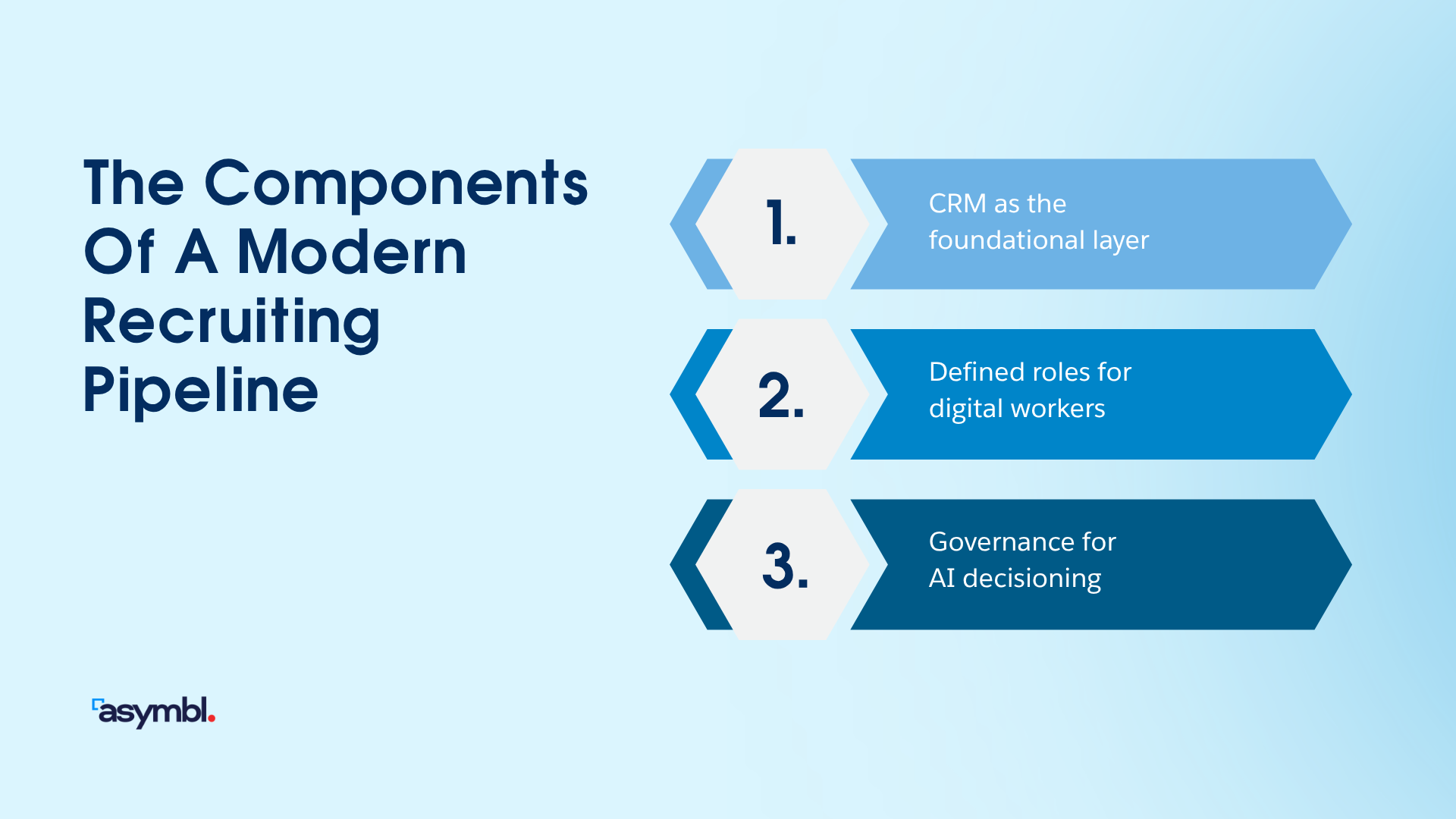
1. CRM as the foundational layer:
In the linear funnel model, the ATS is the system of record. Candidates enter when they apply and exit when they are hired or rejected. Everything that happened before the application, and everything that happens after the hire, exists outside the system's memory.
A CRM-native architecture inverts that relationship. The CRM, for example, Salesforce, holds the candidate relationship from first engagement through post-hire performance signals.
The ATS functions as a workflow execution layer within that relationship rather than a primary repository of talent intelligence.
This means that a candidate nurtured over six months of engagement, evaluated for one role, placed in a silver medalist pool, and re-engaged for a second role eighteen months later carries a continuous, accessible record across all of those interactions. The pipeline does not forget.
2. Defined roles for digital workers:
Organizations deploy automation at a stage, measure whether it reduced manual effort, and conclude that AI is or is not delivering value. What they rarely do is design the digital worker as a member of the workforce with defined responsibilities, performance expectations, and governance boundaries.
According to a Global Human Capital Trends 2026 Report by Deloitte, 59% of organizations are taking a technology-focused approach to AI, layering AI onto legacy systems and processes rather than reimagining how humans and AI interact, collaborate, and make decisions.
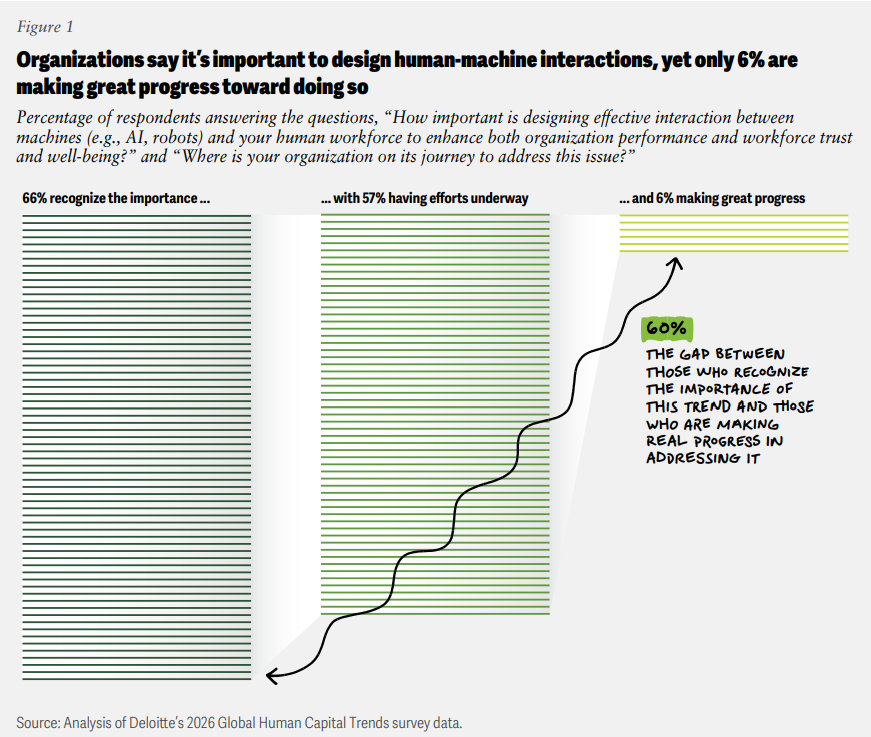
In recruiting, this often results in automation being added to individual workflow steps without defining how digital workers should operate as accountable participants in the hiring process.
A digital worker that handles initial qualification outreach needs a defined scope, including which candidates it contacts, what questions it asks, what thresholds determine advancement, and when it escalates to human judgment.
Without that design, the digital worker either over-executes and eliminates candidates who deserved human review, or under-executes and fails to deliver the capacity relief it was deployed to provide.
The performance of digital workers needs to be measured alongside human recruiters, using consistent metrics, with clear accountability for outcomes.
3. Governance for AI decisioning:
Recruiting decisions carry legal, ethical, and organizational consequences. When AI participates in those decisions, at screening, qualification, or evaluation stages, the governance framework that applies to human decision-makers must extend to digital ones.
- Who owns the criteria that an AI qualification agent applies?
- Who monitors for adverse impact across demographic segments?
- Who defines the threshold at which a digital worker's decision requires human review?
These are design questions that determine whether AI in recruiting is a scalable capability or an accelerating liability.
A recruiting function built on pipeline orchestration logic is a component of enterprise operating infrastructure that forecasts workforce needs, manages a continuously active talent relationship layer, integrates human and digital labor with defined accountability, and produces measurable impact on business outcomes.
What Executives Should Measure In A Hybrid Recruiting Funnel
Recruiting has historically been measured in ways that satisfied the recruiting function without informing the business. Time-to-fill told operations whether headcount was coming. Cost-per-hire gave finance a unit cost to benchmark. Source-of-hire told talent teams which channels to fund.
These metrics served their purpose within the TA function. What they rarely did was give executives the information they needed to treat recruiting as a strategic lever rather than an administrative service.
This limitation was tolerable when recruiting operated at the margins of business decision-making. It is no longer tolerable when workforce composition, hiring velocity, and talent pipeline health directly affect revenue forecasting, market responsiveness, and organizational capability.
The shift to a hybrid recruiting model, where human and digital workers share pipeline execution, makes this measurement gap more consequential.
According to a 2024 BCG Research on AI Adoption, across industries, many organizations are already deploying AI in operational workflows, yet relatively few have translated that adoption into measurable business outcomes.
It shows that only 26% of companies have developed the capabilities required to move beyond AI proofs of concept and generate tangible value.
Without metrics that connect recruiting activity to business performance, talent functions risk falling into the same pattern of deploying digital labor across the funnel while lacking the measurement framework needed to demonstrate its real impact.
Organizations that measure only what the linear funnel was designed to report will systematically underestimate the impact of their recruiting function and misallocate investment within it.
The Metrics That Reflect A Modern Pipeline
A hybrid recruiting function operating on unified data and integrated digital labor produces a different category of measurable outcomes. These metrics sit above the traditional funnel, connecting recruiting performance to business performance in ways that make the talent function legible at the executive level.
1. Pipeline velocity
The pipeline velocity measures the rate at which qualified candidates progress through the full pipeline from initial engagement to the hiring decision, across roles, business units, and time periods.
It reflects not just how fast individual stages move but how well handoffs between stages maintain momentum. A pipeline with fast individual stages but slow handoffs will show strong stage-level metrics and a slow overall velocity. This gap is where orchestration failure lives, and it is invisible to stage-level reporting.
2. Stage compression through digital execution
As digital workers absorb execution-layer tasks across the funnel, the elapsed time for stages they own should measurably compress.
Tracking stage duration before and after digital labor integration, and comparing it against human recruiter performance on the same tasks, provides a direct measure of digital worker impact. This metric makes AI investment quantifiable in terms of time recovered rather than effort estimated.
3. Recruiter capacity multiplier
When digital workers handle structured qualification, scheduling coordination, outreach sequencing, and compliance logging, human recruiters are freed to operate at higher leverage.
The recruiter capacity multiplier measures how many job requirements, candidates, or hiring manager relationships a recruiter can effectively manage when digital execution absorbs the deterministic work.
Organizations with well-designed hybrid models see this metric improve meaningfully without increasing headcount. It is one of the clearest financial expressions of AI ROI in recruiting.
4. Forecast accuracy
If a recruiting function cannot predict with reasonable accuracy how many hires it will produce in a given quarter, across role types, pipeline sources, it cannot influence enterprise workforce planning in any meaningful way.
Forecast accuracy measures the gap between projected and actual hiring outcomes over time. A function with improving forecast accuracy is developing the data maturity and pipeline discipline to be treated as a strategic partner in workforce planning rather than a reactive service provider.
5. Quality-of-hire indexed to business outcomes
This is the metric that connects recruiting performance to the outcomes the business actually cares about. Quality-of-hire at its most basic measures new hire performance against defined role criteria at 90 and 180 days.
At a more sophisticated level, it indexes that performance against sourcing channel, screening method, interview structure, and the specific digital or human touchpoints that influenced each hire decision.
When quality-of-hire data connects back to pipeline records, the recruiting function can answer questions that most talent teams currently cannot like:
- The sourcing channels producing the highest-performing hires, not just the most hires
- The screening criteria predicting downstream success
- The interview structures discriminate effectively versus creating the appearance of evaluation rigor without the substance.
These answers have direct implications for where recruiting invests, how it designs its evaluation processes, and how it justifies those decisions to the business.
6. Digital worker productivity relative to human effort
In a hybrid recruiting model, the performance of digital workers should be reported with the same transparency as human recruiter performance.
- How many candidates did the digital qualification agent advance that were subsequently hired?
- What was the accuracy rate of its screening decisions relative to human review?
- Where did it produce errors that required human correction, and what was the cost of those corrections?
This reporting treats digital labor as a measurable workforce component rather than a background automation tool, and it provides the governance visibility that responsible AI deployment requires.
Conclusion
The organizations building durable hiring capability in 2026 are not asking how to optimize the traditional recruiting funnel stages.
They are asking whether their architecture can hold candidate relationships across time, whether their data survives system boundaries, and whether the humans and digital workers in their pipeline have clearly defined roles or are simply sharing the same ambiguous workload.
These are operating model questions and adding another tool to the stack doesn’t answer them.
The traditional funnel describes what recruiting looks like from the outside. Orchestration describes how it actually works. The gap between those two things is where most enterprise talent functions are losing ground without a metric that tells them so.
Building a recruiting function that forecasts reliably, learns from its own outcomes, and produces measurable business impact is not a future state. It is an architectural choice available now, for organizations willing to ask the right questions before selecting the next solution.
Asymbl runs on Salesforce, unifying your CRM, ATS, and digital labor into a single pipeline. If fragmented data and undefined AI roles are limiting your recruiting outcomes, see exactly how Asymbl Workforce Orchestration works. Book a demo
FAQs
Executives should look beyond stage-level conversion rates to metrics connecting recruiting to business outcomes. Pipeline velocity tracks how quickly qualified candidates progress through the full funnel. Forecast accuracy measures projected versus actual hiring outcomes. Recruiter capacity multiplier reflects output relative to team size as digital labor absorbs execution tasks. Quality-of-hire indexed to business performance connects hiring decisions to revenue, retention, and workforce capability
A CRM-native architecture holds candidate relationships continuously from first engagement through post-hire performance, rather than resetting with each new job requirement. Prior engagement signals, evaluation history, and relationship context remain accessible at every stage without manual reconstruction. It also enables the post-hire feedback loop most architectures ignore, connecting new hire performance back to the sourcing channels and screening methods that produced each hire
Quality of hire measures new employee performance against role expectations, typically assessed at 90 and 180 days. For funnel optimization, it is the only metric that reveals whether screening criteria, evaluation methods, and sourcing channels are producing hires who succeed. Without it, funnel optimization targets conversion volume rather than conversion value, and the function can hit its metrics while systematically underdelivering for the business
Employer brand shapes candidate behavior before any recruiter interaction occurs. Strong brand recognition drives higher-quality inbound at awareness, better outreach engagement rates, and stronger offer acceptance. It also raises the warm pipeline ratio, the proportion of candidates who already have a relationship with the organization when a relevant role opens, directly improving top-of-funnel quality and time-to-qualify
Candidate drop-off is the loss of qualified candidates at any funnel stage before a hire decision. Common causes include process friction, slow response times, misaligned compensation expectations, and communication gaps. Reducing it requires diagnosing which stage is producing the loss and addressing the underlying cause
A funnel emphasizes stage-by-stage conversion, measuring how volume reduces from awareness to hire. A pipeline emphasizes relationship continuity, managing talent across time regardless of whether an active job requirement is open
Meet Ben: Here's What Managing AI Like an Employee Actually Looks Like
Ben, Asymbl's digital worker, shares what managing a digital employee looks like. Training plans, KPIs, and real mistakes included.

The Right Fit Starts With a Conversation.
See what working together could look like.
.webp)