

In staffing firms, every new tool has to justify its cost against recruiter capacity, placement revenue, and the systems already running the desk. If an ATS handles the core workflow, replacing it just to add AI creates more risk than value.
The operating pressure on staffing firms has changed. Clients expect faster submissions, quicker candidate responses, live pipeline visibility, and documentation on demand. Recruiters are still expected to deliver all of that while managing sourcing, screening, scheduling, follow-up, and redeployment across multiple roles and accounts.
That is where staffing automation has moved beyond simple task reduction. This guide breaks down what actually drives staffing automation decisions, how the market shifted in 2026, what to evaluate before buying, and how Asymbl approaches the problem through Unified Talent Relationship Management and Workforce Orchestration™.
What Drives How Staffing Firms Actually Automate
Staffing firms automate differently based on factors such as hiring volume, role complexity, recruiter capacity, workflow standardization, and the amount of candidate communication involved. These factors determine which tasks digital workers can handle and where recruiters still need to make decisions.
Margin Protection Decides What Gets Automated
Staffing firms are pragmatists. They evaluate automations based on whether it improves margins, increase recruiters’ capacity, and support placement outcomes. A tool can earn a place in the workflow, but only when it creates measurable business value.
The evaluation usually focuses on whether the automation helps the firm handle more recruiting activity without adding the same level of operational cost.
According to the 2026 Forrester State of Business Buying, more than 60% of business buyers engage in some form of trial before committing, and just over a third convert that trial into a full paid engagement.
For staffing firms, this means automation decisions need to be tied to clear outcomes, such as faster placements, improved recruiter productivity, and stronger margins.
Manual Steps Stay Because the Current System Works
Staffing firms are cautious about replacing systems and workflows that already contribute to placements and revenue. Recruiters build their processes around the tools they use every day, from applicant tracking systems (ATS) to communication platforms and candidate databases. Even if some steps remain manual, the overall system is familiar and proven.
Replacing these systems creates uncertainty. Firms need confidence that a new solution will maintain the workflows their teams depend on while improving outcomes such as recruiter capacity, placement speed, or operational efficiency.
This is why staffing automation works best when it enhances existing processes instead of forcing firms to abandon the systems already supporting their business. The goal is not to replace what works, but to remove the manual work that slows recruiters down.
How the Staffing Market Shifted in 2026
For years, staffing firms could rely on experienced recruiters, established processes, and applicant tracking systems (ATS) to manage hiring workflows. These systems worked because they supported the level of speed, visibility, and communication clients expected at the time.
Clients started asking for more visibility, and application volume grew heavier than what the system and teams could carry. Firms are feeling the pressure from the client side as well as the weight of outdated systems and processes.
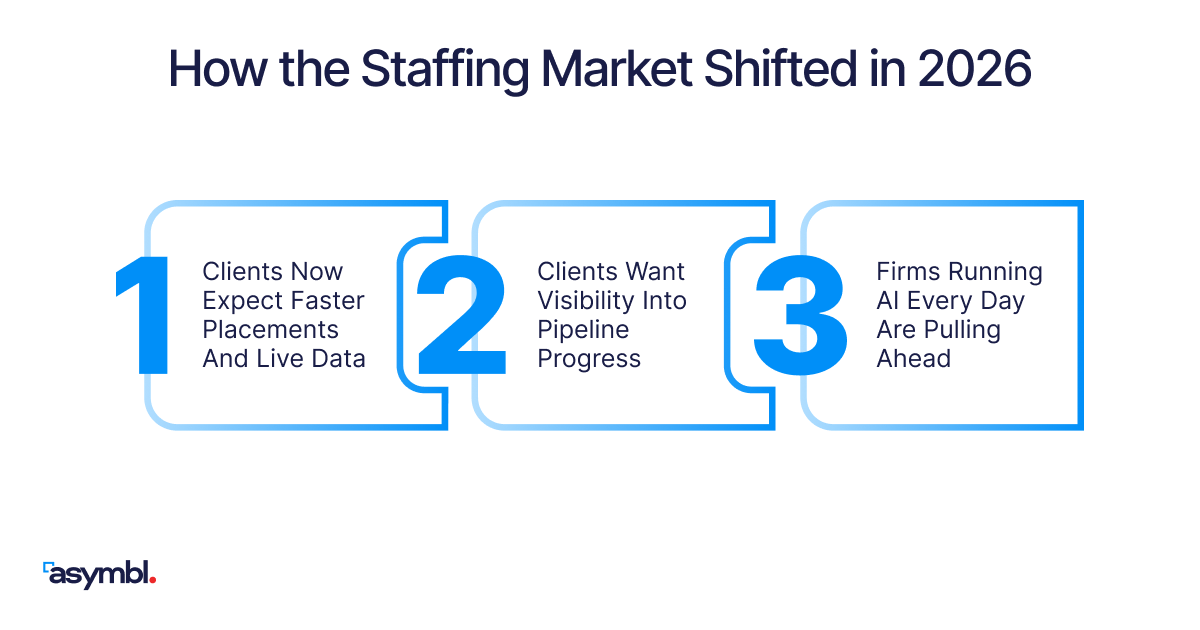
1. Clients Now Expect Faster Placements and Live Data
Clients now expect higher placement velocity and real-time visibility into the candidate pipeline. They also want compliance documentation on request and workforce reporting that holds up across every desk.
2026 Deloitte Global Human Capital Trends found that 7 in 10 business leaders now prioritize speed and nimbleness. It's their primary competitive strategy. A staffing firm is part of its clients' supply chain, and that chain runs on exactly this kind of speed.
Many staffing firms answer client requests by pulling data manually, which delays the answer and diverts the capacity that should be filling the next job order. A client asking for a status update on a Tuesday afternoon doesn't want to wait until Thursday.
2. Clients Want Visibility into Pipeline Progress
Knowing a role is in progress tells a client nothing about the pipeline behind it. A client wants to see who has been sourced, screened, and submitted.
Without visibility, a client can't tell a scarce market from thin coverage on the firm's end. A shortlist of three names pulled from a pool of thirty reads as a strong market. The same three names pulled from a pool of four reads as luck.
A client deserves to know which one they're looking at. Confidence ends up resting on the account manager's word instead of the data behind it.
3. Firms Running AI Every Day Are Pulling Ahead
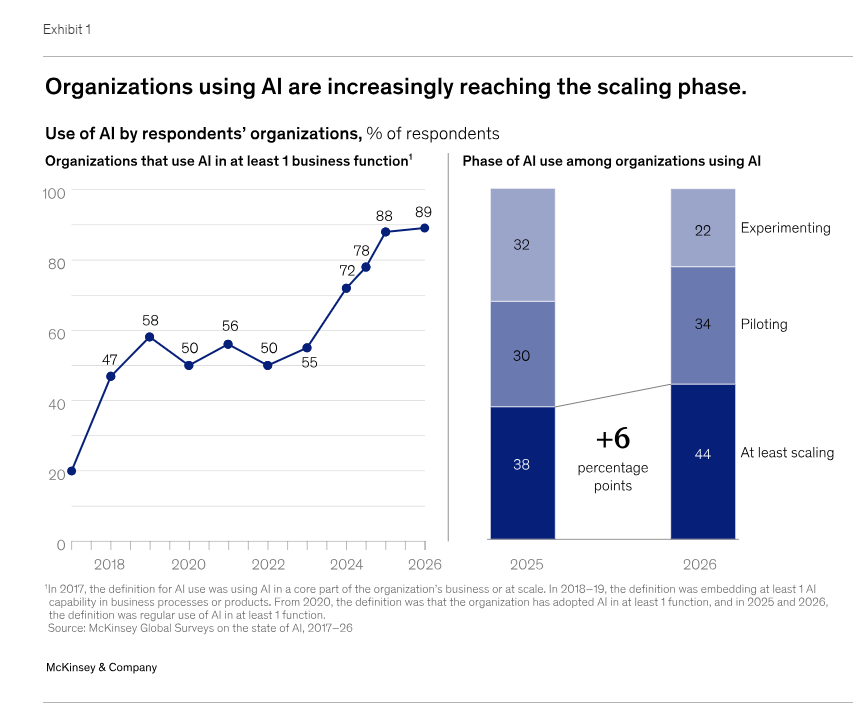
2026 McKinsey State of AI Report found that nearly nine in ten (89%) report regular use of AI in at least one business function and 44% report AI scaling across the enterprise, up from 38% a year ago.
Generic AI trained on generic recruiting data doesn't understand a staffing desk's specific mix of clients, jobs, and margin pressure. It ends up automating the wrong step instead of the one actually slowing the recruiter down.
Asymbl’s digital worker sees talent history, runs inside your recruiting workflow every day, screening, scheduling, and following up alongside the team. It doesn't wait for someone to remember to open it.
What Staffing Firms Should Actually Look for in Automation
Firms running AI daily and firms stuck on a stalled trial go through similar evaluations. Both use a feature list that measures what a product does, rather than what a staffing desk needs. A handful of requirements decide which outcome a firm gets, and none of them show up on that list.
Generally, staffing automation falls into one of the three categories: All-in-one suites, point tools, and general-purpose AI platforms.
All-in-one suites offer broad workflow coverage, but when they've grown through acquisitions, the data across modules stays siloed. Point tools go deep on one step, then hand the rest back to a recruiter. General-purpose AI platforms offer flexibility, but without context on a desk's specific client mix, job types, and margin structure, they can end up automating a step that wasn't the actual bottleneck.
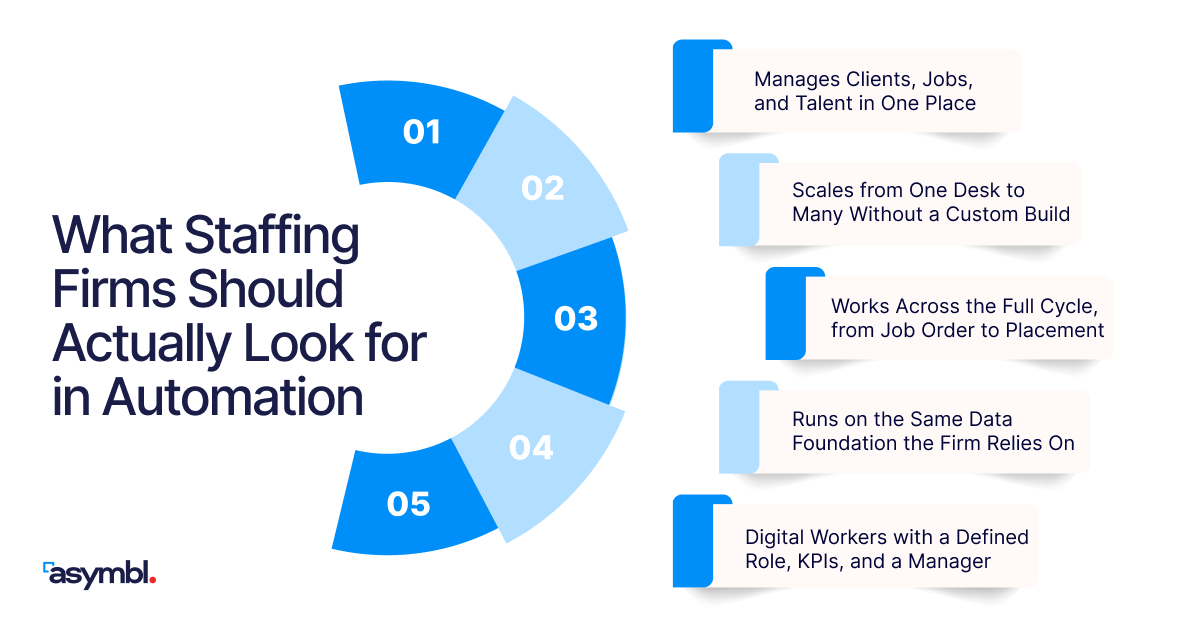
The five requirements below are how to tell which category a tool falls into, and whether it fits how a staffing desk actually runs.
1. Manages Clients, Jobs, and Talent in One Place
A staffing firm runs on three relationships at once:
- The client owns the demand
- The job carries the margin, and
- The talent delivers the revenue
Automation that holds only one of these relationships hands the other two back to a recruiter. The recruiter has to track them by memory and spreadsheet.
Purpose-built staffing agency software holds all three together, along with the submittal and redeployment work that connects them. A recruiter isn't the only record of how a client, a job, and a person actually fit together.
General-purpose platforms adapted for staffing model a single employer and a single requisition. It's the workflow architecture of corporate recruiting.
This system mismatch creates more confusion than capacity on a desk built around three moving relationships instead of one. A recruiter working three client accounts and a dozen jobs needs the client, the job, and the talent linked automatically. The link has to hold every time one of them moves.
2. Works Across the Full Cycle, from Job Order to Placement
Automation that acts at a single step in a multi-step process hands the rest of the steps back to a recruiter. Full-cycle automation should cover sourcing, screening, scheduling, submittal, and follow-up as one continuous cycle.
It should happen inside the system of record where the workflow exists. An additional tool the team has to remember to update falls short of that standard.
Asymbl digital worker sees talent history, job data, client context, and pipeline directly and can act on the whole cycle.
Recruiting automation tools that stop at sourcing or scheduling solve just a part of the problem, and leave the rest exactly where it was. This is why so many trials stall before they ever reach daily use. A recruiter still has to manually carry a person's record from a sourcing tool into the ATS before scheduling starts.
3. Scales from One Desk to Many Without a Custom Build
Automation should scale from one desk to many when the team scales without months of reconfiguration for each new desk. It should extend across functions and client delivery models that each run differently.
The same setup carries from the first desk to the fifth without a development project in between. A firm running IT contract desks alongside an executive search practice needs the same digital workers to flex across both, with one build covering the range.
General-purpose software fails this test. The configuration it demands to fit a second desk's process turns into a custom build. Vendors just bill it as a product instead of a project.
4. Runs on the Same Data Foundation the Firm Relies On
Automated workflows are only as good as the CRM system underneath it. For a firm already running on Salesforce, the records and the reporting already live there. The firm builds them on data it has trusted for years.
Automation built outside your business system depends on an integration between two platforms. This integration brings lag, reconciliation work, and records nobody fully trusts, because nobody's sure which system holds the updated version.
A recruiter checking two systems to confirm one placement status is already paying the cost of that integration lag.
5. Digital Workers with a Defined Role, KPIs, and a Manager
A digital worker without a defined role is a general-purpose AI agent with a friendly name attached to it.
A digital worker needs the same standard applied to people:
- A defined role
- Clear motivations
- Key performance indicators (KPIs)
- Audit trails
- Compliance
- A named human has to be responsible for its performance
- A structured handoff model for the work it passes back to a recruiter.
2025 IBM CDO Study: The AI Multiplier Effect found 79% of surveyed chief data officers are still early in figuring out how to scale and govern AI agents.
Asymbl: Unified Talent Relationship Management for Staffing
Two firms can run the same automation and still get completely different results. Asymbl divides the responsibilities between human workers and digital workers to create a hybrid workforce.
1. One Connected Front Office for Sales and Recruiting
Client records and talent records that live in separate systems create blind spots between desks. Recruiter Suite closes that gap by holding sales, recruiting, and talent data in one operating environment built specifically for staffing and recruiting agencies.
Contact management holds relationships at the firm level rather than the recruiter level. Revenue stays with the firm when a producer leaves, instead of walking out the door with them.
Reporting shows placement activity and pipeline health without anyone assembling it manually from three spreadsheets before a client call. It also puts recruiter and digital-worker performance on the same view, instead of two separate ones nobody reconciles.
For contract and temp desks, invoicing usually lives in a separate system from sales and recruiting. Asymbl Time connects placement data with invoicing workflows, allowing contract and temp desks to manage rate rules, time tracking, and compliance requirements in the same system.
2. Rosa, a Digital Recruiter, Runs the Whole Cycle
Rosa, the Digital Recruiter, handles:
- Resume screening
- Outreach
- Scheduling
- Qualification
- Job descriptions
- Interview summaries
- Offer letters
- Talent history
- Job data
- Client context
- Pipeline directly from Recruiter Suite
Recruiters keep the judgment calls, the relationship conversations, and the negotiation. Rosa carries the consistent execution around them, with a role and KPIs of her own. Asymbl defines the digital recruiter’s role the same way a firm should expect for any digital worker it puts on the desk.
Asymbl Skills give the team pre-built agentic building blocks across job management, talent evaluation, pipeline and submissions, interview coordination, and outreach. New work goes live without a development cycle behind it. A firm doesn't wait on an engineering roadmap to put a new Skill to work.
3. Talent Intelligence Matches on Actual Fit
Asymbl Talent Intelligence builds the signal Rosa runs on, drawn from every past interaction instead. Matching and screening work from actual fit instead of keyword overlap.
Talent Intelligence defines candidate fit from pipeline history, interview feedback, and assignment outcomes. Resume structure and a percentage score that looks precise without meaning much land nowhere close to that kind of fit.
Two people can list the same ten skills on a resume and perform completely differently on assignment. A match built only from those ten skills can't tell them apart.
Talent intelligence learns from every workflow, decision, and outcome. Performance improves with use, instead of holding at day-one quality the way a static algorithm does. Continuous improvement is also what builds confidence in the system doing the matching.
4. Digital Workers Are Designed, Onboarded, and Coached
Design, Onboard, Coach is the operating model behind every digital worker Asymbl puts into a firm.
- Design defines what each digital worker owns, what it hands back to a person, and which KPIs it answers to. Asymbl sets all of that before the digital worker ever touches a live workflow.
- Onboarding brings it into the workflow alongside recruiters. The firm sets governance and audit trails from the start, rather than adding them after a compliance question comes up.
- Coaching keeps it performing as desks, disciplines, and client delivery models change around it. It's the same ongoing attention a good manager gives a person.
Most AI vendors sell software. Asymbl builds the roles, the governance, and the adoption path that keep digital workers live and improving. This is the actual difference between a trial that stalls and automation that runs in daily production.
Proof from Asymbl's Own Recruiting Operation
A two-person recruiting team working with Rosa, the Digital Recruiter, hired 100 people in 100 days. Together they processed 17,000 applications, pre-screened 1,800 applicants, and scheduled 800 interviews to get there. This proof comes from inside Asymbl's own recruiting operation.
The same effort saved $575k in hiring costs and lifted fill rate by 47%. It has delivered a 1,529% return on investment (ROI) since Rosa launched in 2025.
Asymbl now runs close to 200 digital workers across 13 business functions inside its own operation. Asymbl built this model inside its own business before it ever sold the model to a client.
The same design, onboard, coach discipline produced these numbers inside Asymbl's own recruiting operation. This is what a staffing firm is actually evaluating when it looks at whether digital labor can move its own.
Run the Staffing Automation Evaluation on Your Own Desk
Staffing automation is about whether it improves the economics of each desk at scale without creating another system for recruiters to manage.
Start with one workflow that has a measurable cost. Look at sourcing time, screening volume, response times, interview scheduling, submissions, or redeployment, then measure what changes when a digital worker takes responsibility for that work while recruiters keep the decisions and relationships that require human judgment.
The automation also has to fit into the workflow the firm already runs. It should work with the ATS and CRM the desk trusts, connect client, job, and talent data, and cover enough of the recruiting cycle that automation does not simply move the bottleneck to the next manual step.
Asymbl takes this approach through Unified Talent Relationship Management and Workforce Orchestration™, combining recruiters and digital workers around the same staffing data and workflows. Book a demo to see how that model works in practice and explore what Rosa can run across the recruiting cycle.
FAQs
Staffing automation is the use of software and AI-driven digital workers to handle the recurring tasks of a staffing desk's placement cycle without a recruiter manually doing each step.
A digital recruiter needs a single named human owner, typically the recruiting operations lead or desk manager closest to the workflow it runs inside. This owner sets the digital recruiter's goals, reviews its output, coaches it through Skills changes, and answers for its KPIs the way a manager would for a new hire.
Yes. Automation changes how talent moves through the placement process. Applications get answered faster, interviews get scheduled quicker, and follow-up stays consistent, because a digital worker can respond within minutes rather than whenever a recruiter is free.
It makes sense at any size once manual follow-up is costing placements, not just at multi-desk scale. A single-desk agency often feels the case sooner than a larger firm, since there's no second team to absorb the sourcing and screening work a stretched recruiter can't reach. What changes with firm size is the volume automation handles, not whether the case for using it holds up.
12 Recruitment Metrics Every TA Team Should Be Tracking
Modern recruitment metrics need pipeline readiness and capacity. See 12 talent acquisition metrics that matter beyond speed.

The Right Fit Starts With a Conversation.
See what working together could look like.
