

.webp)
Most talent acquisition strategies are recruiting in a sequence, where a role opens, the team posts, sources, vets, and hires, then closes the requisition and starts over on the next one.
The traditional linear recruiting approach works at low volume, but buckles the moment a growing business asks it to do more, because every new hire restarts the same cold process from zero.
The companies pulling ahead have stopped treating hiring as a cycle and started running it the way their sales and marketing teams acquire customers. They run an active pipeline with multiple channels, continuous engagement, and a pool of candidates that exists before the role does.
In this blog, we will examine what a talent acquisition strategy actually is, why the linear hiring cycle breaks under growth, how the function is changing into a demand engine, and how to build one that scales.
What a Talent Acquisition Strategy Actually Is
A talent acquisition strategy is the plan and operating approach a company uses to source, attract, evaluate, hire, and retain the people it needs to meet its goals. It is the system that decides how hiring happens across the company, rather than the act of filling any one role.
Until Now, Talent Acquisition Has Run as a Linear Hiring Cycle
Most talent acquisition strategies still follow a model built around individual vacancies rather than continuous talent acquisition.
Post, Source, Vet, Hire, Repeat: The Cycle Most Strategies Still Run
The linear cycle starts when a role opens. The team writes the post, sources candidates, screens and vets them, runs interviews, makes a hire, and closes the requisition. Then the next role opens, and the cycle restarts from zero with no memory of the one before it.
Each pass is reactive and self-contained. Work begins when a vacancy appears and ends when it is filled, so the team is always starting over rather than building on what came before.
The candidates who were strong but not selected, the sourcing research, the market intelligence gathered along the way, all of it goes stale or disappears the moment the requisition closes. The function generates valuable context on every cycle and then discards it, which means it pays to regenerate that same context on the next one.
Why the Linear Cycle Breaks Down as You Scale
.png)
As hiring volume grows, three gaps appear at once, and they widen together.
- Work scales in a straight line with headcount: Twice the roles means roughly twice the effort, because nothing about filling the tenth role makes the eleventh easier. Nothing compounds in the model, so output rises only as fast as hours do.
- Data fragments as the function grows: More roles, more recruiters, and more tools mean candidate information scatters across an applicant tracking system (ATS), spreadsheets, inboxes, and sourcing platforms, until no one can see the whole pipeline at once or trust what they do see.
- Capacity becomes a hard ceiling: The only way to hire more in a linear model is to add more recruiters, which scales cost as fast as it scales output and turns every growth target into a hiring request for the hiring team itself.
A strategy built on the linear model simply costs more to run the bigger it gets, until the budget no longer supports it. The model was never built to compound, so it cannot, no matter how hard the team works inside it.
How Talent Acquisition Is Changing, and Why It Should Run Like a Demand Engine
The shift underway is from running hiring as a cycle to running it as an engine. The reference model already exists inside the same company, in the way sales and marketing acquire customers at scale, and it fits talent better than the cycle ever did. The point is not to borrow marketing's vocabulary for its own sake. It is that talent has started to behave like a market, and a function facing a market needs the operating model of one.
Talent Is the Backbone, and It Now Behaves Like a Market
Every product shipped, every sale closed, and every service delivered runs on the people the company can hire and keep, which makes talent acquisition a growth function rather than a back-office one.
Candidates compare options, respond to brand and timing, weigh competing offers, and tune out generic outreach the same way buyers do.
A market does not wait in a queue to be processed. It has to be understood, segmented, and engaged on its own terms. Yet most functions still operate as though candidates arrive on demand the moment a post goes live.
According to a February 2026 Gartner HR Research Release, only 31% of recruiting teams use labor market data to inform their talent strategy.
Inbound and Outbound Acquisition: The Way Demand Generation Works
Demand generation runs on two motions, and talent acquisition has the same two. Inbound is the talent that comes to you, the candidates applying through job posts, the careers page, and referrals drawn by your reputation.
Outbound is the talent you go after through direct sourcing, targeted outreach, promoted roles, and proactive engagement of people who are not applying.
Treating these as one demand-generation system, rather than posting and waiting, is the core of the shift. A linear cycle runs one motion at a time and only when a role is open. An engine runs both simultaneously, so inbound interest is building while outbound sourcing fills the gaps inbound cannot reach.
The strongest engines measure which channels produce hires, exactly as marketing measures which produce customers, and they move effort toward what converts instead of spreading it evenly across everything. The discipline is treating channels as a portfolio to manage continuously rather than a checklist to complete once.
The Candidate Journey Is a Funnel, Not a Single Transaction
A buyer moves through awareness, interest, consideration, and decision. A candidate moves through the same funnel, from first hearing of the company to accepting an offer, often over months and across several touchpoints that have nothing to do with a specific open role.
Seen as a funnel, hiring stops being a single transaction triggered the moment a requisition opens and becomes a flow the team manages and converts over time.
A funnel view means the most valuable work often happens before the role exists, in the awareness and interest stages where a future candidate first forms an opinion of the company. A team that only engages candidates at the decision stage, which is what the linear cycle does, is trying to convert demand it never built.
The funnel is what lets a team meet talent early and carry it forward until the timing is right for both sides.
Employer Brand Is Always-On Demand, Not a One-Time Campaign
Marketing does not build a brand only when it needs a sale. It runs awareness continuously, so demand already exists when the team is ready to convert it. Employer brand works the same way and fails the same way when it is treated as a campaign that switches on for a hiring push and off again afterward.
A company that invests in its reputation as a place to work generates standing inbound interest, so roles open to an audience that already knows the company rather than into silence.
Each positive candidate experience, each piece of content, each employee who speaks well of the place adds to a pool of awareness that lowers the cost and time of every future hire.
Candidate Engagement and Experience Decide Whether the Engine Converts
An engine can attract talent at the top and still produce few hires if it handles people poorly once they are in it.
A strong candidate enters the funnel, hits a slow reply, waits a week for the next step, sits through silence after an interview, and concludes the company is disorganized or uninterested.
The candidate disengages before the offer stage, and the demand the engine worked to generate leaks out through a process failure that had nothing to do with attraction.
Engagement and experience are the conversion layer of the talent engine. Every delayed response, unclear next step, and dropped thread is a leak, and leaks compound across stages so that a funnel wide at the top can still run dry at the bottom.
How to Build a Talent Acquisition Strategy Like a Demand Engine
.png)
Running talent acquisition as a demand engine comes down to a set of deliberate workflow design choices:
1. Start From Business Demand, Not Open Reqs
Map the roles growth will require, the skills the company will need, and the timing of both, rather than waiting for requisitions to land on the desk. Planning from demand lets the engine build a pipeline ahead of the hire instead of scrambling after it.
This is the workforce orchestration layer, and it points every other part of the engine at the right talent before the pressure arrives. Planning by skill rather than by job title also widens the field the engine can draw from, which matters more than most teams assume.
In a 2022 McKinsey Report, “Taking a skills-based approach to building the future workforce,” hiring for skills is more predictive of job performance than hiring for education, and more than two times more predictive than hiring for work experience, which the McKinsey report attributes to a Hunter and Hunter 1984 issue.
So a strategy that plans around the capabilities the business will need produces better hires than one that plans around credentials and waits for reqs to define the search.
2. Run Multiple Channels in Parallel, Not One Job Board
Running job boards, referrals, direct sourcing, events, communities, and social presence in parallel widens the top of the funnel and protects it when any one source dries up. Diversification is risk management as much as reach.
The best practice is to run channels continuously and compare them on hires produced rather than applications generated. A channel that fills the funnel with applications that never convert is a cost rather than a contribution, and a team measuring volume will mistake it for performance.
Marketing learned long ago to fund the channel that produces customers and to starve the one that only produces clicks. Talent acquisition gains the same clarity the moment it tracks conversion to hire by channel and lets the spend follow what actually works.
3. Target and Retarget the Right Talent the Way Marketing Does
Marketing segments an audience, aims the right message at the right buyer, and then retargets the people who showed interest but did not convert.
Talent acquisition can run the same motion: targeting candidates by skill and fit, then re-engaging silver-medalists, past applicants, and prior pipeline who already know the company and once raised their hand.
Retargeting known talent is the highest-yield motion in the engine, because re-engaging someone the company has already reached costs a fraction of sourcing a stranger and converts faster, since the relationship and context already exist.
Managed well, this becomes an active pipeline, an asset that lets the next role start from a warm shortlist instead of zero, and that single change is the biggest source of compounding advantage as hiring volume climbs.
The first hire into a new pipeline is expensive, but the tenth is affordable, because the pipeline built during the first nine already holds candidates for it. The cost and time per hire fall as the pipeline matures, the exact inverse of how the linear cycle behaves under volume.
The linear cycle throws this advantage away every time it closes a requisition. An engine treats known talent as the first place to look rather than the last resort, and keeping that pool warm takes ongoing engagement, treating relationships as something to maintain rather than something to spin up per role.
4. Give Active and Passive Candidates Equal Weight
An engine that only catches active candidates competes for a thin slice of the available talent, and it competes hardest where every other company is also fishing.
Building continuous engagement that reaches passive candidates too is what gives the strategy room to scale beyond the people who happen to be job-hunting this week.
Reaching passive talent requires the funnel and the brand to already be working, because a passive candidate will not respond to a cold transactional pitch but will respond to a company they have heard good things about over time.
This is where the earlier practices pay off, since passive engagement only works on top of pre-built awareness.
5. Connect the Data So the Engine Runs on One Source of Truth
An engine spread across an ATS, a customer relationship management (CRM) system, spreadsheets, and inboxes cannot be seen or steered as one system.
Connecting the data into one source of truth makes channels comparable, the pipeline visible, and the whole funnel measurable end to end. Without connected data, every metric is a partial reconstruction stitched together manually, and a number nobody trusts is a number nobody acts on.
The fragmentation problem is not unique to recruiting, and it is the most common thing that stalls any attempt to scale on top of disconnected systems.
According to a 2026 McKinsey Study on Scaling Agentic AI Systems, eight in ten companies cite data limitations as a roadblock to scaling, which is the same limitation a talent engine hits when its signal lives in disconnected systems.
Asymbl Recruiter Suite addresses this directly by unifying applicant tracking, sourcing, engagement, and outcomes on one Salesforce-based record, so the engine runs on connected data instead of a monthly reconciliation exercise.
6. Orchestrate Capacity So Growth Does Not Mean More Recruiters
The linear model scales capacity in only one way, by adding recruiters, which is why its cost rises in lockstep with its output. An engine scales capacity differently by removing repeatable work from people, so existing recruiters carry more pipeline without more hours.
A hybrid model, where digital workers absorb the repeatable execution, and recruiters focus on judgment and relationships, is what lets the engine grow output without growing headcount in step with it.
Rosa, a Digital Recruiter, does exactly this, taking on the high-volume execution so a team carries more open roles without each one waiting longer or costing more in loaded time.
7. Govern With Shared Definitions and Outcome Metrics
If one recruiter scores a candidate as qualified on different criteria than another, the pipeline data is an average of incompatible judgments, and the engine cannot be tuned because no one agrees on what its numbers mean.
Everyone has to score quality, stage, and fit the same way, or the connected data from the previous practice loses its value.
Tracking conversion through the funnel and tying it to business outcomes, rather than to activity, keeps the engine tuned and leadership invested as the strategy scales.
Activity metrics like applications sourced or interviews scheduled describe effort rather than results, and an engine optimized for effort drifts toward looking busy. An engine optimized for outcomes, like conversion to hire and the quality and retention of those hires, stays pointed at what the business actually needs.
How Asymbl Helps You Run Talent Acquisition as a Scalable Engine
Asymbl treats recruiting as workforce orchestration on a single Salesforce-based foundation that companies already run their customer acquisition on, which makes it a natural home for a talent acquisition strategy built like a demand engine.
Asymbl runs this model on itself, where Rosa, our Digital Recruiter, helped drive a 47% increase in fill rate and helped a two-person recruiting team make 100 hires in 100 days while saving $575,000 in hiring costs. This is the kind of compounding a linear model cannot reach, and each layer below powers a different part of the engine.
Recruiter Suite: Recruiting on the Same Foundation as Sales and Marketing
Recruiter Suite is a talent relationship management platform built on Salesforce that unifies applicant tracking, candidate search, engagement, and outcomes in one system, so the engine runs on connected data instead of a stack of tools that each tell a partial version of the story.
With hiring data on the same foundation as the rest of the business, talent acquisition stops operating on the edge of the company and becomes part of its operating model. Channels become comparable, the funnel becomes measurable end to end, and the data from every hire stays in one place where the next hire can use it.
The connected record is what turns the eight separate practices above from aspirations into something a team can actually run, since every one of them depends on data that does not break between roles.
An Active Pipeline of Engaged Talent
Managing candidate relationships at the company level turns past and active contacts into an active pool that the next role can draw from immediately.
It makes retargeting and passive engagement practical rather than theoretical. Silver-medalists, past applicants, and nurtured passive candidates stay engaged and findable over time, so a new requisition opens into a warm shortlist instead of a cold search.
The pipeline persists whether or not a role is open, which is the precise behavior the linear cycle cannot produce. When the relationship and its full history live in one place, the most expensive part of sourcing, the reach, is already done before the engine ever starts a new search.
Talent Intelligence: Targeting and Matching Like Demand Intelligence
Talent Intelligence is the recruiter brain running on the Asymbl Intelligence platform, matching candidates on pipeline history, interview feedback, and prior outcomes rather than keyword overlap.
It scores fit the way an experienced recruiter would and surfaces the right candidate the company may already own before anyone opens a net-new search.
By matching on the full context that predicts success, it raises the quality of who enters the funnel and points the engine's effort at the talent most likely to convert and perform.
Targeting stops depending on which recruiter remembers which candidate, because the intelligence is available to the whole team and works from evidence of fit rather than guesswork.
Digital Workers: Capacity That Scales the Engine Without Linear Headcount
The Asymbl Digital Recruiter is a pre-built digital worker that absorbs the repeatable execution across sourcing, screening, scheduling, and outreach, so existing recruiters carry more open roles without each one waiting longer or costing more in loaded time.
Recruiters move off the administrative treadmill and onto the judgment and relationship work that actually requires them, while the digital worker handles the volume that was capping the function.
Every interaction, hire, and outcome also feeds Asymbl Intelligence, so the system learns what a good hire looks like for the company and gets sharper with each cycle.
Conclusion
A talent acquisition strategy scales when it stops running as a linear cycle and starts running as a demand engine, with multiple channels working in parallel, continuous engagement across the funnel, a standing pipeline that outlives any single role, connected data underneath it, and capacity that grows without adding a recruiter for every increment of output.
One strategy costs more the bigger it gets and eventually hits a budget limitation that no amount of effort can push through. The other compounds grow, so each hire makes the next one faster and cheaper.
The first is recruiting in sequence with a strategic title. The second is talent acquisition built the way the business already acquires customers, on a foundation designed to compound rather than to repeat.
See how Asymbl helps you run talent acquisition as a scalable engine. Book a demo to see what a connected system of human recruiters and digital workers could do for the way your company hires.
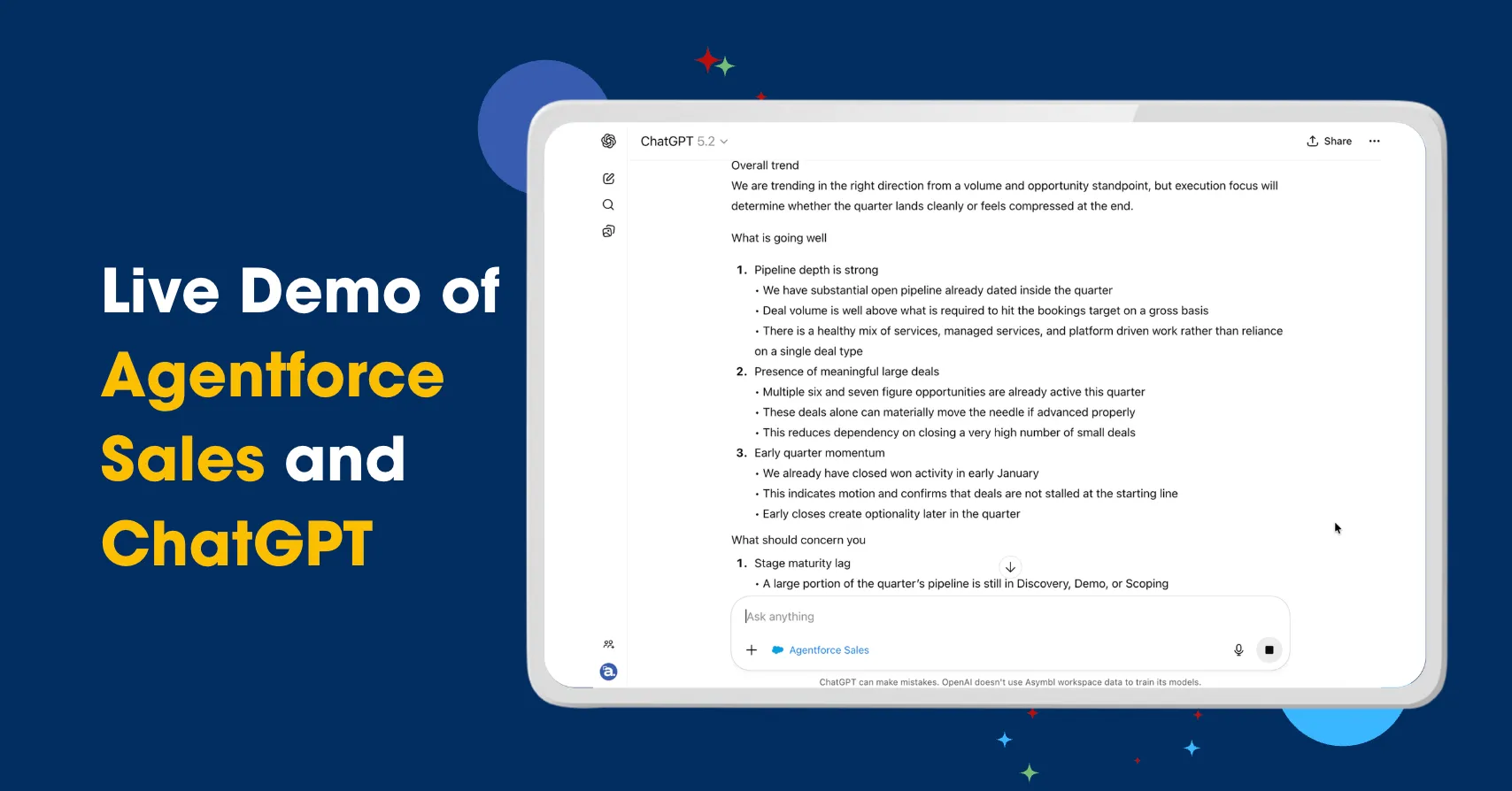
How Asymbl's CEO Uses Agentforce Sales in ChatGPT for Strategic Visibility
Most executives use ChatGPT for research and writing. Few have considered it as a window into their business data. Asymbl CEO Brandon Brandon demonstrates how connecting Agentforce Sales to ChatGPT changes how leaders access pipeline intelligence.

The Right Fit Starts With a Conversation.
See what working together could look like.
.webp)