
A contractor's assignment ends Friday. A week later, a recruiter on another desk sources the same skill set from scratch for a new job order. Meanwhile, the contractor is taking calls from a competing firm.
Talent redeployment is the practice of moving contractors whose assignments are ending into their next assignment before they roll off. Corporations use terms like employee redeployment and internal mobility for moving their own staff. For a staffing firm, workforce redeployment protects utilization and gross profit. In temporary staffing, a contractor sitting between assignments is revenue walking away.
Your firm already holds both inputs redeployment needs: every assignment end date and a record of each contractor's work. Most firms act on them once the end date arrives. Recruiters can't see which contractors are wrapping up against which open job orders. Follow-through loses to live job orders every week. Late action means fewer temps out billing, re-sourcing spend on skills you already placed, and client accounts at risk.
Below, we break down what late redeployment costs your firm, lay out a model that runs every week, and look at how AI digital workers change what contractors move into, and where Asymbl fits.
What Late Redeployment Costs a Staffing Firm
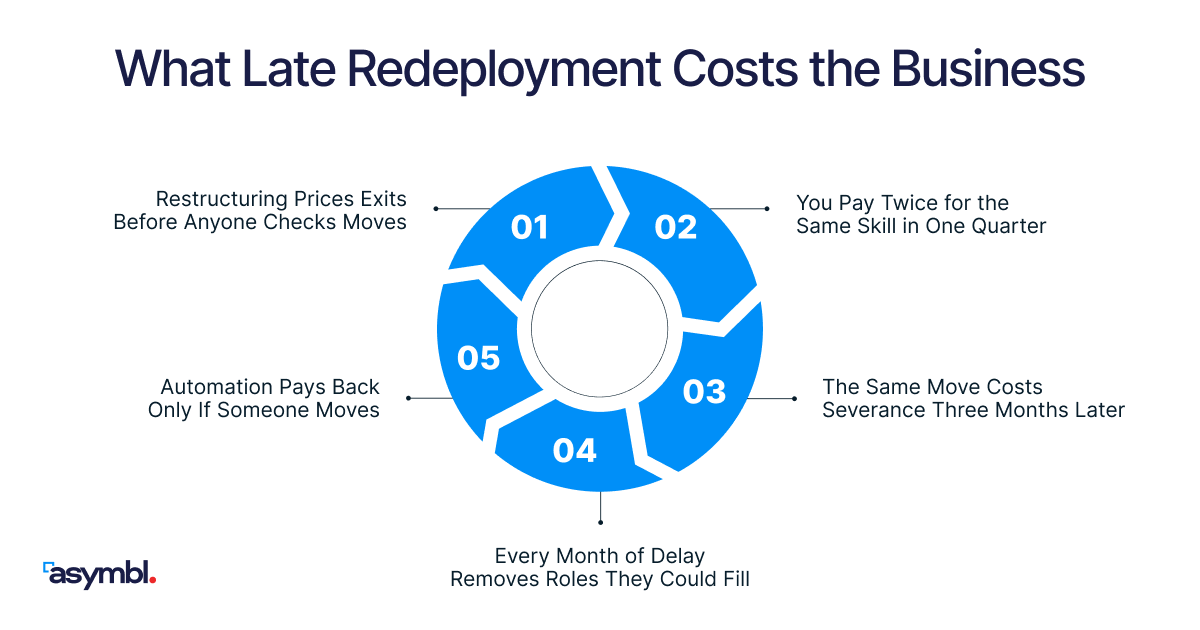
Late redeployment charges a staffing firm several times for one contractor, and each charge lands with a different owner:
- Recruiting carries re-sourcing spend.
- Finance carries lost bill hours.
- Account managers carry the client conversation.
Nobody sees the full bill, so the decision that sets the price goes unexamined.
Roll-Offs Get Written Off Before Anyone Checks Open Job Orders
Finance books an ending assignment as finished revenue the moment the client confirms the end date. The forecast drops the bill hours. The recruiter who placed the contractor turns to live job orders. The check against open job orders on other desks and other clients happens later, if it happens at all.
By then, the contractor has usually made their own plan. Talent between assignments takes calls from every firm that holds their profile. In contingent staffing, whoever submits the right person first gets paid. A competing recruiter with a concrete assignment on the table wins that race.
The sequence causes the write-off:
- Account management confirms the end date with the client.
- Recruiting hears about it in a weekly meeting, or from the contractor directly.
- The redeployment process starts only when someone remembers to start it.
- A few weeks later, a job order arrives for the same skill set, and a recruiter sources it from zero.
Reversing that sequence adds no new spend. It means checking open job orders on the day the client confirms the end date, while the contractor is still billing. The contractor still knows your recruiter and still runs payroll through your firm. Your offer arrives before anyone else does.
You Pay Twice for the Same Skill in One Quarter
You pay twice when one desk lets a contractor roll off while another sources the same skill. Both recruiters act correctly on their own desks. Neither can see the other's work.
Take a Java developer finishing a six-month assignment with a fintech client. Their recruiter on the IT desk logs the end date and moves on. Two weeks later, a branch in another city opens a job order for a Java developer. Their recruiter starts with job boards and LinkedIn searches. Then they screen a dozen people the firm has never placed.
The firm pays sourcing costs on one side and loses gross profit on the other. The contractor it already vetted and placed may be billing for a competitor before the second search ends. Your C-suite feels this as margin pressure from re-buying talent every month when the firm already owns the relationship.
Standard reporting never puts the two transactions on the same page. The fill report shows a new placement. The utilization report shows one contractor off billing. Nothing links the two lines, so the same pattern repeats next quarter with a different skill set.
Split-desk firms feel it most. Sales owns the client and recruiting owns the talent. Nobody owns the moment a contractor comes free, which is exactly when the firm could have kept them.
The Same Move Costs You the Contractor Three Weeks Later
Timing sets the price of an identical move. Redeploying a contractor while the assignment winds down costs a phone call and a submittal. Three weeks after roll-off, the same move often costs you the contractor.
During the final weeks of an assignment, the contractor still bills through your firm. They know your recruiter, and your payroll works for them. A credible next assignment from you usually wins, since switching firms adds friction for them too. The conversation is short, and the ramp onto the next client is short as well.
After roll-off, the position reverses. The contractor faces an income gap and an inbox full of recruiter messages. The first firm with a concrete offer gets the yes. If that firm is a competitor, your next job order for the same skill starts from scratch. You pay full sourcing cost to find someone less proven than the person you already placed.
A contractor on the bench between assignments costs you bill hours and gross profit. The chance of losing them to another firm also grows. None of those costs show up on the day of the decision.
The contractor and the job order were identical on both dates. The only variable was when someone looked.
Every Week on the Bench Removes Assignments They Could Fill
Every week a contractor waits on the bench, fewer open assignments still fit them. Job orders move on their own clock. The one open this week is often filled within a few weeks, by your firm or by a competitor. The one arriving next month hasn't been scoped yet.
A contractor who rolls off and waits watches this week's job orders close one by one. The matching set gets smaller every Friday. Their skills also lose currency with time away from client work. An IT consultant three months off a project lacks recent experience on the release a client now runs. Clients notice the gap and ask about it in submittal reviews.
Per Deloitte's 2025 Global Human Capital Trends, 66% of managers and executives said most recent hires weren't fully prepared. Experience was the most common gap. Clients apply the same test to contractors, and one coming straight off a client project brings recent, relevant experience to the next submittal. One who has waited three months on the bench has to explain the gap.
Delay turns a redeployment case into a lost contractor without anyone deciding it.
Staffing firms that cut bench time share one habit. They start matching before the end date, while every open job order is still available.
AI Digital Workers Pay Back Only If Freed Recruiter Hours Go Somewhere
AI digital workers free recruiter hours. Those hours become a return only when recruiters spend them on work that earns. Hours with nowhere to go turn into idle capacity at full cost. The business case behind the investment never closes.
Returns come from rethinking how work gets done between your people, your software, and AI. Firms that hand tasks to AI digital workers one for one tend to miss those returns. Most businesses still take that route.
According to Deloitte's 2026 Global Human Capital Trends, 59% of businesses surveyed take a tech-focused approach to AI. Those businesses are 1.6x more likely to miss AI returns that exceed expectations than businesses with a human-centric approach. The value appears when someone decides where the freed hours go next.
Our own recruiting team at Asymbl works this way. Five AI digital workers take on sourcing, screening, and initial outreach. They're projected to give our recruiters back 21 hours per week in 2026, for talent relationships and closing.
Redeployment conversations and client relationships are the natural destination. Even a few of those reclaimed hours let a recruiter call every contractor ending an assignment this month. They can ask account managers which clients have extensions under discussion. Those calls protect gross profit that would otherwise roll off with the contractor.
A Talent Redeployment Strategy That Runs Continuously
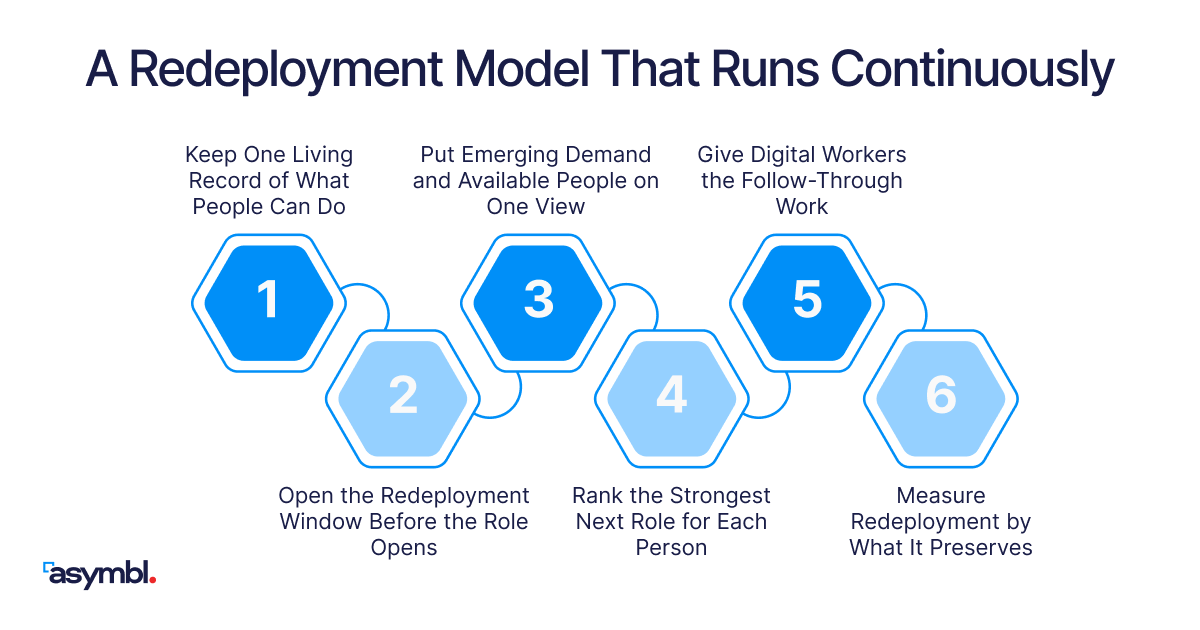
Since timing sets the price, the redeployment process has to run every week, well before end dates arrive. Most firms run pieces of it through one strong recruiter's habits. Your redeployment rate then rides on one calendar, and the parts a firm could own stay undefined.
Keep One Living Record of What Your Talent Can Do
A living record captures what each contractor can do today, built from assignment outcomes. It includes:
- What they delivered on their last assignment and how the client rated it
- How far they got on submittals that didn't land
- Which environments they know
- What they want next
Most of that information already exists. It lives in your applicant tracking system (ATS) and customer relationship management (CRM) system. The rest is in email threads and recruiter memory. The gap is connection. A record that pulls those pieces together turns a static profile into a working picture of the contractor.
The record belongs to the firm. When the recruiter who placed someone changes firms, the history, client feedback, and relationship stay with you. Recruiters often carry contractor relationships in their heads, and those relationships leave when they do. A firm-owned record keeps them in the building.
Assembling the record also defines your redeployable pool as a by-product. Every contractor with an upcoming end date and a current record is a talent you can match today. Every contractor without one is a gap you can see and fix.
Open the Redeployment Window Before the Job Order Goes Out
Ask the redeployment question at intake, when a new job order arrives and before anyone opens a sourcing search. Your team surfaces and considers contractors with matching skills and upcoming end dates first. Your team records the outcome either way.
A standing step removes the argument. Checking existing talent becomes part of intake, so a recruiter doesn't have to ask a colleague for a favor. Job orders that never needed outside sourcing stop reaching job boards. The ones that do go out with the internal option already settled.
The window opens from the other direction too. Set a standing lead time before every assignment end date, such as a fixed number of weeks out. The redeployment conversation starts while the contractor is still billing and still taking your calls first. The trigger is a date on the calendar, set long before the date that matters.
For firms that run both triggers, redeployment is a step every job order and every end date passes through.
Put Incoming Job Orders and Ending Assignments on One View
Demand and availability belong to the same view, since each one signals the other weeks before a match looks obvious. Demand shows up long before a job order gets written. A client project ramps up. An extension comes under discussion. An account manager hears about the new budget on a quarterly call.
Availability shows up as assignment end dates, project wind-downs, and client work moving to AI digital workers. Recruiters usually see this side first. Account managers usually see the demand side first. A shared view requires sales and recruiting to work from connected data.
Holding both on one view turns matching into a weekly habit. Your team starts the match while the contractor is still billing and the client is still planning.
The same view shows the near misses. A contractor who almost fits three upcoming job orders points to a skill gap you can close. A recurring job order type with no matching contractors tells your recruiters where to build the pipeline next quarter.
Rank the Strongest Next Assignment for Each Contractor
Ranking works in both directions. Given a job order, surface the contractors already in your pool who fit it. Given a contractor coming free, surface the open job orders they're strongest for, ordered by likelihood of a successful placement.
Scoring reads capability alongside track record with similar clients, level, location, availability date, rate expectations, and stated interest. This mix mirrors how an experienced recruiter decides. Keyword matches on job titles miss most of it.
Consider a contractor titled "business analyst" who spent a year running Salesforce data migrations. A title search never surfaces them for a migration job order. A ranking that reads assignment outcomes puts them near the top.
Ranking that runs every week means the shortlist exists before the conversation starts. Your recruiter opens the call with three strong options already checked against the contractor's history. Two recruiters also stop sourcing the same person for different job orders without knowing it.
Give AI Digital Workers the Follow-Through Work
Follow-through is where redeployment breaks down, and it suits AI digital workers well. The steps are small, and each one has to happen on time. They include:
- Watching assignment end dates and flagging contractors coming free
- Refreshing availability and preferences before a match goes out
- Sending the first message and chasing the reply
- Booking the conversation with the recruiter
- Briefing the account manager on the proposed move
- Writing the outcome back to the contractor's record
This work arrives every week and never feels urgent. Recruiters don't want to do it, and it keeps losing to live job orders with a client waiting. A contractor ending an assignment in three weeks rarely wins against a req due tomorrow.
AI digital workers take on the outreach, reminders, scheduling, and record updates. Recruiters keep the conversations that decide the move. They negotiate rates and read whether a contractor wants a change of client. Coverage stops depending on who had a quiet afternoon.
Measure Redeployment by What It Preserves
Measure redeployment by the gross profit, bill hours, and relationships it keeps inside your firm. Standard staffing reports count new placements and fill rate. They rarely count capability retained, sourcing spend avoided, or ramp time saved.
Five numbers make it visible:
- Redeployment rate. Count contractors placed into a new assignment within a window you define, such as 30 days. Divide by the contractors whose assignments ended in that period.
- Days on bench between assignments. Track the average gap from end date to next start date.
- Share of job orders filled from existing talent. Compare redeployed fills against fills sourced from scratch.
- Gross profit retained per redeployment. Count the margin that stayed with your firm because a contractor kept billing.
- Contractor retention twelve months on. Check whether redeployed contractors are still working through your firm a year later.
How AI Digital Workers Change What Contractors Move Into
A redeployment model ranks contractors against the job orders clients send today. Clients onboarding AI digital workers are changing what those job orders contain, often faster than they rewrite them. Your matches stay accurate only if you can see which shape of work comes next.
The Work Nobody Wants Moves to AI Digital Workers First
The first work clients hand to AI digital workers is the work their people least want to do. The mix varies by team. For one finance team, it means invoice reconciliation. For a support desk, it means first-line questions and weekly status reports.
This work often filled a large share of a contractor's week. It appeared in every job description for the role. Moving it to an AI digital worker leaves the role standing. What changes is the reason the role was sized the way it was.
A client who once ordered support contractors for ticket volume may now order a different skill profile, such as people who handle escalations. The freed hours become valuable only when someone points them at something else. For your firm, a contractor whose assignment ends early needs a next move. The client may also need a different kind of contractor than the one you placed.
Staffing firms that track these shifts at the account level see the change coming. They can redeploy affected talent before the end date and propose the reshaped assignment to the client first.
Job Content Changes Faster Than Job Descriptions
The work inside an assignment changes within weeks. Job descriptions and contractor profiles change on a yearly cycle at best. Clients reissue last year's job description for this year's job order. Contractor profiles in your ATS still list the title from their last placement. Both describe work that has moved on.
The people doing the work expect the change. In the 2025 Accenture Pulse of Change survey, 64% of employees expected AI to affect their roles. The expected changes range from new skills to task adjustments and significant reskilling. A job description written last year captures none of it.
Matching through stale titles produces confident answers built on outdated definitions. Your recruiters submit contractors to job orders whose content no longer matches the description. The client rejects the submittal, and nobody can say why the match looked right on paper.
The fix starts at intake. Ask clients what the contractor will do each week and which tasks AI digital workers now handle. Confirm which decisions stay with the person. Record what each contractor actually did on the last assignment, beyond the title they held.
Matching on tasks and outcomes stays accurate as titles fall out of date. It also gives redeploying talent a fair shot at assignments their old title would have hidden.
Higher-Value Work Needs a Definition Contractors Can See
Higher-value work means little to a contractor until someone names what it includes:
- Which decisions do they now own?
- Which exceptions come to them?
- Which client relationships do they carry?
When a client moves work to AI digital workers, the remaining assignment often includes checking that work. It also covers the cases AI digital workers can't resolve. Your recruiters can turn that into a written definition contractors see before they accept. A clear definition also tells the contractor what good looks like in the new shape of the role.
Without that definition, the freed hours refill with whatever arrives. The contractor concludes the change removed the parts of the job they did well. They start returning calls from other firms.
A visible definition turns a change in tasks into an assignment someone wants. It also gives your recruiters a clear brief for redeploying talent into work that didn't exist a year ago.
Every AI Digital Worker a Client Onboards Creates Redeployment Demand
Each AI digital worker a client onboards raises a redeployment question the same day. Which of your contractors on that account are affected, what do they do next, and when?
Clients often plan the software carefully and leave the people's questions for later. For a staffing firm, later means a batch of end dates landing in the same month. This backlog is exactly what redeployment exists to prevent.
Firms that ask account-level questions early hear about these changes first. They can redeploy affected contractors to other clients or into the reshaped assignments the same client now needs. Account managers become the early warning, and recruiters get weeks of notice.
Companies that cut headcount expecting AI to fill every gap will need people for new kinds of work. The talent for that work is scarce, and staffing firms are positioned to find it. Treat each client onboarding as a paired event. One AI digital worker onboarded means one set of contractor moves designed.
Workforce Planning Now Covers Two Kinds of Workers
Workforce planning now counts AI digital workers alongside people, at your clients and inside your own firm. For a client, planning now asks which work goes to people and which goes to AI digital workers. It also maps where the handoffs happen.
A plan built that way adds capability coverage and work allocation alongside headcount and budget. Firms planning both together see a contractor move coming a quarter out. Firms planning them separately find out when an assignment ends early.
Asymbl measures its own hybrid workforce with Profit Per Worker. It divides earnings before interest, taxes, depreciation, and amortization (EBITDA) by the combined human and AI digital worker count. The metric puts people and AI digital workers in the same denominator, treating them as one workforce.
Corporations talk about internal mobility and workforce mobility when their own employees change roles. Inside a client, an employee redeployment strategy now has to account for AI digital workers too. For a staffing firm, that client planning shows up as changed demand on your job orders. Some clients already plan this way. In the 2026 Deloitte State of AI in the Enterprise, 19% of businesses reported one specific talent change for AI. They're changing the balance between full-time, contract, and gig workers. It's the least common of the nine adjustments surveyed, an early signal. Each of those shifts reaches a staffing firm as a reshaped job order.
The same logic applies inside your own firm. If AI digital workers take on outreach and scheduling, plan where your recruiters' hours go next. Redeployment conversations are the obvious first answer.
How Asymbl Supports Continuous Redeployment
Planning for two kinds of workers takes connected records, outcome-based intelligence, and AI digital workers carrying weekly follow-through. Asymbl builds for it through Workforce Orchestration™, putting the right worker on the right work. Our own workforce is rapidly approaching 200 digital workers across 13 business functions and 30 systems.
Recruiter Suite Holds People, Roles, and History Together
A redeployment view needs talent records, job orders, and assignment history connected, and Recruiter Suite provides that connection. Recruiter Suite is a Salesforce-based staffing ATS with AI woven in from day one. It connects to your CRM to unify sales, recruiting, and operations in one front office.
- Pipeline Management gives a live view of every contractor across every job order.
- Interview Management keeps structured feedback attached to the record.
- Contact Management keeps every relationship at the firm level, with full communication history. When a recruiter leaves, their contractor relationships stay with your firm.
- Offer and Placement records placement completions and outcomes, so you see revenue and gross profit by recruiter and team as they happen.
Connecting to your CRM creates visibility into pipeline and redeployment signals without changing systems. You can build a redeployment view from live data. Talent Relationship Management becomes something your whole front office works from.
Talent Intelligence Ranks Fit From Outcomes, Not Keywords
Ranking the strongest next assignment requires reading outcomes, and Talent Intelligence does that with a reasoning engine. It evaluates talent-to-client fit the way a recruiter would. It learns what makes a great placement by reading pipeline history, interview feedback, and assignment performance. It also draws on the institutional knowledge that usually lives in a recruiter's head.
The AI Matching Engine surfaces talent against job orders and job orders against talent profiles. It searches across available, in-contact, and prior placement pools. This two-way view matches how continuous redeployment needs to run.
Natural language search takes the place of boolean strings. A leader can ask who has led a Salesforce data migration for a financial services client. The answer draws on assignment history that job titles alone never surface.
Talent Intelligence delivers faster placements from your existing database. You prioritize warm pipeline over cold outreach, so sourcing spend goes down. Your team rediscovers relationships from past placements instead of re-buying them on LinkedIn every month. You also see which recruiter, client, and talent combinations lead to extensions.
Asymbl Intelligence Keeps Context When People Leave
Redeployment quality depends on what your firm remembers, and Asymbl Intelligence keeps that memory when a recruiter moves on. It's Asymbl's platform layer that captures the judgment, context, and pattern recognition built up across every workflow, decision, and outcome. It then makes that signal available to every worker on the platform, human and AI.
Think of it as your staffing firm's brain, with memory and reasoning. It learns from data, signals, and outcomes continuously to build more accurate models of what good looks like. It runs under every Asymbl product, including Talent Intelligence and Rosa, a Digital Recruiter.
For redeployment, this means what your firm knows about a contractor stays put when a recruiter changes firms. Which client rated them highly, which assignment types suited them, and what they asked for next all remain usable. Redeployment quality compounds with every placement instead of resetting with every departure.
Rosa Carries the Outreach and Scheduling Every Week
Follow-through is the step redeployment loses most often, and Rosa takes it on alongside your recruiters. Rosa is a pre-built AI digital worker who runs inside Recruiter Suite. She's powered by Asymbl Intelligence and Talent Intelligence, and she works inside the systems your team already uses.
Rosa handles:
- Personalized outreach to large talent pools
- Application screening
- Interview scheduling with live availability
- Voice calls that confirm interest, check availability, book the interview, and log the call summary and outcome to the record
- Interview summaries and hiring-manager briefings
- Every action is governed and auditable from day one.
We proved this capacity on our own hiring first. Two recruiters and one AI digital worker hired 100 people in 100 days. Our Digital Recruiter handled 17,000 applications, pre-screened 1,800 people, and scheduled 800 interviews.
Those results come from Asymbl's internal hiring. For your firm, the same outreach, calls, and scheduling can point at contractors with upcoming end dates. Your team decides which contractors and dates Rosa works from. Rosa takes on the tasks recruiters hate doing, so they can focus on the conversation that decides the move.
Asymbl Time Turns Assignment Dates into Scheduled Work
Assignment end dates become a usable signal once time data and placement data live together, and Asymbl Time connects them. Asymbl Time is a time tracking application built for staffing firms. It's built alongside Recruiter Suite, so placement data and time data live in the same place.
Live visibility into hours logged shows when a contractor is wrapping up an assignment and is ready to redeploy. You also see the gross profit generated on each placement. End dates stop waiting in a system nobody opens.
From that connected data, your team can configure a view of assignments ending in the next 30 days. A recruiter or an AI digital worker can read it every morning and act on it. Assignment end dates become a daily input for redeployment. The signal your firm already captures starts driving work.
Reporting Shows Fill Rate and Redeployment Side by Side
Leadership resources redeployment once it sees redeployment next to fill rate. Recruiter Suite reporting runs on the same records as the work. Live dashboards and custom reports track the metrics that drive your revenue and margins. You see revenue and gross profit by recruiter and team, placement activity, and pipeline health.
Your team can configure reports for redeployment rate, days on bench, and share of job orders filled from existing talent. Gross profit by route, redeployed or sourced from scratch, can appear on the same dashboard leadership already reads. Cost avoided becomes a line leadership reviews every month.
Start Talent Redeployment Before the Next End Date Arrives
Your firm already owns the two things talent redeployment needs. One is a record of what each contractor has done. The other is a set of dates telling you when each of them comes free. What's missing is the connection between the two. You also need the capacity to work it every week, before an end date forces the question. Redeployment run every week costs less and keeps more contractors than redeployment run under pressure. It's the same work either way.
Firms that run it every week get a second return on the client side. Every client that onboards AI digital workers reshapes some of the assignments you fill. Your account manager can bring a redeployment plan to that planning conversation, with named contractors for the reshaped work. The firm that arrives with those names gets the next job order. Over time, your redeployment record becomes a reason clients call your firm first.
The first move is small. Check every contractor ending an assignment this quarter against your open job orders this week. Keeping that check running across every desk takes connected records and follow-through capacity most recruiting teams lack. Asymbl puts AI digital workers on outreach and scheduling, so your recruiters keep the conversations that decide each move.
Book a demo to see how Asymbl connects your end dates, contractor records, and open job orders. Your recruiters start every redeployment conversation while the contractor is still billing.
FAQs
Talent redeployment is business-driven, while internal mobility is individual-driven. Internal mobility describes employees choosing new roles inside their own employer, usually at their own pace. In a staffing firm, redeployment starts from a business event, an assignment end date, and moves a contractor into their next assignment, often with a different client. The firm sets the timing, and the goal is protecting utilization, gross profit, and the contractor relationship.
A good redeployment rate is one that rises against your own baseline, measured the same way every period. Published benchmarks vary by vertical and by how firms define the window, so compare like for like. Set one window, such as 30 days for professional assignments or a shorter one for high-volume temp work. Then segment the rate by desk, skill set, and client to find where contractors leak to competitors.
Redeployment should start at least as far ahead of the end date as your firm typically takes to fill a comparable job order. If similar job orders take four weeks to fill, a two-week lead time leaves the contractor on the bench. Add time for client submittal review and the contractor's own decision. Longer, specialized assignments need more lead time than high-volume temp roles with fast fill cycles.
Talent redeployment can work without new technology at a small scale. A spreadsheet of assignment end dates, checked weekly against open job orders, covers a few dozen contractors. It breaks at a few hundred contractors and a few dozen open job orders. End dates go stale, matches depend on what one recruiter remembers, and follow-through slips. At that point, connected ATS and CRM data and AI digital workers carry the volume.
Talent redeployment should be owned by whoever is accountable for utilization and gross profit, not only whoever is measured on fills. In many firms, that's a delivery or operations leader rather than an individual recruiter. Recruiters run the conversations, and account managers supply demand signals. The owner sets the lead time, reviews the redeployment rate weekly, and resolves conflicts when two desks want the same contractor.
An assignment extension usually doesn't count as talent redeployment. An extension keeps a contractor on the same assignment with the same client, while redeployment moves them into a new assignment after the current one ends. Track the two separately. Blending them inflates the redeployment rate and hides whether your firm can actually move contractors between job orders. Extensions still belong in the same view, since a pending extension changes who is coming free.

High-Volume Hiring Software: What Actually Holds Up at Scale
High-volume hiring software promises speed. See which platforms actually connect placements to revenue. Explore the 2026 comparison of five leading tools

The Right Fit Starts With a Conversation.
See what working together could look like.
