

.webp)
Recruiters use AI candidate matching to search talent pools, prioritize applications, and identify candidates who appear to fit an open role.
For many organizations, the platform returns a ranked list, the recruiter reviews the top results, and hiring decisions move forward. What often remains unclear is why those candidates were ranked a particular way in the first place.
That lack of visibility creates problems throughout the hiring process. Recruiters struggle to explain recommendations, hiring managers question rankings they cannot validate, and TA leaders have limited insight into whether candidate evaluations are consistent across teams and roles.
In this blog, we'll examine how AI candidate matching works today, why traditional matching methods leave important information behind, and what corporate talent acquisition teams should expect from a modern candidate matching system.
How Teams Typically Use AI Candidate Matching
.png)
For many recruiting teams, AI candidate matching begins with sourcing. Recruiters use it to search talent pools, surface relevant candidates, and reduce the time spent reviewing resumes. As adoption grows, many organizations are expanding those use cases to support screening, rediscovery, and pipeline management.
1. Automated Candidate Matching Starts With The Job Description
A team opens a role, the platform extracts required skills, preferred skills, seniority, location, and compensation range, and most systems let recruiters adjust weighting or set knockout criteria on top of that extraction.
The output inherits every weakness of the input:
- Job descriptions are frequently copied from an older requisition
- Inflated by a hiring manager's wish list, or vague about what success in the role actually requires
- A description asking for eight years of experience when the role needs three is a drafting decision with no consequence until matching runs against it
A single filter on continuous employment or a specific degree removes a segment of the pool before any scoring runs.
2. AI Resume Matching Turns Profiles Into Searchable Data
AI resume matching parses documents into structured fields, identifying skills, titles, employers, education, certifications, chronology, and in some systems an inferred seniority level. Large applicant pools become searchable and comparable, and manual review time drops immediately.
The parser reads a static document the candidate wrote about themselves, at one point in time, for one audience. It captures what they chose to include and formats it consistently. Everything it produces is a cleaner version of a self-report.
What sits outside that document is the relationship the organization has already built with the person. Prior applications, recruiter notes, hiring manager feedback from an earlier round, interview outcomes, and engagement history all live elsewhere in the stack, unread by the system producing the match.
3. Candidate Match Algorithms Rank Before Recruiters Review
In most AI candidate matching systems, the recruiter begins with a list of candidates the system has already ranked and prioritized. A recruiter hiring for dozens of roles cannot review every application in the same depth, so ranking helps focus attention where it is most needed.
The problem begins when the platform shows the result without showing the reasoning. A candidate might receive a 92% match score or appear first on the shortlist, but the recruiter cannot see which skills, experiences, or signals produced that ranking.
They also cannot see which candidates were excluded before the ranking was generated or why they disappeared from consideration.
Once the reasoning is hidden, the ranking becomes difficult to challenge. Recruiters often accept the order because there is little else to work with, and hiring managers assume the highest-ranked candidates are the strongest fit because the system presents them that way.
Why Traditional Candidate Matching Fails
Most matching engines compare available information, calculate similarity, and return a ranked list of candidates.
Resume Matching Still Starts With Surface-Level Signals
A resume cannot show how a candidate performed in previous interviews with your company, whether a hiring manager shortlisted them for a similar role six months ago, or whether they have consistently engaged with your organization over time.
For corporate talent acquisition teams, those details often matter as much as the resume itself. When candidate matching relies almost entirely on resume data, it ignores much of the context the organization has already collected. The result is a recommendation based on what the candidate submitted today, rather than everything the company already knows about them.
Keyword Alignment Misses Fit
Keyword matching assumes strong candidates describe their work using the same language the job description uses, but strong candidates frequently do not.
Adjacent experience, transferable capability, nonlinear career paths, and industry-specific vocabulary all break the assumption. A candidate can hold exactly the capability a role requires and describe it in words the parser never looks for.
A weak-fit candidate who rises in the ranking eventually gets screened out by a human, late and at some expense. A qualified candidate filtered out at intake is never seen by anyone, so the error never enters a report, never appears in a quality-of-hire review, and never gets corrected.
Hiring Teams Need The Reasoning Behind The Ranking
Although a ranked list gives the recruiters a starting point, they still have to explain why a candidate should advance to the next stage, and hiring managers still have to understand what makes that person relevant to their team.
| Who | What they need from a match | What a score alone gives them |
|---|---|---|
| Recruiter | Which evidence supports advancing this candidate over the next one | A number to relay |
| Hiring manager | How this candidate maps to what the role actually demands | A position in a list |
| TA leader | Whether recommendations are consistent across recruiters and roles | An average |
| Legal and compliance | How the recommendation was generated and who reviewed it | Nothing on the record |
A recruiter in this situation has two options:
- Trust the system without being able to justify it, or
- Rebuild the analysis manually and absorb the hours the tool was bought to save.
Most recruiters choose the second option on the roles that matter most and the first option on everything else. The result is a process where the quality of AI oversight is inversely correlated with pipeline volume, which is the opposite of what the investment was meant to produce.
Why That Fails Corporate Talent Acquisition Specifically
The limitations of traditional candidate matching affect every recruiter, but the consequences are different for corporate talent acquisition teams.
- Staffing firms submit candidates to clients, who make the final hiring decision.
- Corporate TA teams own that decision themselves, which means they also own the quality of hire, compliance obligations, and the long-term impact of every recommendation.
Candidate Fit Breaks When Context Is Missing
Corporate recruiting rarely evaluates a candidate for the first time. Many applicants have already interviewed for another role, spoken with a recruiter, received hiring manager feedback, completed an assessment, or remained in the talent pipeline after a previous search.
Most candidate matching systems do not use that history when generating a recommendation. They compare the current resume with the current job description and score the match from scratch.
The result is that previous hiring decisions rarely influence future ones. A candidate who reached the final interview six months ago may be ranked no differently from someone the organization has never seen before. Recruiters end up reviewing the same profiles, asking the same questions, and rebuilding knowledge the company already collected instead of building on it.
Static Criteria Cannot Capture Signal-Based Hiring
As recruiters screen candidates and hiring managers conduct interviews, the team starts learning what the role really needs. A hiring manager may realize they value customer-facing experience more than years of experience.
These insights change how the team evaluates talent, but the matching engine continues using the original criteria it received when the requisition was created.
Most candidate matching systems never learn from those decisions. They continue ranking candidates against the same fixed requirements even though the hiring team has already adjusted its understanding of what good looks like.
A stronger approach considers signals such as previous interview feedback, recruiter notes, assessment results, candidate engagement, hiring manager preferences, and outcomes from similar hires. Instead of asking, "Does this resume match the requisition?" it asks, "Based on everything this organization has learned, how likely is this candidate to succeed in this role?"
Hidden Scores Create Trust And Compliance Risk
A match score is only useful if people can understand how it was produced. Many AI matching platforms can show the score, but they cannot explain which skills, experiences, or hiring signals contributed to that difference.
The recruiter has no evidence to share with the hiring manager beyond saying, "The system ranked this person higher."
Hiring managers cannot evaluate recommendations they do not understand. Talent Acquisition (TA) leaders cannot tell whether different recruiters are applying the same standard across similar roles. When someone questions a hiring decision weeks later, there is often no record explaining why the recommendation was made in the first place.
According to a 2025 Gartner survey, of 2,918 job candidates, only 26% of job applicants trust AI to evaluate them fairly. When candidates already assume AI is involved, employers need to be able to explain how recommendations are generated and where human review takes place.
New AI hiring regulations increasingly require organizations to document how automated recommendations were produced, how bias is monitored, and where human oversight occurs. If a matching system records only the final score and not the reasoning behind it, those questions become difficult to answer after the hiring decision has already been made.
Bias Risk Grows When Decision Logic Is Not Visible
Every hiring team wants candidate evaluations to be consistent, but consistency is difficult to verify when the matching system never explains how it reached its recommendations.
Imagine a recruiter notices that candidates from a particular background rarely appear in the top-ranked results for similar roles:
- Was it because they genuinely lacked the required skills?
- Did the job description unintentionally favor one type of experience?
- Did historical hiring patterns influence the model?
If the platform cannot show which factors shaped the recommendation, the team has no way to investigate.
The challenge becomes even bigger over time. One recommendation may look perfectly reasonable on its own, but bias becomes visible only after dozens or hundreds of recommendations are compared across similar roles, departments, or candidate groups.
Without visibility into the decision logic, TA leaders cannot identify those patterns or determine whether the system is applying the same standard consistently.
Corporate talent acquisition teams therefore need to know:
- Which signals influenced every recommendation
- How those recommendations change across different hiring scenarios
- Where recruiters reviewed or overrode the AI's suggestions.
Without that record, bias monitoring becomes largely reactive, because the team is trying to evaluate outcomes without being able to examine the decisions that produced them.
What AI Candidate Matching Needs To Become Stronger
.png)
Instead of simply comparing resumes to job descriptions, a stronger candidate matching system should combine recruiting context, explainable reasoning, organizational knowledge, and human oversight into every recommendation.
The following capabilities separate a ranking engine from a matching system that corporate talent acquisition teams can rely on:
Intelligent Candidate Fit Scoring With Explainable Reasoning
Intelligent candidate fit scoring shows which signals contributed to the recommendation, which requirements the candidate met, and where the gaps sit, so a recruiter evaluates the reasoning rather than accepting the number:
- Required and adjacent skills, separated, so a recruiter can see whether a gap is core or peripheral
- Seniority and relevant experience, assessed against the role's actual demands rather than the stated year count
- Engagement history, covering how this candidate has interacted with the organization before
- Prior feedback, from earlier rounds or similar roles, where it exists
- Identified gaps, named explicitly, so the recruiter enters the screen knowing what to probe
The practical test is whether a recruiter can carry a recommendation into an intake meeting and defend it line by line.
Signal-Based Hiring Across Skills, History, And Engagement
Matching should read the resume alongside the context the organization has already collected. Each source answers a question the resume cannot:
- Skills indicate capability
- Relationship history indicates what has already been established with this person
- Engagement indicates interest, responsiveness, and where the candidate is in their own decision
- Hiring manager feedback indicates how fit is interpreted for this specific team
- Interview and assessment data add structured evidence where the organization collects it
Looking across these signals gives recruiters a more complete picture of the candidate. Someone whose resume does not perfectly match the job description may still be a strong fit because they previously reached the final interview stage, received positive hiring manager feedback, or demonstrated relevant skills during an earlier assessment.
Every hiring decision, interview outcome, and recruiter interaction adds context the organization can reuse. Instead of starting every search from scratch, future matching benefits from everything the company has already learned about what predicts success in similar roles.
Saved And Shared Context Across The Hiring Team
Corporate hiring is collaborative, and the context it generates has to survive the handoffs between everyone involved. Recruiters, hiring managers, interviewers, recruiting operations, and sometimes legal all contribute to a decision, and each of them often works from a different record.
Stronger matching preserves candidate history, recommendation rationale, criteria changes, reviewer notes, and decision points in one place. Consistency improves because everyone is evaluating against the same written standard rather than their own reading of it.
Audit Logs That Preserve The Reason Behind The Recommendation
An audit log should hold the reasoning trail alongside the event history:
- Criteria used
- Signals considered
- Score rationale
- Recruiter review actions
- Hiring manager feedback
- Decision changes
- Final dispositions
Together, these make an AI-assisted decision reconstructable months after anyone remembers making it.
This gives recruiting teams the raw material to learn which signals actually predicted a successful hire, which is the difference between a process that repeats and a process that improves.
Governance Guardrails That Keep Humans Accountable
Guardrails define what the system recommends independently, what a human must review, and when a decision escalates.
Recruiters retain authority over candidate progression, hiring managers retain accountability for role-specific judgment, and recruiting leaders set the review standards and bias monitoring practices the whole process runs against.
Digital workers operating inside recruiting need the same structure a human hire would get. A defined role, a job to be done, success criteria, explicit decision boundaries, and a named human accountable for the output.
Where those exist, an AI acting inside recruiting is a managed participant. Where they do not, it is an unmanaged recommendation engine with organizational consequences.
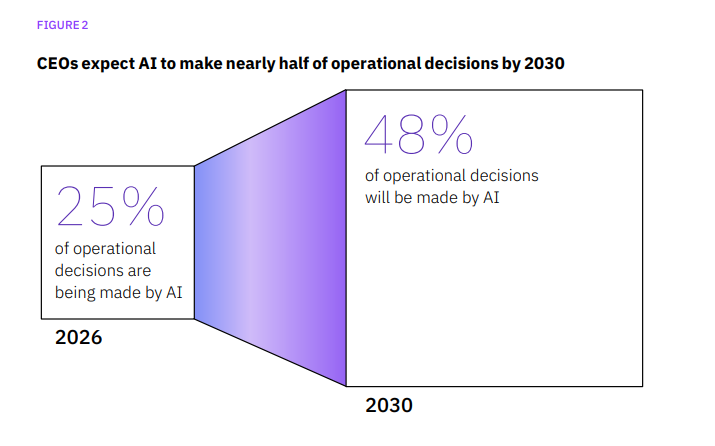
According to the 2026 IBM “Rewiring the C-Suite: The Fast Track to 2030,” a survey of 2,000 CEOs across 33 geographies and 21 industries, executives expect 48% of operational decisions, where consistency and guardrails can be codified, to be made by AI without human intervention by 2030, against 25% today.
Asymbl Recruiter Suite And Asymbl Intelligence
Instead of evaluating candidates using resumes and job descriptions alone, Asymbl Recruiter Suite combines recruiting workflows, hiring history, candidate relationships, and AI-driven analysis.
Semantic Search Beyond Boolean Keywords
Asymbl Recruiter Suite includes AI-enhanced search that goes past Boolean keyword matching, using semantic search and interactional data to surface stronger candidate matches.
Recruiters search the way they describe a role rather than translating it into Boolean syntax first. Candidates who hold the capability but describe it in a different language stay inside the result set, which closes the most common path by which a qualified person disappears before any human sees them.
Asymbl Intelligence As The Context Layer
Asymbl Intelligence captures the judgment, context, and pattern recognition that accumulate across every workflow, decision, and outcome, and makes that signal available to every human teammate and every digital worker on the platform.
Most platforms hold candidate records without producing anything new from them, so a digital worker onboarded onto that foundation is as capable on day one as it will ever be. Asymbl intelligence reads outcomes, so the hundredth requisition is screened against everything the previous ninety-nine established about what good looked like in this organization, for these hiring managers, in these roles.
This is also where the institutional knowledge problem gets addressed structurally. The context a senior recruiter carries in their head becomes a property of the system rather than a property of their tenure, which means it stays when they move on.
Matching Based On Signals And Recruiting Context
Asymbl Talent Intelligence is the reasoning layer that scores candidates against roles. It reads pipeline history, interview feedback, assignment outcomes, and unstructured documents into a continuously improving model of candidate fit, evaluating the way an experienced recruiter would rather than the way a database would.
It returns a detailed breakdown of how each candidate's qualifications map to what the role actually demands, which is the explainable reasoning a recruiter needs in front of a hiring manager. Candidate Intelligence adds analysis and likelihood scoring, so the fit is clear before the first conversation rather than after it.
Digital Workers With Defined Governance Guardrails
Asymbl's digital workers ship with a defined role, a job to be done, success criteria, structured human handoffs, and measurable outcomes, which is the same discipline a firm applies to a human hire.
Rosa, the Digital Recruiter, applies that structure to recruiting execution, handling candidate identification, application screening against role criteria, interview scheduling, and feedback summarization.
Her screening signals come from Talent Intelligence rather than keyword overlap, so it works from actual fit. Recruiters keep judgment, stakeholder alignment, exception handling, and the final decision.
When Asymbl ran this model internally, a two-person recruiting team hired 100 people in 100 days, processing 17,000 applications and pre-screening 1,800 candidates, and scheduling 800 interviews.
What Hiring Teams Should Expect From AI Candidate Matching
Most discussions about AI candidate matching focus on the quality of the algorithm. In practice, the quality of the recommendation depends just as much on the information the algorithm can access.
If the platform only compares resumes against job descriptions, the recommendation will always be limited to those two documents. If it can also read recruiter notes, interview feedback, previous hiring decisions, engagement history, and hiring manager input, the recommendation reflects the organization's actual hiring knowledge instead of a single application.
That is why candidate matching is ultimately an architecture decision rather than a feature comparison. The systems that consistently produce stronger hiring recommendations are the ones that connect recruiting data instead of keeping it scattered across multiple tools.
Before investing in another AI matching platform, ask a simple question: What information is my current system unable to see? The answer often explains why recruiters still spend time validating recommendations that AI has already produced.
See how Asymbl Recruiter Suite and Asymbl Intelligence combine recruiting context, explainable fit scoring, and custom workflows to deliver candidate recommendations your hiring team can understand, trust, and defend.
Book a demo to see how AI candidate matching works when every recommendation is backed by visible reasoning instead of a standalone score.
FAQs
AI resume matching parses a document into structured fields and compares it against a job description. AI candidate matching, in its stronger form, evaluates the full relationship the organization holds with a person, including prior applications, interview feedback, engagement history, and outcomes from similar hires.
Accuracy depends on the depth of data the model reads more than on the model itself. A system operating on resume text and job description keywords reproduces the limits of keyword screening at higher speed. A system reading pipeline history, interview outcomes, and prior performance signals evaluates closer to how an experienced recruiter would.
It can reduce inconsistency between recruiters by applying the same criteria to every candidate, which addresses one source of bias. It does not remove bias arising from historical hiring data, proxy signals, or job description language, and it can scale that bias efficiently.
Ask:
- Which data sources the model reads beyond the resume and the requisition
- The vendor to show a live recommendation and explain the specific signals behind the ranking
- What the audit log records and whether it preserves reasoning or only events
- Where a human is required to review and when the system escalates.
It works only where internal profiles and prior applicants carry the same depth of signal as external candidates. Most systems hold job titles and performance ratings for employees, and closed requisition records for past applicants, and neither supports a real comparison.
.webp)
Candidate Sourcing Strategies for Continuous Pipelines
Modern candidate sourcing strategies need pipelines, not just channels. See the architecture and operating model that makes sourcing work

The Right Fit Starts With a Conversation.
See what working together could look like.
.webp)