

Enterprise Recruitment Software: What to Look for at Scale

.webp)
Most enterprise talent acquisition teams are accountable for the quality of hire without the data to defend it. Recruiting data sits scattered across an ATS, an HRIS, a CRM, and spreadsheets that nobody fully trusts.
AI initiatives that promised to close the visibility gap often stall because the intelligence was never connected to where recruiting actually happens. The enterprise recruitment software RFP (Request for Proposal)runs through the same checklist every cycle:
- Scalability
- Automation
- Integrations
- Compliance
Vendors arrive prepared to score on every line. The blind spot is the architecture underneath the checklist.
Tools that score well in the demo turn into requisition resets that destroy talent continuity. Automation that promised capacity creates a governance vacuum. Integrations that promised unified data become a sync layer, the business stops trusting after the first reconciliation failure.
The right question is whether the architecture underneath your enterprise recruitment software was designed for how enterprise hiring actually operates
In this blog, we will learn why enterprise hiring breaks the standard checklist, the failure patterns that follow, and the six architectural properties that separate platforms built for enterprise scale from platforms that will not survive it.
What Makes Enterprise Hiring Fundamentally Different
Enterprise hiring looks like mid-market hiring on the surface. However, the volume of hiring and stakeholders are different in enterprise hiring.
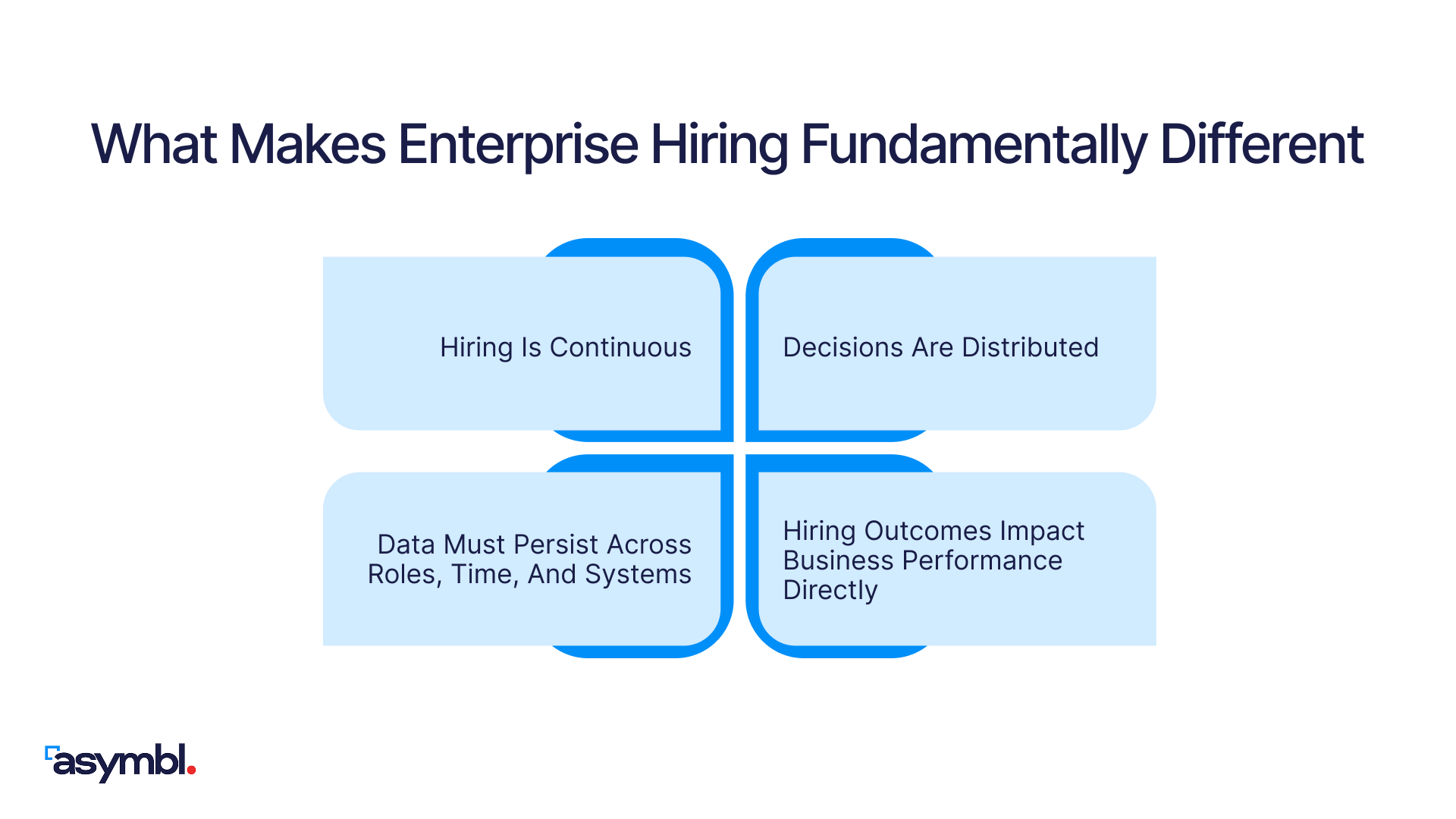
The data carries different obligations, and the stakes are attached to different parts of the business. Each of these pulls the enterprise recruiting system in a direction the standard applicant tracking system (ATS) was not designed to handle.
1. Hiring Is Continuous
Most recruiting platforms were architected for episodic hiring. For example, a job requirement opens, becomes the unit of work, moves through stages, and closes.
Data archives and the next requisition start fresh. The episodic hiring model worked when hiring volumes were lower, sourcing was role-specific, and candidate data rarely got reused across openings.
At enterprise scale, the model breaks against continuous talent operations, where hiring activity does not stop or start with every new opening.
- Pipelines outlive the roles they were opened for: A senior engineer pipeline built for one requisition becomes the foundation for the next three.
- Candidates appear, exit, and reappear across multiple job openings over months or years, often as silver medalists who fit the next role better than the one they originally applied to.
- Engagement signals accumulate over months of touchpoints, including application, interview, decline, alumni outreach, and re-engagement.
- Internal mobility, alumni rehires, and external sourcing all draw from the same talent pool, just from different angles.
When the system underneath this activity is built around episodic hiring events, the institutional value never sticks.
Every new job opening is a fresh start, and the recruiter ends up rebuilding the context that the organization has already paid for. The economic cost of that rebuild compounds with hiring volume. At 50 hires a year, the cost is recoverable, but at 5,000, it becomes structural.
2. Decisions Are Distributed
Mid-market recruiting workflows assume the recruiter is the final decision maker. The recruiter sources, screens, coordinates, and moves the candidate through to offer acceptance. The platform optimizes around the linear workflow.
At enterprise scale, the recruiter is no longer the decision maker. The recruiter is the coordinator of a distributed decision lattice, where the hire moves through stakeholders who each own a different piece of the hiring cycle:
- Hiring managers drive role definition and selection.
- Finance controls headcount approval, budget allocation, and offer thresholds.
- HR enforces policy and consistency across business units.
- Legal and compliance set constraints that vary by jurisdiction, role type, and regulatory framework.
- Regional teams adapt the process to local labor markets, language, and statutory requirements.
According to the 2026 Gartner Talent Acquisition Trends Report, AI revolution and cost pressures are the two forces driving the top trends for talent acquisition in 2026, and one consequence is the redistribution of recruiting work across roles that have not historically owned it.
Finance is now closer to hiring decisions than ever. Legal touches more requisitions than ever. The platform has to keep pace with that redistribution.
A platform that assumes the recruiter owns the decision produces a single point of operational failure at exactly the moment the work needs to move across the lattice.
Decisions stall in inboxes, approvals lose their audit trail, while hiring manager feedback never lands inside the candidate record. The workflow no longer matches where decisions actually live
3. Data Must Persist Across Roles, Time, And Systems
Candidate data is a property of a relationship that may span ten years, four roles, and three or more separate systems. Most enterprise stacks treat the job requirement as the boundary of the data record, which means continuity breaks every time a requirement closes.
The structural failure pattern is called talent memory decay:
- ATS-bound records fragment candidate history across requisitions and never reassemble.
- Integrations move data between systems but lose the context, history, and judgment that made the data useful in the first place.
- Engagement, outcome, and interview-feedback history lives in tools the next recruiter does not log into, so the institutional knowledge is technically preserved but operationally invisible.
A persistent talent record is the only structure that lets the system get smarter as it operates. Without it, every new requirement restarts the same intelligence-gathering exercise the company has already done.
Sourcing, engagement, and vetting repeat. Each repetition is a tax the organization pays on top of the actual hiring work, and it compounds quietly until a CHRO asks why hiring cost per role keeps rising while volume holds flat.
4. Hiring Outcomes Impact Business Performance Directly
At enterprise scale, hiring volume alone is mostly enough to move the P&L. Every hire is a unit of capacity the business has already promised against in its revenue plans, delivery timelines, and operating budgets.
When a senior leadership team arrives two months late, the market it was built to open also arrives two months late. A flawed engineering hire pushes a product roadmap a quarter to the right.
A missed headcount forecast leaves finance planning against capacity that never arrives. The connection between hiring activity and business performance runs through three direct channels:
- Hiring delays push out revenue and delivery timelines, which are reflected in finance and operations forecasts.
- Talent quality compounds into productivity, retention, and unit economics over multi-year horizons.
- Hiring forecasts feed financial planning, capacity models, and capital allocation decisions made by the CFO and the COO.
When the recruiting system cannot connect to the business systems that govern those outcomes, the TA function cannot tie its work to the metrics the business actually plans against. It is measured on activity instead of contribution.
Enterprise recruitment software has to produce data that the CFO and the COO use in their own planning, in the same systems they already trust. A reporting layer that sits inside the ATS, disconnected from finance and workforce planning, leaves TA defending its credibility instead of using its data.
What Enterprise Hiring Cannot Afford To Lose?
Once hiring is continuous, distributed, persistent, and tied to business outcomes, the failure modes change.
The risk is no longer that a single hire takes too long. It is rather about the system losing the four properties that make enterprise hiring defensible against scale, regulation, and economic pressure.
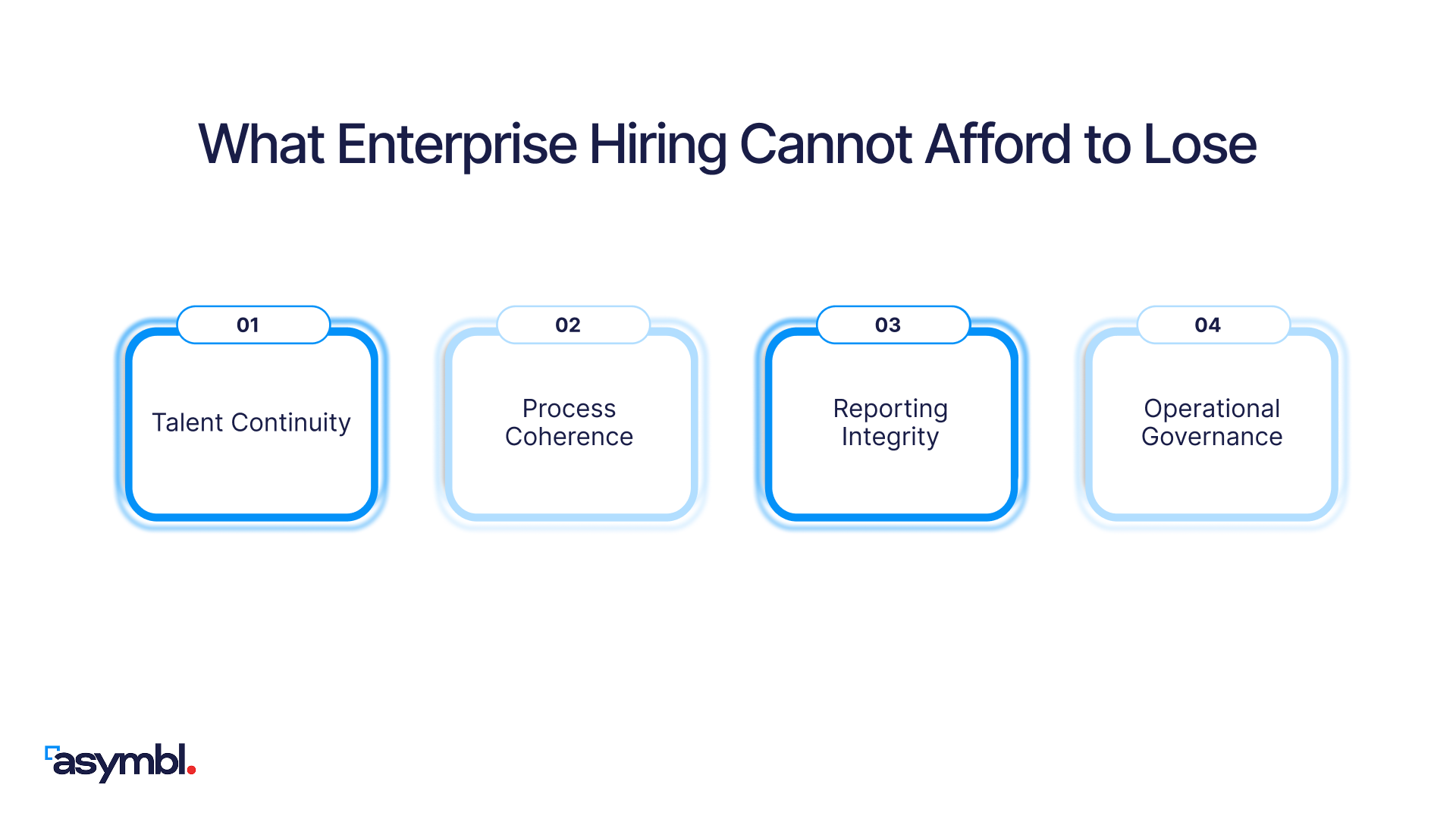
1. Talent Continuity
Every requisition that starts from zero pays a tax because:
- The recruiter sources candidates that the organization has already engaged.
- The team sends outreach that ignores prior conversations.
Strong candidates from the last cycle never surface for the new role they would have been perfect for.
The structural problem is lost talent continuity, and the cost shows up in three places:
- Acquisition costs rise because sourcing repeats work the business has already paid for, often paying the same external sourcing fees twice.
- Pipeline quality weakens because prior engagement signals, including interview feedback, decline reasons, and historical fit indicators, are invisible to the current sourcing motion.
- The talent advantage compounds for competitors instead of for you, because every relationship the firm forgets is a relationship a competitor can build.
Talent continuity is a financial challenge for the company. For example, a 10,000-applicant funnel without continuity produces a smaller pool of usable talent than a 4,000-applicant funnel with full historical context, because the latter knows which applicants have already been vetted, declined, or onboarded somewhere else in the business.
2. Process Coherence
Enterprise hiring runs across two pressures that pull in opposite directions:
- A global standard that protects the brand, the data posture, and the legal exposure,
- A local execution model that responds to the labor market, candidate pool, and team where the role sits.
When the platform cannot hold both at once, the consequence is process drift:
- Compliance risk increases as regions improvise around the global standard, often without documenting the variance.
- Candidate experience varies enough that the brand fragments, so the same firm presents one face in San Francisco and a noticeably different one in São Paulo.
- Performance becomes unmeasurable because the underlying process is not the same from one team to the next, and aggregate metrics lose their meaning.
The platforms that handle this well separate two layers:
- The policy layer, which is enforced globally and centrally
- The execution layer is configurable by region, business unit, or role type.
A platform that conflates the two layers either over-enforces and breaks local execution, or under-enforces and leaks compliance exposure. Both failures land in the same place, where the legal review finds a gap between what the policy says and what the system actually does.
3. Reporting Integrity
Enterprise leaders rely on hiring data to forecast headcount, set budgets, and plan workforce capacity. The minute the data stops being trustworthy, hiring stops being part of the planning conversation, and the TA function stops being heard at the table where capital is allocated.
The failure pattern here is reporting drift, driven by fragmentation:
- Metrics conflict across the ATS, the CRM, the HRIS, and the analytics layer, because each system holds a different version of the same record, and reconciliation runs on a manual cadence.
- Stage definitions vary across business units, so funnel reports cannot be compared across the enterprise.
- Reporting becomes reactive rather than predictive because the data layer is too unstable to support forecasting.
Reporting integrity is harder to rebuild than to lose. Once a CFO catches a number that does not reconcile, the entire data pipeline becomes suspect, and the TA function is back to defending its credibility instead of using its data.
The platforms that hold reporting integrity at scale are the ones where every stage transition, every approval, and every outcome are captured into a single canonical record, with the analytics layer reading from that record rather than rebuilding it.
4. Operational Governance
As automation and AI move into recruiting, governance shifts from a policy document to an operating model. The questions stop being abstract.
- Who owns the decision an AI agent makes when it screens out a candidate?
- How are exceptions handled when a digital worker misroutes, miscommunicates, or violates a policy boundary?
- How is the entire decision chain audited when a regulator, a class-action attorney, or an internal compliance team needs to reconstruct what the system did and why?
When the platform does not answer these questions structurally, AI introduces risk faster than it reduces workload. The compliance exposure scales with the volume of automated decisions, and so does the loss of decision control over what the system is producing on the business's behalf.
Operational governance is a set of structural properties baked into the platform, like:
- Defined decision rights
- Traceable decision paths
- Escalation logic, and
- Accountability that travels with every automated action.
Where General Hiring Tools Break Under Enterprise Conditions
General hiring tools are designed for an operating model that the enterprise has already outgrown. When the operating model changes, the tool's strengths turn into structural limitations, and four breakage patterns emerge.
1. Requisition Resets Destroy Continuity
The requisition is the unit of work in most ATS platforms. Open a requisition, move candidates through stages, close the req, and archive the data. The model is clean and linear, but it also resets the talent relationship every time it runs
As each new requisition creates a new record context, past interactions are disconnected from the current pipeline. Candidate journeys fragment across requisitions; the same person should have been visible inside.
A senior product manager who applied for a director role two years ago, who was a strong silver medalist, and who now fits a current VP opening better than any external candidate, never surfaces in the current sourcing motion because the current sourcing motion is querying the new requirement’s record instead of a unified candidate model.
2. Workflow Tools Without Data Architecture Create Stack Sprawl
- When the ATS does not handle sourcing well, the team adds a CRM.
- Outreach is manual, so the team adds an automation tool.
- Reporting is poor, so the team adds an analytics layer.
- Sourcing across passive candidates is weak, so the team adds an AI matching tool.
Each tool solves a workflow problem, but eventually creates a data problem. According to the 2025 McKinsey State of AI Report, 88% of organizations now report regular AI use in at least one business function, but only 23% are scaling an agentic system across the enterprise.
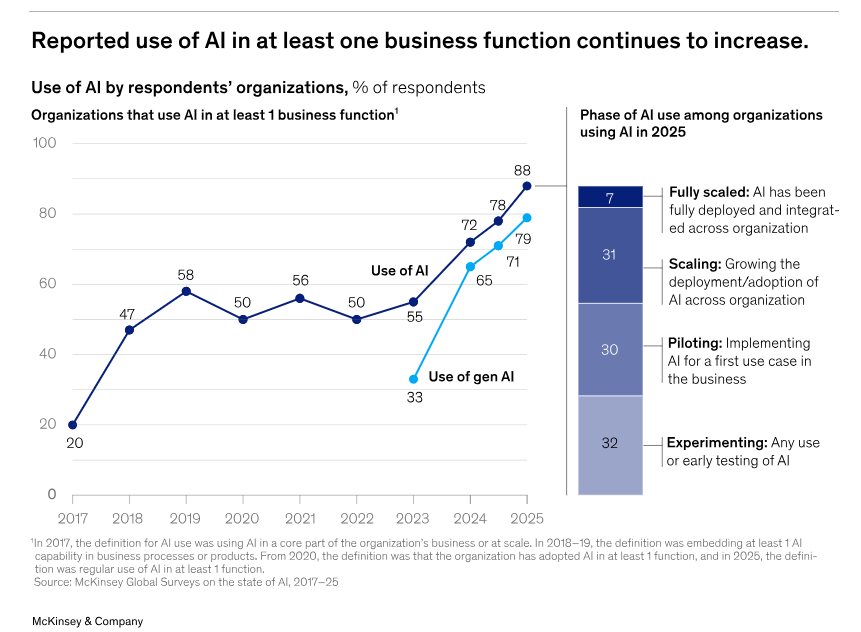
The result is stack sprawl:
- Duplicated candidate records across the ATS, the CRM, and the sourcing tool, with no single canonical record.
- Inconsistent stage definitions across tools, so funnel reporting fails on its own arithmetic.
- Integration overhead that grows faster than the value the new tools were supposed to deliver, often consuming the productivity gain that justified them.
Workflow expansion without a unified data foundation does not solve the original problem. It just moves the problem one layer down, where it becomes harder to see and more expensive to fix.
3. Automation Without Governance Creates A Governance Vacuum
Automation is supposed to remove work, but in a stack without governance, it adds a different kind of complexities, like:
- Monitoring
- Correction
- Exposure management.
This pattern is called a governance vacuum, and it often shows up after the demo, instead of during it. The structural issues behind the governance vacuum are predictable:
- No defined ownership of automated decisions, so when an AI agent screens out a candidate, the firm cannot say who is accountable for the decision.
- No escalation path when the automation gets it wrong, so corrections happen ad hoc by whoever notices first.
- No audit trail that satisfies a regulator, a legal review, or a candidate's own data subject access request.
For enterprise TA, the consequence shows up as compliance exposure, loss of decision control, and an inability to trust the outputs the platform is producing on the organization's behalf.
4. Efficiency Tools Fail To Produce Capacity
In the 2025 Deloitte AI ROI Report, only roughly 1 in 5 organizations qualify as AI ROI Leaders. The rest invest at the same pace and see less return because they treat AI as a faster way to do existing work rather than as a redesign of the work itself.
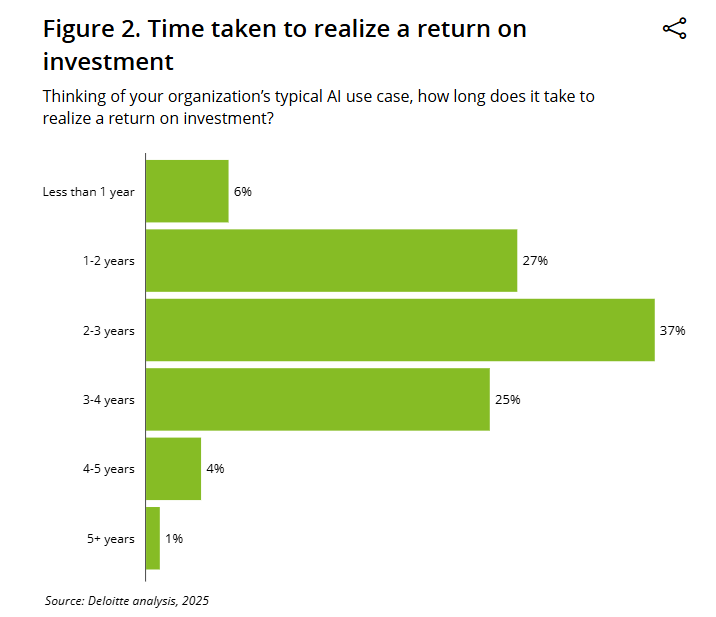
Enterprise recruitment software repeats this pattern by layering tools on top of broken processes. It results in recruiters moving faster through the same friction, while aggregate capacity barely changes.
The platforms that produce real capacity at scale change the structure of the work. They redistribute deterministic execution to digital workers, redesign handoffs between human and digital execution, and rebuild the data layer underneath the workflow so that the speed gain at one stage does not get absorbed by friction at the next.
What Enterprise Recruitment Software Should Actually Be Evaluated For
The standard buyer's checklist evaluates features. However, an enterprise buyer needs to evaluate the architecture.
Six properties below separate platforms that hold up under enterprise conditions from platforms that become a mere migration project. Each property maps to one of the failure modes above. Together, they form an architecture-level evaluation framework that the feature checklist cannot replace.
1. Data Continuity As A System Foundation
The first question is whether the platform maintains a persistent talent record or whether it operates as a sequence of disconnected application records held together by integrations.
Evaluate:
- Unified candidate record across roles, requisitions, and time that travels with the candidate, not with the requisition.
- Pre-application engagement signals captured into the same record as application data, interview history, and post-hire outcomes.
- No record reset at requisition close, so the next requisition opens against a fully populated talent model rather than a blank record.
If the platform's data model resets at the requisition boundary, every other capability stacked on top of it inherits that fracture.
- The matching tool matches on partial data.
- The analytics layer reports on partial data.
- The AI agent operates on partial data.
That is why continuity has to be foundational and cannot be added as a feature later.
2. Workflow Layer Vs. Data Layer Separation
The second question is whether the platform distinguishes between the workflows your team configures and the data those workflows operate on.
The architectural concept is called layer separation, and platforms that get it wrong create silos faster than they remove them.
Evaluate:
- Workflows configurable for different teams, regions, or business units without forking the underlying data model.
- Process flexibility that produces a consistent canonical data layer, with configurable execution on top.
- No new data silos introduced when a new region or business unit configures its own workflow.
Workflow tools that own their own data create as many silos as the integrations they were meant to replace. The right architecture lets workflows flex without forcing data to fork.
Done well, regional teams configure their own intake, approval, and feedback flows on top of one canonical talent record. Done poorly, every regional configuration is a new silo and a new reconciliation problem.
3. Digital Worker Role Design And Governance
The third question is whether AI is treated as a tool added to the platform or as a worker added to the team. It influences everything downstream, including governance, accountability, performance management, and audit posture.
Evaluate:
- Defined role boundaries for what tasks are automated, what tasks are human-owned, and where the handoffs happen.
- Digital workers as managed roles, with a job description, a motivation for success, measurable KPIs, and escalation paths, rather than as features bolted onto a workflow.
- Structured handoff between human and digital execution at every decision point that requires judgment.
If digital workers operate without a job description and a manager, the platform is shipping liability rather than capacity. The right architecture treats digital workers with the same operating discipline applied to any new hire through the following phases:
- Onboarded
- Governed
- Measured, and
- Coached.
4. Cross-Functional System Integration
The fourth question is whether the platform aligns with the rest of the enterprise operating model, or whether it operates as an island that the rest of the business has to integrate around.
Evaluate:
- Alignment with HR workflows, finance planning cycles, and IT architecture constraints, including identity, security, and audit posture.
- Data that the CFO, COO, and CIO recognize and use in their own systems, without requiring TA to export, transform, and re-present its numbers.
- Inheritance of enterprise security and governance from the systems the rest of the business already runs on, rather than parallel infrastructure that has to be separately governed.
If recruiting data lives outside the systems the business plans against, recruiting stays outside the planning conversation.
5. Capacity Modeling And Predictability
The fifth question is whether the platform forecasts hiring outcomes or whether it only reports on them after the fact. Capacity modeling is what turns recruiting from a tactical reporting function into a planning input that the business can budget against.
Evaluate:
- Pipeline conversion forecasting based on historical and current data.
- Planning scenarios for different demand curves, hiring volumes, and time horizons.
- Throughput stabilization so the business can budget against predictable hiring capacity rather than estimating against historical averages.
According to the 2025 McKinsey State of AI Report, high performers in enterprise AI redesign workflows around predictive capability rather than adding predictive features to existing workflows.
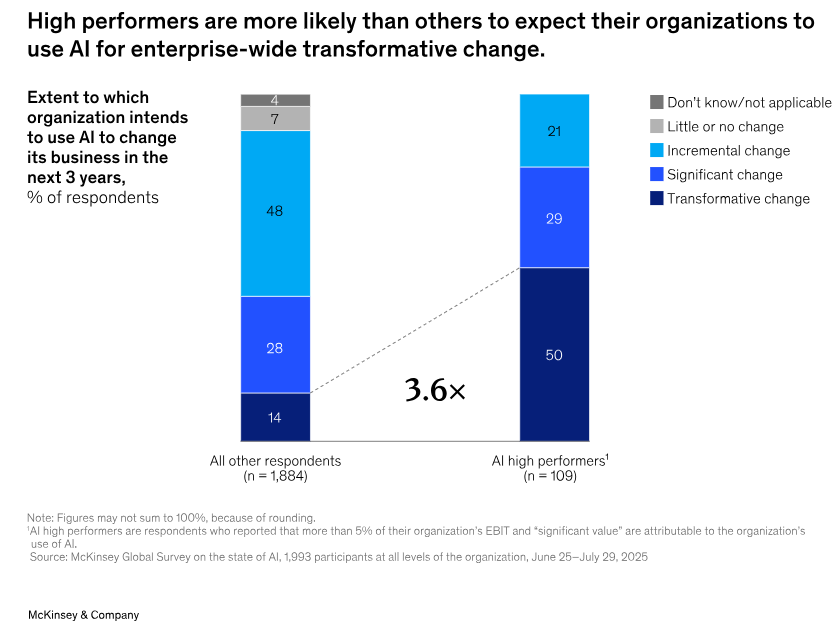
The same pattern applies in recruiting. Capacity modeling is an architecture choice that shapes the data layer, the workflow layer, and the AI layer simultaneously. It does not survive being added later as a dashboard.
6. Global Compliance With Localized Execution
The sixth question is whether the platform can hold a global standard and execute against local rules at the same time. Enterprise hiring touches multiple jurisdictions, and the platform has to enforce policy globally while adapting execution locally without leaking to either side.
Evaluate:
- Global policy enforcement for bias mitigation, data security, retention, and audit trail across every region.
- Regional adaptation for candidate data handling, employment law, accessibility, and language requirements.
- Auditability that satisfies a regulator, an internal compliance review, or a data subject access request without manual reconstruction.
If compliance is a configuration the customer has to maintain, it is not compliance, but a future incident waiting to be discovered.
The platforms that get this right encode policy structurally and let region-specific configurations sit on top of the policy layer without breaking it.
Where Asymbl Fits: Enterprise Recruitment Software Designed For Scale
The six evaluation criteria above describe the architecture enterprise hiring actually requires. Asymbl was built against those criteria from the beginning.
Most recruiting technology was assembled from acquired point solutions that were never designed to work together, then connected by integrations after the fact.
Asymbl took the opposite path and was built on a Salesforce-based foundation, a unified data model, and digital workers that operate as managed roles inside that system.
For corporate TA leaders evaluating an enterprise recruitment software platform, the architectural fit shows up in four places that map directly to the evaluation framework.
1. Salesforce-Based Unified Data Foundation
Most enterprise recruiting stacks fragment data across an ATS, a CRM, a sourcing tool, and an analytics layer, then spend the next two years stitching the pieces back together with integrations. The Integration tax compounds with every new tool added to the stack.
Asymbl Recruiter Suite is built on Salesforce, which means recruiting data lives in the same architecture as your CRM, finance operations, and workforce planning. The implications:
- Candidate, client, and employee records share a unified data model, rather than living in parallel and being reconciled by an integration layer.
- Recruiting data is queryable alongside revenue, account, and customer success data, in the same system that the rest of the business already plans against.
- No integration layer is needed because the data is already unified at the model level.
This is the structural answer to data continuity, workflow, and data layer separation, and cross-functional integration in a single architecture decision. The data model your team builds around recruiting is the same data model the business plans against.
2. Workforce Orchestration For Enterprise Teams
Enterprise hiring is a coordinated set of workflows running across recruiters, hiring managers, finance, legal, and operations. Asymbl orchestrates that coordination on a single platform rather than across a stack of tools that each see only one slice of it.
- Recruiter Suite manages the end-to-end talent relationship, from first engagement through hire and beyond.
- Asymbl Time connects recruiting outcomes to workforce capacity, billing, and operational planning, so a hire is not just a record in TA. It becomes a line in the business's capacity model and a downstream input to finance.
- Enterprise leaders trace hiring decisions through to financial and capacity outcomes inside the same system, without exporting data to a tool that cannot see where the decision came from.
The result is workforce orchestration applied at the level of the hiring function, where human teams and digital workers operate as one coordinated system, with shared data, shared workflows, and shared accountability.
This is what cross-functional system integration looks like when it is built into the architecture rather than approximated by middleware.
3. Digital Workers With Defined Roles And Governance
Most automation in recruiting is task-level, like:
- Schedule a meeting.
- Screen a resume.
- Send an email.
Governance is treated as a policy document, instead of as a property of the system. Asymbl treats digital workers the same way it treats human workers. Each one is onboarded into the workflow with a job description, a motivation for success, and measurable KPIs.
- Digital Recruiter is a pre-built digital worker that handles job description generation, candidate outreach, application screening, interview scheduling, interview summaries, and offer letter generation, with structured handoffs to human recruiters at every decision point that requires judgment.
- Digital Recruiter operates under the same management discipline as a human contributor with defined responsibilities, escalation paths, performance tracking, and continuous coaching through Asymbl's Design, Onboard, and Coach framework.
- The proof point sits inside Asymbl's own operations. Two human recruiters working alongside a Recruiter Agent hired 100 people in 100 days.
Recruiter Agent processed 17,000 applications, pre-screened 1,800 candidates, and scheduled 800 interviews, saving $575,000 in hiring costs and increasing fill rate by 47%. The Customer Zero program documented a 1,529% ROI when Asymbl’s Recruiter Agent launched.
This is what digital worker governance looks like when it is structural. Recruiter Agent does not replace human recruiters but extends them, with the same operating discipline applied to any new hire on the team.
4. Capacity Modeling Across The Full Talent Lifecycle
Enterprise hiring teams need to forecast capacity, not just track activity. Asymbl talent intelligence is the layer that makes capacity modeling possible.
- Persistent talent record across roles, time, and systems, so enterprise hiring teams never restart sourcing from zero, and silver medalists, alumni, and internal mobility candidates remain visible against every new requisition.
- AI matching across the full talent lifecycle, including external candidates, alumni, and internal mobility, using pipeline history, interview feedback, and prior outcomes rather than keyword overlap on a resume.
- Pipeline forecasting and capacity scenarios that enterprise hiring planning actually uses, with conversion data flowing back into the model continuously.
Asymbl Intelligence captures the judgment and context accumulating across every workflow and decision and makes that signal available to every digital worker and every human teammate operating on the platform.
The system gets smarter the more your team uses it. That is what data continuity and capacity modeling look like when they are built into the foundation rather than added as a feature later.
Conclusion
The platforms that win at enterprise scale share an architecture, preserve continuity, enforce governance, unify data, and produce predictable capacity. The platforms that lose share the opposite pattern:
- Workflow expansion ahead of data architecture
- Automation ahead of governance, and
- Reporting layers stacked on top of fragmentation that the platform never resolved.
Architecture does not show up in the demo of an automated screening flow. It shows up two years in, when the business is forecasting headcount against the recruiting pipeline, when a regulator asks for a decision audit, when a top recruiter leaves, and the relationships do not leave with them, and when an AI agent the team onboarded last quarter is operating with the same accountability as the human recruiters next to it.
A few questions to sit with as you evaluate your current stack:
- If your hiring volume doubled tomorrow, would your platform absorb the load or break under it?
- When a top candidate from last year fits a current role better than any external candidate, does your system surface them automatically?
- If a regulator asked your TA team to reconstruct a screening decision an AI made six months ago, could the platform produce the audit trail?
The answers to those questions tell you whether you are evaluating enterprise recruitment software or just a larger version of the same platform you already have.
Asymbl was built on the architecture enterprise hiring requires:
- A Salesforce-based data foundation
- Governed digital workers
- Capacity modeling across the full talent lifecycle.
If you are evaluating enterprise recruitment software and want to see how unified data, governed digital workers, and capacity modeling come together inside one platform, book a walkthrough with Asymbl.
We will show you how Recruiter Suite, Talent Intelligence, and Recruiter Agent operate as one system, calibrated to your hiring volume and the business outcomes your team is accountable for.
FAQs
General recruiting tools fail at enterprise scale because they are built around requisitions, isolated workflows, and fragmented data, all of which break under enterprise complexity.
Data continuity in recruiting means maintaining a persistent, unified talent record across roles, time, and systems, rather than recreating candidate context at every requisition. A candidate engaged for an engineering role two years ago, who now fits a leadership role today, should appear with a full history attached. Without continuity, every requisition starts the same intelligence-gathering exercise the firm already paid for.
Automation alone cannot solve enterprise hiring challenges because, without proper system design and governance, it amplifies existing structural issues rather than removing them.
The best enterprise recruitment software is the one designed for how enterprise hiring actually works, which is continuous, distributed, multi-system, and directly connected to business outcomes. Look for platforms that:
- Preserve data continuity across the full talent lifecycle
- Enforce governance across human and digital contributors, and
- Produce a predictable hiring capacity rather than just automating individual tasks.
Enterprise recruiting software typically uses custom pricing based on headcount, hiring volume, and modules selected, but the more important number is the total cost of ownership. Implementation, training, integration, maintenance, and the ongoing cost of fragmented data when systems do not share a unified foundation often outweigh licensing fees.
Enterprise ATS software should integrate with HRIS, payroll, background check, and assessment tools at a minimum, but the more important question is whether the platform requires integrations to function or whether core capabilities share a native data foundation.
Integration-dependent architectures create sync delays, duplicate records, and reporting gaps. Enterprise teams should evaluate whether a platform's integrations supplement a unified system or compensate for a fragmented one.

Legacy ATS Limitations: Why Your Recruiting System Is Holding You Back
The ATS platforms are not fundamentally flawed. They’re simply not built to support today’s dynamic recruiting environment. As strategies shift to emphasize early engagement, automation, and cross-functional coordination, the supporting systems must shift too.

The Right Fit Starts With a Conversation.
See what working together could look like.
.webp)