

How to Choose the Top Recruiting CRM Software for Corporate
Most teams evaluating the top recruiting CRM software ask which platform has the most features, the cleanest interface, or the longest integration list. Those questions sort the demos, but they do not predict which team is still scaling hiring two years later and which one has quietly hit a capacity wall.
A recruiting CRM is the architecture a TA function runs on. It decides whether the hiring manager context reaches the recruiter at the moment a candidate is shortlisted, whether a departing recruiter takes the relationships and candidate knowledge with them, and whether more hiring demands more headcount on the team itself.
According to the 2024 Deloitte Global Human Capital Trends Research, 73% of business and HR leaders recognize the importance of ensuring human imagination keeps pace with technological innovation, while only 9% report real progress on that alignment. The wrong choice modernizes a model already running out of room, while the right one rebuilds it.
In this blog, we will examine the leading recruiting CRM platforms in 2026, the four criteria that actually separate them for a corporate TA team, and the operating model that the right CRM makes possible.
Top Recruiting CRM Software Solutions in 2026
Corporate talent acquisition (TA) teams hire into their own headcount, and their scoreboard is quality of hire, candidate experience, and time-to-fill against a plan.
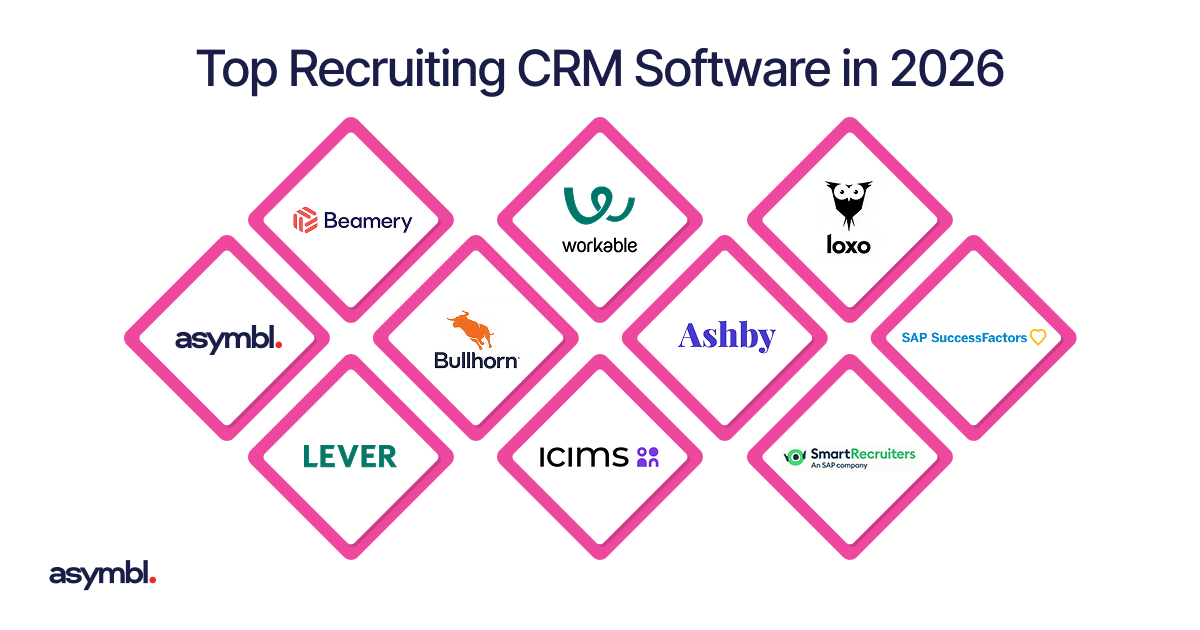
The table below maps the ten platforms most often shortlisted in 2026 against the criteria that matter for corporate teams
Here’s a detailed overview of each recruiting CRM software along with its key features and pricing:
1. Asymbl
Asymbl is a workforce orchestration company, and its recruiting platform is built inside Salesforce rather than connected to it. Recruiter Suite, Skills, Talent Intelligence, and Rosa, a Digital Recruiter, are all based on the same Salesforce data model, so candidate records, job orders, pipeline activity, candidate scoring, and the actions a digital worker takes share one set of records with the same governance and security as the rest of the business.
Key Features:
- Salesforce-based unified data layer: Candidate, recruiting activity, and post-hire outcomes sit on one data model, so intelligence reasons against the live record rather than the last successful sync.
- Talent Intelligence as the reasoning engine: It goes beyond resume parsing to fold pipeline history, interview feedback, and assignment outcomes into a continuously improving model of candidate fit, with natural language search in place of Boolean syntax.
- Native digital workers via Agentforce: Rosa, a pre-built Digital Recruiter, onboards inside the same Salesforce environment as the human team, with shared governance, a single audit trail, and no separate integration to maintain.
- Real-time revenue and redeployment visibility: Gross profit, fill rates, and redeployment signals surface per recruiter on the same live records, so the front office sees margin where it is made and where it leaks.
Pricing: Asymbl pricing starts at $60/user/month for Launch (Recruiter Suite + Skills), $125/user/month for Premier (adds Talent Intelligence), and custom pricing for Ultimate (adds Rosa, a Digital Recruiter). Advisory services are custom-scoped, while Agentforce packages start at $25K (Break-Fix) and ~$30K (Jetpack) for 4-week engagements.
Best for: Corporate TA teams on or moving to Salesforce that want unified talent relationship management with intelligence and digital workers on one foundation
2. Beamery
Beamery is a talent lifecycle platform built around a large skills graph that maps capabilities across an entire workforce. For a large enterprise managing internal mobility, reskilling, and long-horizon nurture of future employees, the skills inference and talent-intelligence layer are among the most sophisticated in the market.
Key Features:
- Skills-based talent graph: It infers skills across internal employees and external candidates, scoring fit on capability and trajectory rather than job titles.
- Candidate relationship management: Nurture campaigns and segmented talent pools keep passive candidates warm across long enterprise hiring horizons.
- Internal mobility and reskilling: It surfaces internal candidates and maps reskilling pathways against open roles before a search goes external.
- AI-driven matching: Deep-learning models rank candidates against roles using the skills graph instead of keyword overlap.
Pricing: Custom
Best for: Large enterprises building a skills-based internal talent and mobility strategy.
3. SAP SuccessFactors
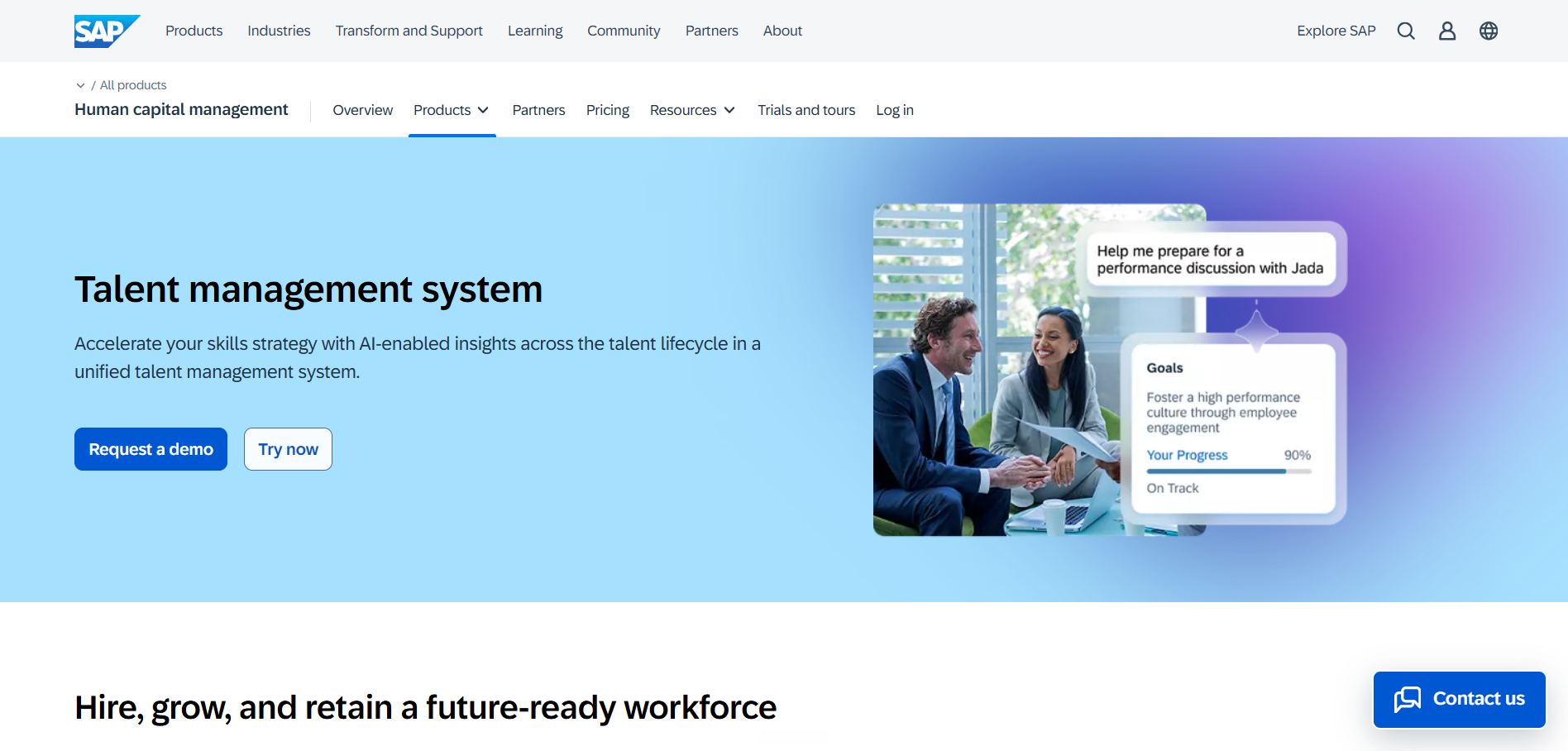
SAP SuccessFactors is an enterprise human capital management (HCM) suite with recruiting as one module inside a much larger system of record. Firms choose it when hiring has to sit beside payroll, core human resources, and global compliance for a workforce in the tens of thousands.
Key Features:
- Recruiting inside a full HCM suite: The recruiting module shares one system of record with payroll, core HR, and performance, so hiring data sits beside the rest of the employee lifecycle.
- Career site and CRM: A configurable career site builder and candidate relationship management support employer branding and pipeline nurture at enterprise scale.
- AI-assisted hiring: Generated job descriptions and candidate matching cut manual effort inside the requisition workflow.
- Global compliance and reporting: Governance, audit, and reporting are built for organizations hiring across many geographies and regulatory regimes.
Pricing: Custom
Best for: Large corporate employers standardizing hiring inside an existing SAP ecosystem.
4. SmartRecruiters
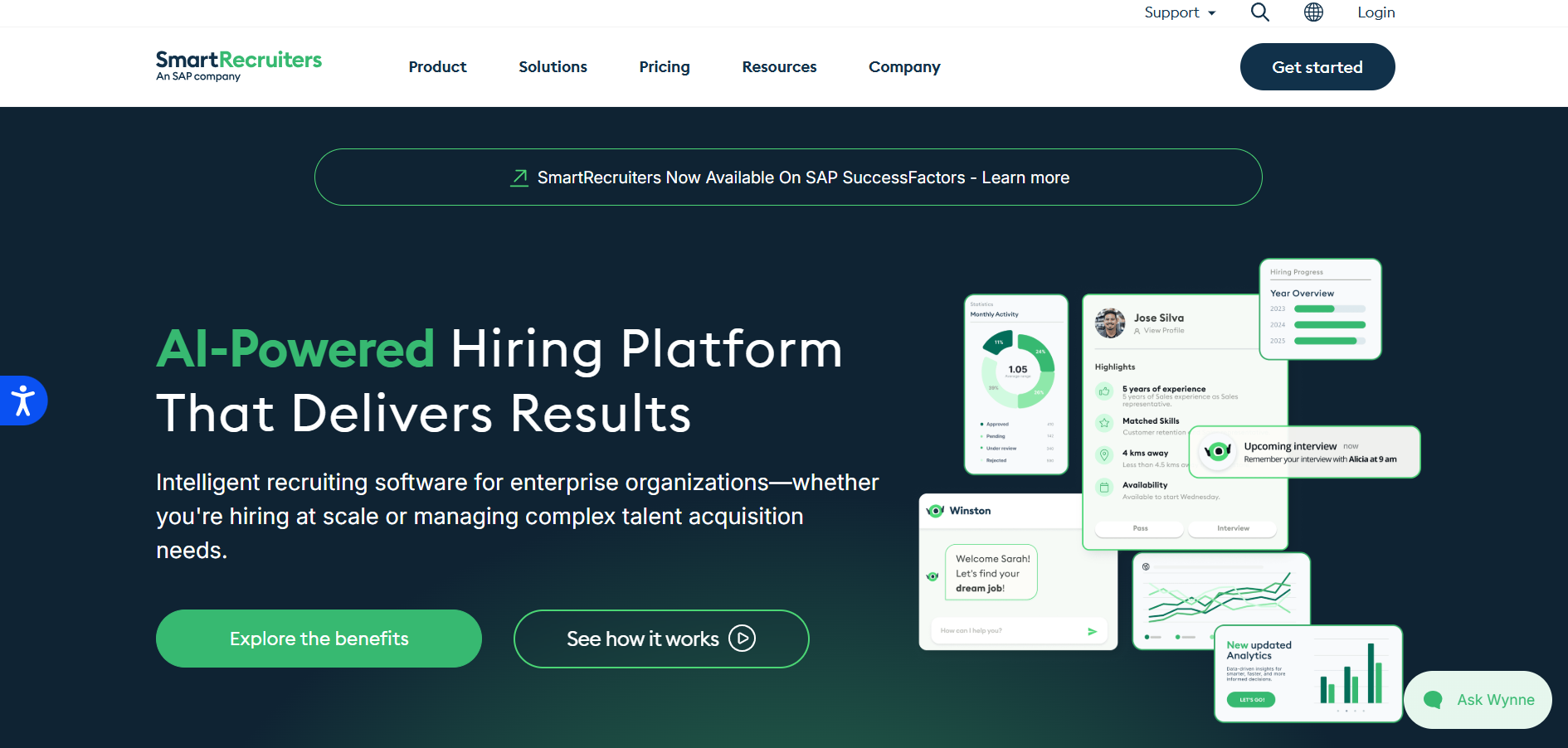
SmartRecruiters is an enterprise talent acquisition suite that combines an applicant tracking system (ATS) with candidate relationship management and a marketplace of recruiting add-ons. It performs well where corporate hiring happens at volume, with strong careers-site tooling, collaborative hiring workflows, and a candidate experience that holds up across thousands of applications.
Key Features:
- Enterprise ATS and CRM: Applicant tracking, candidate relationship management, and CRM campaigns run in one suite built for high-volume corporate hiring.
- Careers sites and collaborative hiring: Branded career sites and structured, multi-stakeholder hiring workflows hold up across thousands of applications per role.
- AI screening and matching agents: Built-in agents screen inbound applicants and surface the strongest matches so internal recruiters spend time on candidates worth a conversation.
- Recruiting marketplace: A large ecosystem of pre-built integrations connects sourcing, assessment, and background-check tools to the core platform.
Pricing: SmartRecruiters pricing starts at $14,995/year for the Essential plan, which includes ATS, CRM, onboarding, messaging, job distribution, and scheduling. Professional, high-volume, and Complete plans add AI-powered recruiting capabilities and advanced features, with custom pricing available on request for larger organizations and enterprise hiring needs.
Best for: Mid-market and enterprise corporate TA teams hiring at scale.
5. Lever
Lever pairs an applicant tracking system with candidate relationship management in a single product, now part of the Employ portfolio. Its design philosophy put nurture and proactive sourcing at the center early, which earned it a loyal following among mid-market corporate teams that build relationships ahead of open roles.
Lever tracks candidates moving toward a company's own roles and carries no native concept of an external client, a submittal, or a margin on a placement.
Key Features:
- Combined ATS and CRM: LeverTRM unifies applicant tracking and candidate relationship management in a single product, so active pipelines and nurtured relationships live together.
- Nurture campaigns: Automated, multi-touch sequences keep passive candidates engaged ahead of the roles that eventually fit them.
- Visual pipeline analytics: Funnel, conversion, and diversity reporting give corporate teams a clear read on where candidates stall.
- Outreach and scheduling automation: Built-in automation handles repetitive outreach and interview coordination so recruiters stay on higher-value work.
Pricing: Custom
Best for: Mid-market corporate recruiting teams that source proactively and value candidate nurture.
6. iCIMS
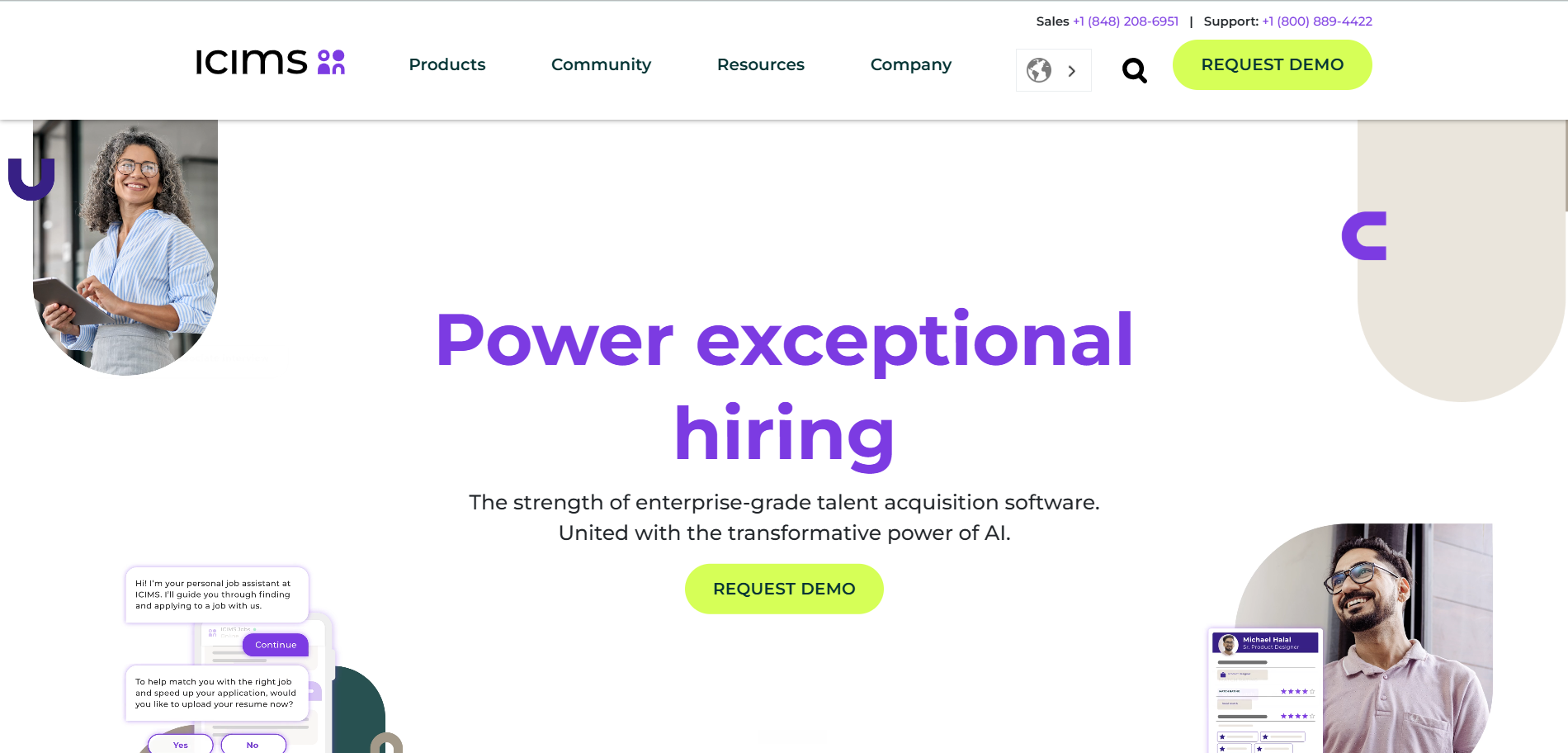
iCIMS is an enterprise talent cloud, one of the most established applicant tracking and recruiting CRM platforms for large corporate employers. It spans sourcing, CRM, the career site, onboarding, and a deep integration ecosystem, and big TA organizations rely on it for configurability and scale across global hiring.
Key Features:
- Talent Cloud breadth: One platform spans applicant tracking, candidate relationship management, career sites, and onboarding for large employers.
- Candidate marketing: CRM campaigns and talent pools nurture passive candidates across long enterprise hiring cycles.
- AI matching and copilot: Matching and a recruiting copilot assist sourcing and screening across high-volume pipelines.
- Integration ecosystem: A deep catalog of integrations and enterprise configurability let large TA organizations standardize hiring across geographies.
Pricing: Custom
Best for: Large enterprises with mature, high-volume internal recruiting operations.
7. Bullhorn
Bullhorn is the most widely deployed customer relationship management and applicant tracking system built specifically for staffing and recruiting agencies. It models clients, contacts, job orders, submittals, placements, and redeployment the way a staffing desk actually works, with strong support for high-volume contract and permanent recruiting.
Key Features:
- Staffing-native CRM and ATS: Clients, contacts, job orders, submittals, and placements are modeled the way a staffing desk works, with strong contract and permanent recruiting support.
- Redeployment workflows: The platform tracks assignments and contractor status, so firms can act on redeployment, the highest-margin placement type in staffing.
- Bullhorn Amplify AI agents: Add-on agents source, match against placement history, and screen, layering AI onto the core ATS and CRM.
- Back office and analytics: Onboarding, time and pay, and reporting extend across a broad staffing marketplace and partner ecosystem.
Pricing: Bullhorn ATS pricing starts at $99/user/month for Starter (1–2 users) and $165/user/month for Core. The Pro plan uses custom pricing and adds CRM, AI Assistant, automation, analytics, and dedicated support. Higher-tier plans include more customization, integrations, workflow automation, and recruiting intelligence capabilities.
Best for: Staffing agencies that want a proven, staffing-native system of record and will assemble the intelligence layer around it.
8. Loxo
Loxo positions itself as a talent intelligence platform that folds an applicant tracking system, candidate relationship management, sourcing, and outreach into one product. It is built for staffing firms and search agencies, with AI sourcing and a large contact database aimed at filling the top of the funnel quickly.
Key Features:
- All-in-one talent intelligence: Applicant tracking, candidate relationship management, sourcing, and outreach run in one platform built for agencies.
- AI sourcing and contact data: AI sourcing draws on a large verified-contact database to fill the top of the funnel quickly.
- Natural-language and Boolean search: Recruiters search the database in plain language or Boolean, surfacing matches without deep search expertise.
- Multi-channel outreach: Sequenced email and outreach campaigns with engagement analytics run inside the same platform.
Pricing: Loxo offers a free plan for solo recruiters, while the Basic plan starts at $169/user/month and includes ATS, CRM, analytics, reporting, and multi-user access. Professional and Enterprise plans use custom pricing, adding AI sourcing, outreach automation, AI agents, advanced integrations, SSO, and enterprise-grade security.
Best for: Search firms and recruiting agencies that want sourcing and CRM unified in one lightweight platform.
9. Ashby
Ashby is an all-in-one recruiting platform combining applicant tracking, candidate relationship management, scheduling, and analytics, and it is known specifically for the depth of its reporting.
Ashby is built around a company's internal hiring funnel, and its analytics are tuned to corporate questions such as quality of hire, funnel conversion, and interviewer load.
Key Features:
- All-in-one recruiting: Applicant tracking, candidate relationship management, scheduling, and analytics share one platform.
- Best-in-class analytics: Deep pipeline, funnel, and source dashboards answer hard hiring questions most platforms cannot produce.
- Advanced scheduling: Complex multi-interviewer scheduling and structured hiring are handled natively.
- AI sourcing and matching: AI assists sourcing and surfaces strong matches against the internal hiring funnel.
Pricing: Ashby pricing starts at $400/month for its All-in-One Foundations plan, designed for startups with up to 100 employees. Growth, Enterprise, and Analytics plans use custom pricing based on company size, usage, and commitment. Optional add-ons include Advanced Scheduling and AI Notetaker for enhanced recruiting workflows.
Best for: High-growth corporate teams that treat recruiting analytics as a core discipline.
10. Workable
Workable is an applicant tracking system with sourcing, AI screening, and candidate relationship management features, built largely for small and medium-sized businesses (SMBs). It is fast to deploy, affordable, and covers posting, sourcing, and screening competently. For a company hiring a handful of roles a quarter, the time-to-value is genuinely hard to beat.
Workable is built for an employer filling its own roles, so it carries no client, billing, contractor, or placement architecture, and an agency outgrows it the moment recruiting becomes the business rather than a function inside the business.
Key Features:
- Multi-board posting and sourcing: One-click posting to many job boards plus AI sourcing fills the top of the funnel fast.
- AI screening and scoring: Candidate scoring and recommendations help small teams shortlist without heavy manual review.
- Built-in candidate CRM: Lightweight candidate relationship management and texting keep communication inside the platform.
- Fast, structured setup: Hiring templates and quick configuration get a small company up and running in days.
Pricing: Workable pricing starts at $299/month (billed annually) for the Standard plan, which includes recruiting, ATS, sourcing, and core HR tools. Premier starts at $599/month and Enterprise at $719/month, adding advanced hiring features. An optional AI recruiting agent is available separately, with usage-based credit pricing.
Best for: Small and mid-sized companies hiring for their own teams.
How Corporate Teams Should Evaluate Recruiting CRM Software
Each of the four evaluation criteria below maps to a structural failure that shows up not in the demo but eighteen months after go-live, when the team tries to scale hiring, add intelligence, or answer a question the platform should be able to answer and cannot.
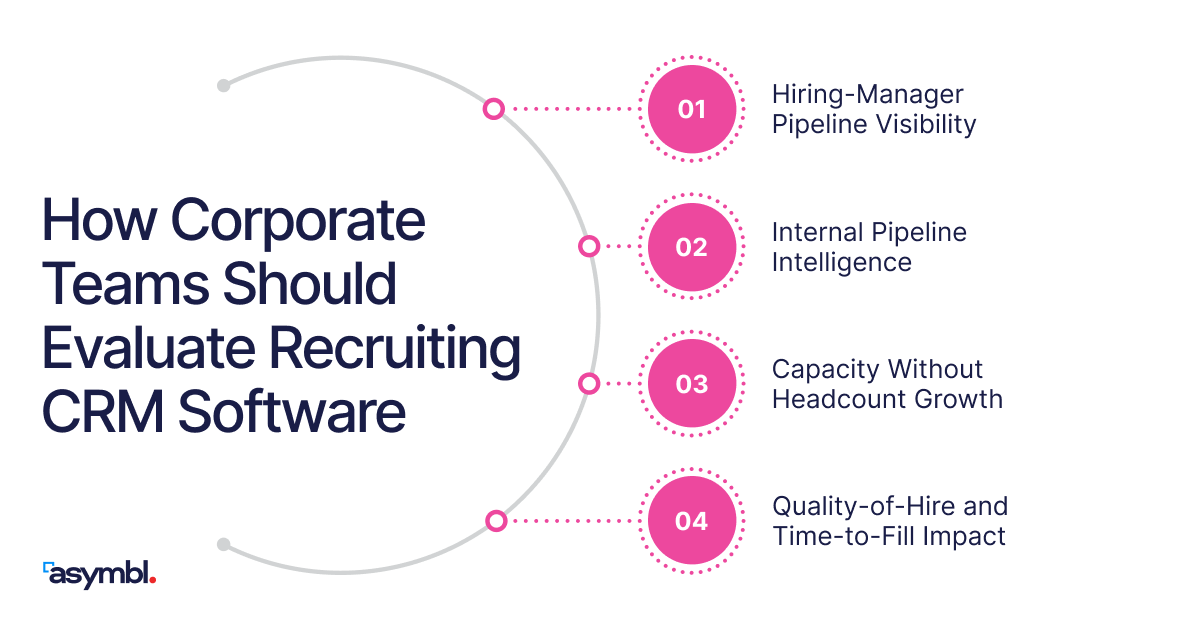
The table below frames them as a scorecard, and the sections that follow trace why each one decides TA performance.
1. Hiring-Manager Pipeline Visibility
Hiring managers have stopped accepting a weekly status email as proof of progress. They want to see where their open requisitions stand, which candidates are in play, and when a shortlist will land, on their own schedule rather than the recruiter's.
When visibility depends on a recruiter stopping work to assemble a spreadsheet, every status update is sourcing capacity spent on reporting rather than hiring.
Visibility is a credibility mechanism that happens to look like a reporting feature, and a platform that cannot produce it in real time raises the cost of every open role.
What to look for:
- Real-time pipeline movement visible across all of a hiring manager's open requisitions, without a manual pull
- Time-to-fill forecasting grounded in the strength of the live pipeline, so TA can commit with evidence
- A hiring-manager view the team can share directly, rather than recompiling from scratch each week
The question to ask a vendor: “Show me, on a live requisition with a full pipeline, the view a hiring manager would see, and tell me how many manual steps stand between the recruiter's work and that view”
2. Internal Pipeline Intelligence
The teams losing quality of hire tend to be the ones where the right candidate depends on which recruiter happens to remember them. That knowledge often lives in inboxes, interview notes, and memory, outside the system entirely.
When the strongest recruiter on the team leaves, the relationships and the judgment walk out with them, and the next recruiter restarts the hiring-manager relationship from zero, while the candidate who was a perfect fit becomes a stranger to the new requisition owner.
Intelligence is the property that turns individual recruiter performance into team performance. A platform with real pipeline intelligence reads prior hiring outcomes, interview feedback, candidate history, and engagement signals, and scores candidate fit on that accumulated context rather than on keyword overlap with a job description.
Natural language search lets a recruiter who knows the role find the right people the way they actually think about them, without translating the role into Boolean syntax. The newest recruiter on the team works from the same signal as the most tenured one.
Most teams are not close to this yet. According to the 2026 Gartner HR Research, only 31% of recruiting teams use labor market data to inform their talent strategy, which means most are still running on individual memory and static profiles.
A CRM that holds the intelligence in the platform converts institutional knowledge into a shared asset, so a departure stops being a hiring risk.
The question to ask a vendor: “Ask them to walk a real candidate's fit score against a real role and explain it.”
A platform that reasons over rich signals can defend the score past surface fit. A platform that matches keywords cannot.
3. Capacity Without Headcount Growth
More hiring requires more recruiter hours. More recruiter hours require more recruiters. The more recruiters stretch a budget, the function is usually under pressure to hold flat. Every team hits this wall, and the ones breaking through it are running digital workers inside the recruiting workflow, absorbing the sourcing, outreach, screening, coordination, and scheduling that used to fill a recruiter's day.
What to look for:
1. Digital workers with defined jobs and measurable outcomes, operating inside the workflow
2. Volume work that genuinely leaves the recruiter's plate, rather than bouncing back after a single step
3. A direct test: can the same team carry more open requisitions faster, without a new hire?
The question to ask a vendor: “Which parts of a requisition on my team get fully handled, end to end, by the platform, and which ones get a faster version of the same manual job?”
4. Quality-of-Hire and Time-to-Fill Impact
According to the 2025 Deloitte Survey on AI ROI, only 6% recouped their AI investment within a year. The teams inside that 6% treated the CRM as the engine of the hiring function, measuring digital worker output beside human effort and forecasting time-to-fill from live pipeline data. The teams outside it bought tools and waited for the tools to pay off on their own.
What to look for:
- Quality of hire, time-to-fill, and cost-per-hire treated as first-class metrics, visible in real time
- Pipeline activity that ties directly to a hiring forecast, a leader can commit to
- A measurable reduction in the team's dependency on adding recruiters to hit its hiring plan
The question to ask a vendor: “Show me the report that ties this week's pipeline activity to next quarter's time-to-fill and quality-of-hire outlook.”
A platform built for internal hiring at scale has it. A platform bolted together from disconnected tools tracks a funnel that stops at the click and never reaches the outcome.
Asymbl: Rebuilding the TA Operating Model with the Right CRM
When sourcing, CRM, and recruiting data sit in separate systems, a digital worker reasons against partial context and produces partial results. When the intelligence layer is a tool bolted onto the applicant tracking system, every recruiter spends part of the day reconciling records that should already agree.
The boundary looks small on day one, a field that does not sync or a candidate status updated on Monday that lands on Thursday, and it compounds into an intelligence gap that gets more expensive to close every quarter.
Asymbl removes the boundary by building recruiting inside Salesforce rather than connecting to it. Requisitions, hiring-manager relationships, pipeline data, Talent Intelligence scoring, and the Digital Recruiter all operate on one Salesforce data model, under one security and governance framework.
Three layers do the work, and they share one set of records:
- Recruiter Suite runs the full talent relationship management cycle, from first sourcing contact through hire and the outcomes that follow. For corporate teams, it surfaces time-to-fill, pipeline health, and quality-of-hire signals in real time, so a recruiter working a requisition sees the matching candidates, the hiring manager's recent feedback, the interview history, and where the role stands against plan in one view.
- Talent Intelligence is the recruiter brain. It reads pipeline history, interview feedback, hiring outcomes, and the unstructured notes a recruiter has captured, and turns them into a continuously improving model of candidate fit. Natural language search replaces Boolean expertise, and silver-medalist candidates resurface the moment a similar role opens rather than waiting for someone to remember the name.
- Rosa, a pre-built Digital Recruiter, acts on that foundation, handling outreach at scale, screening against the full record, interview scheduling, and structured summaries, with every action recorded on the same data model the human team works in.
The proof is internal, which is the strongest kind a team can ask for. A two-person Asymbl recruiting team working with Rosa, a Digital Recruiter hired 100 people in 100 days, processing 17,000 applications, pre-screening 1,800 candidates, scheduling 800 interviews, lifting the fill rate 47%, and saving roughly $575K.
The recruiting digital worker division operates at a 26x return on investment with 21 hours per week reclaimed for the human team. None of that came from running faster searches. It came from recruiting and digital labor operating on the same records.
Conclusion
Two corporate TA teams can buy recruiting CRM software in the same quarter, run the same workflows, and look identical at go-live. Two years on, they are different functions. One is still adding recruiters to add hires, watching cost-per-hire climb as it grows.
The other is carrying more open requisitions per recruiter every quarter, because the volume work moved to digital workers and the candidate intelligence stayed in the platform when its best recruiter left.
The divergence was set on the day of the decision, in a property no demo highlights and no feature grid scores: whether the platform is the architecture the TA function runs on or a system of record the team runs around. A recruiter-only model has a hard ceiling, and the teams pulling away are the ones where that ceiling no longer applies.
The right recruiting CRM gives hiring managers real-time visibility, gives recruiters a sharper signal than a Boolean search, and gives digital workers the unified data foundation to run the volume work recruiters were never meant to spend their hours on. The most useful question to bring to any evaluation is the plainest one. Ask your recruiters how many systems they open to make a single hiring decision. The answer tells you what your current architecture is costing you, and what the next one has to fix.
If your TA team is feeling the pull between growing hiring volume and growing headcount, that tension is an operating-model problem before it is a software one.
See how Asymbl Recruiter Suite, Talent Intelligence, and Digital Recruiter operate from one unified Salesforce foundation to lift capacity, protect the quality of hire, and give hiring managers real-time visibility at once. Book a demo and walk through what the model looks like with your team.

Is Salesforce the Future of Recruiting for Staffing Firms?
Staffing tech is evolving. Discover why more firms are turning to Salesforce—and how Asymbl is unlocking its full potential for the industry.
The Right Fit Starts With a Conversation.
See what working together could look like.
.webp)