

.webp)
Recruiters spend years building candidate relationships, yet many staffing firms still manage those relationships through systems designed primarily to track applicants. Candidate history lives in one system, client conversations in another, job details somewhere else, and reporting in a separate dashboard. Recruiters fill the gaps by switching between applications, searching emails, or relying on personal knowledge that disappears when people leave the business.
The challenge is choosing software that reflects how staffing firms actually operate. This guide explains what candidate management software is, how it differs from generic recruiting CRM platforms, the capabilities staffing firms should evaluate before investing, and how the leading candidate management software solutions compare in 2026.
Candidate Relationship Management Software Has To Do More Than Store Candidate Records
Candidate information becomes more valuable with every interaction, provided the system keeps the relationship connected to the work around it.
1. Candidate Relationships Break When They Live Outside The Staffing Workflow
The information needed to manage candidate relationships is often fragmented across separate systems:
- Candidate notes in the applicant tracking system (ATS)
- Email and text history in the outreach tool
- Client context saved in the customer relationship management (CRM) system
According to the “2026 Accenture AI-Ready Data Report,” 72% of organizations do not have trusted data of the right quality, overlaid with standardized governance practices to support advanced AI.
In staffing, trust comes from keeping candidate relationships connected rather than scattered across separate systems. Once notes, conversations, and client context are split across different records, the relationship loses the continuity that makes it valuable across recruiters, workflows, and job orders.
Candidate relationship management software has to preserve that context so the relationship stays with the firm instead of the individual recruiter.
2. Pipeline Management Loses Value When It Is Separated From Client And Job Context
Every pipeline stage represents a recruiting decision, but that decision depends on information spread across the wider staffing workflow:
- Open jobs: Every requirement this candidate maps to right now, across clients, including the ones they never applied to.
- Client expectations: Rate limitations, interview process, and what this client has rejected before.
- Prior submissions: Whether the firm has already put this person in front of this client, and how it ended.
- Availability: Assignment end dates, notice periods, and current commitments.
- Engagement history: What was promised, what was answered, and when the last real conversation happened.
- Placement history: How the candidate performed on assignment and whether the client would take them back.
- Recruiter ownership: Who is accountable for the next action and by when.
The recruiter still has to verify availability by phone or check the submission history with the account manager.
For example, a candidate showing as "submitted" may have rolled off a competing assignment two weeks ago, which changes both their availability and accepted rates, and the pipeline has no way to know.
3. Staffing Leaders Need Revenue Visibility, Not Just Candidate Activity
Revenue signal answers whether the activity is converting into placements the firm gets paid for:
- Candidate pipeline health by job, weighted by how close each candidate actually is to submission.
- Placement likelihood against the requirements currently open.
- Redeployment opportunities surfacing while the assignment is still running.
- Revenue and gross profit per recruiter and per team.
- Client coverage, meaning which accounts are being worked and which are drifting.
Evaluate a platform on how directly it connects relationship data to staffing outcomes.
What Staffing Firms Should Evaluate Before Choosing Candidate Relationship Management Software
.png)
Software demonstrations tend to emphasize features because they are easy to compare. However, long-term success depends on how well the platform fits the operating model of a staffing firm.
The evaluation should focus on where candidate data lives, how easily recruiters can work across clients and job orders, and whether the system gives leadership the visibility needed to improve placements and profitability.
1. Salesforce-Based CRM And ATS Alignment
Many small and midmarket staffing firms already run Salesforce for sales, or want recruiting to sit closer to client and revenue data. The instinct is correct, and the follow-through is where firms lose the advantage.
A recruiting application connected to Salesforce through an integration maintains its own data model and pushes records across on a schedule. A Salesforce-based application extends the existing data model, so candidate, job, submission, and placement sit alongside account and contact in one record.
Four questions separate the two architectures:
- Does the application live inside the Salesforce org, or sync into it from outside?
- Can a recruiter see client records, job orders, and candidate history in one view without switching systems?
- Can admins configure workflow without standing up a parallel system to hold what the platform cannot?
- Does reporting connect recruiting activity to revenue and margin without a manual reconciliation step?
2. Candidate Pipeline Management Across Jobs, Clients, And Recruiters
Strong candidate pipeline management tools put the whole desk on one screen, so the recruiter answers the questions that decide the next action without opening another system:
- Which candidates are active right now, and at what stage?
- Which job is each attached to, across every client?
- Which clients have they already been submitted to, and what came back?
- Which recruiter owns the next action?
- What is blocking progress, and how long has it been blocking?
Most platforms show the current stage but don’t answer the fifth question about how long a candidate has been stuck in a stage. A candidate waiting for a client interview for nine days can look the same as one added yesterday. Knowing how long a stage has been inactive, and who owns the next step, makes it much easier to spot bottlenecks.
3. Talent Pipeline Software That Supports Redeployment
Redeployment is the highest-margin placement type in staffing, and the one most firms lose to their own architecture because the talent is already known, vetted, and generating a relationship the firm paid to build.
Redeployment works when the availability signal and the context needed to act on it are available in a single view:
- Accurate candidate history, including which assignment types they performed well on.
- Prior placement context, including client feedback and whether the client would take them back.
- Assignment and availability timing, so the signal arrives while the assignment is still running.
- Client fit signals drawn from what similar clients have accepted.
- Engagement history, so outreach starts from the last conversation.
- Search and matching across existing records, so the bench is queried before the market is.
The firm sources net-new talent for a requirement its own bench should have filled, and the margin lost never had a chance to show up on the profit and loss statement.
Test this directly in an evaluation. Ask the vendor to show what the system surfaces on the day a contractor becomes available, and whether the match reads across the bench and the open job orders at the same time.
4. Candidate Engagement That Preserves Relationship History
Relationship history only holds if the platform captures it as a byproduct of the work, against the candidate record:
- Emails and text messages, inbound and outbound
- Outreach sequences and where each candidate sits in them
- Candidate responses, including the ones that came back negative
- Event and campaign participation
- Recruiter notes and call outcomes
- Prior submissions and their results
Any system that depends on a recruiter logging the interaction produces a record that is accurate for the disciplined half of the team and fictional for the rest. Relationship history has to be a byproduct of the work, captured as it happens.
Communication history should also live at the firm level. When it sits in an individual recruiter's inbox, the firm has no continuity plan, and every departure resets the relationship for whoever inherits the account.
5. Reporting And Admin Control For Operations Leaders
Operations leaders should test whether the platform can be governed by the people who run it:
- Field-level permissions, so rate and margin data is visible to the roles that need it
- Workflow configuration through clicks, with no development cycle attached
- Approval processes that route automatically instead of by follow-up
- Dashboards on placement activity, pipeline health, and recruiter performance
- Data quality controls that keep the record trustworthy as volume grows.
- Adoption, meaning whether recruiters use the system or maintain a shadow copy beside it.
According to the 2024 Gartner Digital Worker Survey, of 5,141 employees, only 23% report being completely satisfied with their work applications, down from 30% in 2022.
Best Candidate Management Software For Staffing Firms in 2026
.png)
The criteria above explain what staffing firms should look for. The next step is understanding how the leading platforms compare against those requirements. While each product supports candidate management, they differ in the hiring model they were built for, the architecture behind them, and the workflows they support.
| Platform | Built for | Architecture reality | Best fit |
|---|---|---|---|
| Asymbl | Staffing firms and corporate talent acquisition | Recruiting extends the existing data model alongside client and revenue data | Firms that want recruiting, sales, and placement data in one environment |
| Beamery | Corporate talent acquisition | Talent CRM and data layer. Requires a separate applicant tracking system for full workflow | Large employers nurturing long-term talent pools and internal mobility |
| SAP SuccessFactors | Corporate HR | Recruiting module inside a full human capital management suite | Global employers standardizing hiring inside one HR suite |
| SmartRecruiters | Corporate talent acquisition | Applicant tracking system with CRM features. Broader unification runs through integrations | Midmarket and large employers hiring into their own headcount |
| Lever | Corporate talent acquisition | Combined applicant tracking and CRM in one platform | Growth-stage employers running collaborative internal hiring |
| iCIMS | Corporate talent acquisition | Modular applicant tracking suite. Business visibility depends on integrations | Large employers with complex, multi-region hiring structures |
| Eightfold | Corporate talent acquisition | AI talent intelligence layer over existing systems | Businesses running skills-based matching at high volume |
| Bullhorn | Staffing and recruiting firms | Combined applicant tracking and CRM built for agency front offices | Agencies wanting an established staffing-specific system of record |
| Ashby | Corporate talent acquisition | All-in-one recruiting platform with deep analytics | Data-driven internal recruiting teams |
| Workable | Small and midsize employers | Lightweight applicant tracking with fast deployment | Smaller teams hiring internally with minimal configuration |
Asymbl
Asymbl is a workforce orchestration platform that enables organizations to coordinate human employees and digital workers through connected workflows, data, and business systems. It provides workforce applications and digital workers to help businesses improve hiring, operations, and workforce productivity.
Key features
- Talent Relationship Management: Unifies recruiting, sales, and talent workflows, bringing candidate nurturing, sourcing, matching, engagement, interviewing, and placement into one operating environment. This helps staffing firms reduce context switching and manage the complete recruiting lifecycle from one system.
- Talent Intelligence: Uses an AI-powered reasoning engine to evaluate candidate, job, pipeline, interview, and placement data rather than relying only on resume keywords.
- Rosa, Digital Recruiter: Provides a pre-built digital recruiter that automates recruiting activities such as candidate outreach, screening, qualification, and interview scheduling. By handling repetitive operational work, Rosa allows recruiters to spend more time building relationships and making hiring decisions.
- Pre-Built AI Skills: Includes a library of ready-to-deploy Skills that automate specific recruiting workflows without requiring custom development. These reusable building blocks provide immediate AI functionality and also accelerate the creation of custom digital workers for specialized business processes.
Best for: Staffing firms that want the relationship, the job order, and the margin on one record, and that expect to add intelligence and digital workers without a re-implementation.
Pricing: Asymbl offers subscription-based Recruiter Suite editions starting at $60/user/month (Launch) and $125/user/month (Premier), with custom pricing for Ultimate. Consulting and Digital Labor Advisory engagements are scoped per project, while fixed-fee Agentforce packages start at $25K (Break-Fix) and ~$30K (Jetpack)
Beamery
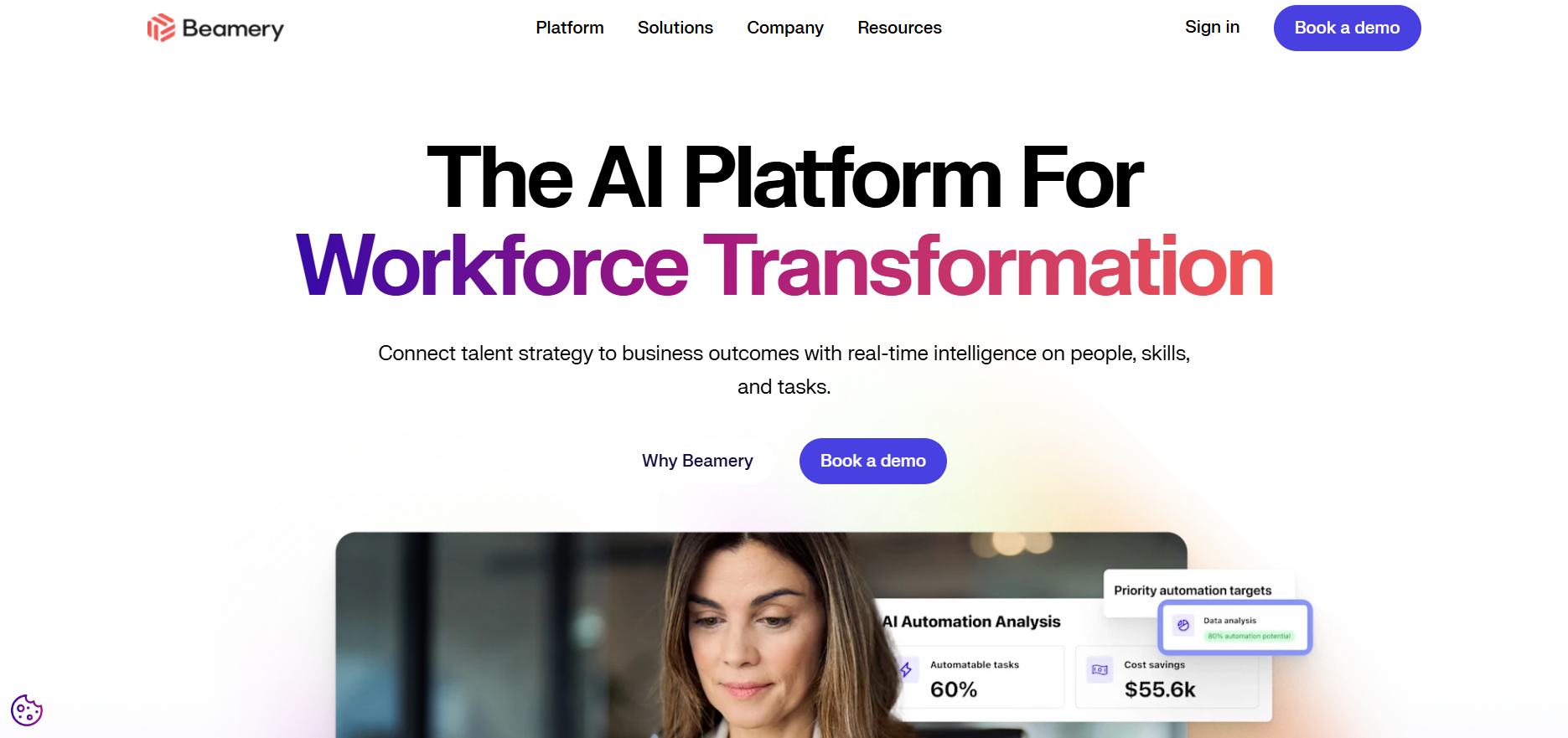
Beamery is an AI talent platform built around a unified data layer covering skills, roles, people, and labour market information. It combines a Talent CRM for pipeline and engagement management with workforce intelligence for scenario modelling and talent risk analysis.
Key features
- Talent CRM: Manages candidate pipelines and engagement across the talent lifecycle, so teams hold relationships with talent pools between openings.
- Skills Intelligence: Converts job descriptions and unstructured data into structured skills frameworks, so candidate-to-role matching runs on skills instead of titles.
- Data platform: Unifies fragmented skills, role, people, and market data into one source of truth for workforce decisions.
- Talent market insights: Supplies external supply and demand data on skills, so sourcing strategy reflects real market availability.
Best for: Large employers building long-horizon talent communities and internal mobility programmes, where the relationship being managed is with a future employee.
Pricing: Custom
SAP SuccessFactors
SAP SuccessFactors Recruiting is the recruiting solution within the SAP SuccessFactors human capital management suite. It combines Recruiting Management with Career Site Builder for recruitment marketing and candidate attraction. Candidate relationship management is built in for nurturing passive talent. Recruiting data connects natively to onboarding, performance, learning, and workforce planning modules across the wider suite.
Key features
- Recruiting Management: Covers requisition creation and approval through offer and background checks, so internal hiring runs under one governed process.
- Candidate relationship management: Nurtures passive candidates for hard-to-fill and critical roles, so pipelines exist before the role opens.
- Career Site Builder: Delivers job publishing, search optimisation, and talent communities, so employer brand and sourcing operate from one hosted site.
- Advanced analytics: Reports across sources, locations, brands, and job categories from first visit through hire, giving full line-of-sight on recruiting data.
- Suite integration: Connects recruiting to onboarding, performance, and workforce planning, so hiring data carries into the employee lifecycle.
Best for: Global employers standardizing internal hiring inside an existing SAP environment where recruiting is one stage of an employee lifecycle.
Pricing: Custom
SmartRecruiters
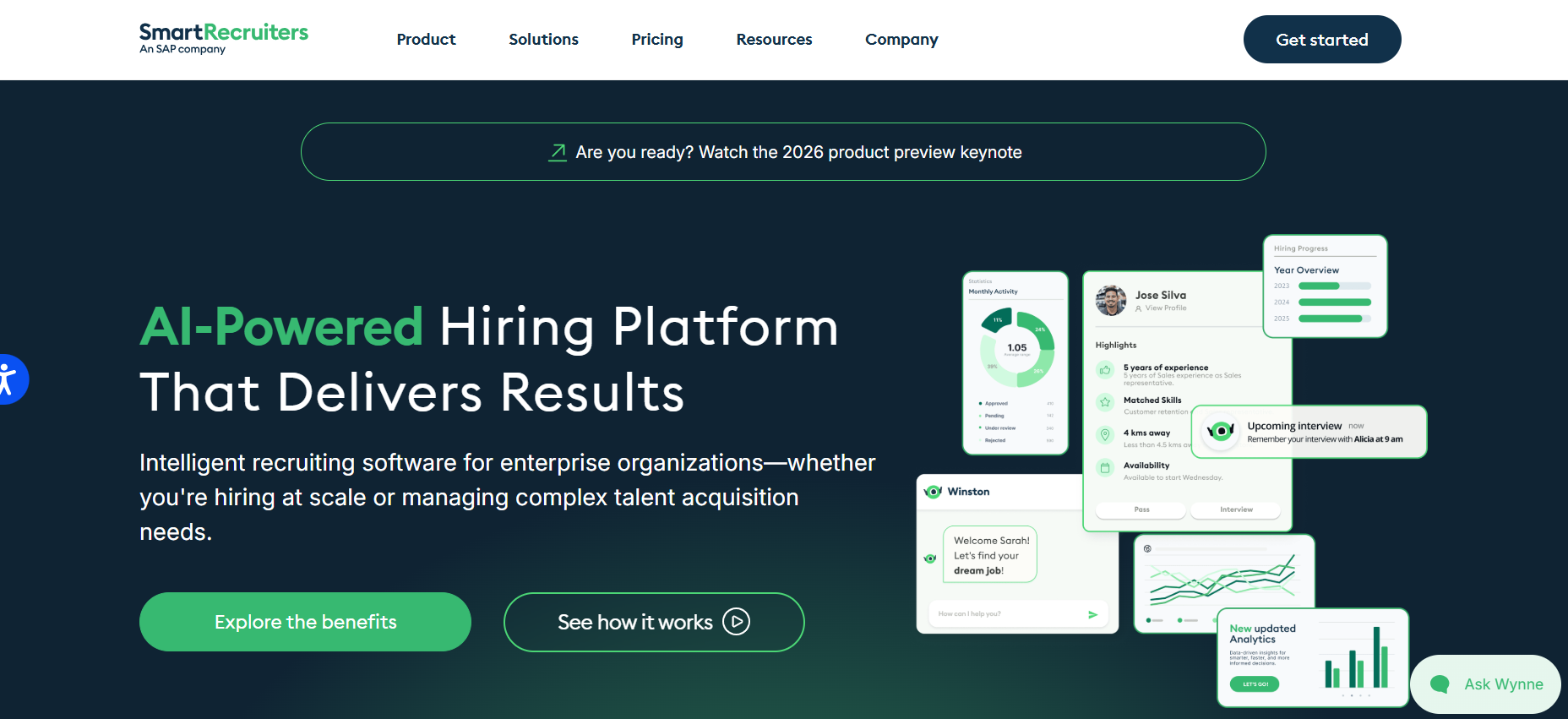
SmartRecruiters is a talent acquisition platform structured around three phases of hiring. Attract covers job distribution, a recruitment CRM, conversational AI chat, and text recruiting. Select covers the applicant tracking system, an AI talent matching engine, AI-powered candidate screening, and dynamic scheduling. Hire covers offer management, an AI hiring agent, analytics, and new hire onboarding.
Key features
- Recruitment CRM: Manages candidate relationships and pipeline ahead of an open role, so sourcing does not restart every time a role is approved.
- AI talent matching engine: Matches candidates to open positions automatically, so recruiters review a ranked shortlist instead of a full applicant list.
- AI-powered screening: Evaluates applicants using machine learning against role criteria, reducing manual review at high application volume.
- Dynamic scheduling: Automates interview calendar coordination, so hiring moves forward without recruiters brokering availability.
- Winston Intelligence: An AI layer across attract, select, and hire that anticipates needs and reduces administrative work for the hiring team.
Best for: Midmarket and large employers hiring into their own headcount who want a modern applicant tracking system with an upgrade path into AI features.
Pricing: SmartRecruiters offers four plans. Essential starts at $14,995 and includes ATS, CRM, onboarding, messaging, job distribution, and scheduling. Professional, High Volume, and Complete are quote-based, adding AI hiring, talent matching, AI screening, conversational AI, advanced analytics, and enterprise features for larger hiring organizations.
Lever
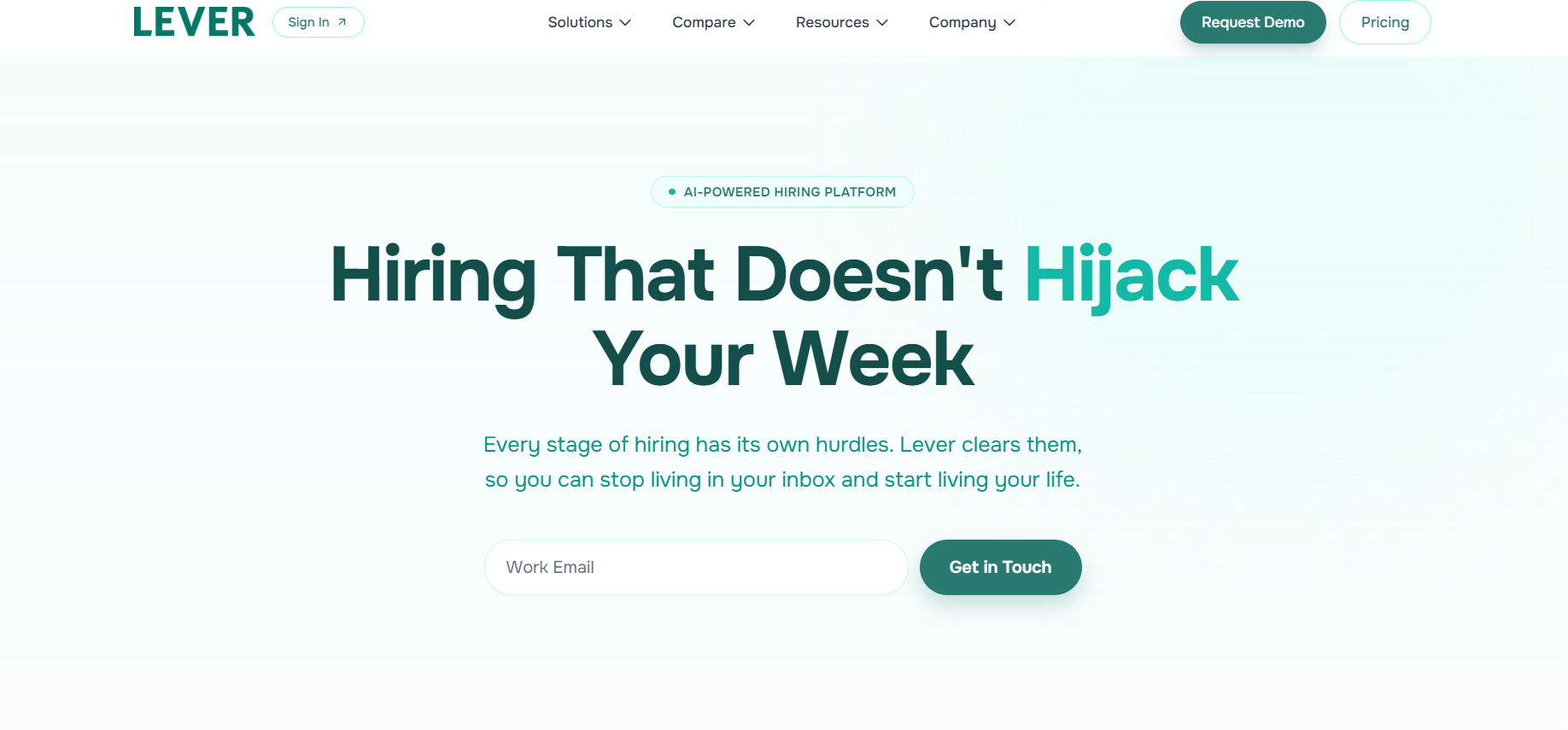
Lever is a talent acquisition suite combining applicant tracking and candidate relationship management in one platform. The applicant tracking system centralizes sourcing, applications, interviews, and candidate management, while the CRM nurtures passive candidates and re-engages past applicants through automated sequences.
Key features
- Unified applicant tracking and CRM: Inbound applicants and passive pipelines run in one system, so recruiters nurture and process talent without switching tools.
- AI-powered screening: Ranks applicants by fit score within seconds, so best-fit candidates surface first at high application volume.
- Candidate insights: Supplies context alongside recommendations, including experience matches and leadership signals, so recruiters understand why a candidate ranked.
- Interview scheduling: Coordinates calendars and sends invites to multiple interviewers at once, removing the coordination load from recruiters.
Best for: Growth-stage employers that value interviewer collaboration and structured internal hiring over commercial pipeline economics.
Pricing: Custom
iCIMS
iCIMS is a modular talent acquisition platform for large hiring environments. Coalesce AI supports candidate matching, personalisation, career path connections, and bias-mitigated decisions. The platform connects to more than 800 partner systems and job boards with multi-language and global compliance support.
Key features
- iCIMS Hire: A highly configurable applicant tracking system with text recruiting and onboarding, so large teams run structured hiring at scale.
- iCIMS Engage: Builds automated sourcing and nurture campaigns, so candidate relationships are maintained across the pipeline without manual outreach.
- Coalesce AI: Handles candidate matching, personalisation, and bias-mitigated decisions, so hiring accelerates while the team retains control.
- Employer branding tools: Career site building, recruitment chatbots, and testimonial video, so attraction runs inside the same platform as tracking.
Best for: Large employers that need structured, auditable internal hiring across many regions and business units.
Pricing: Custom
Eightfold
Eightfold is an AI talent acquisition platform built on skills-based matching. Teams source, interview, and extend offers on one platform, supported by talent insights and analytics that provide a full view of internal talent.
Key features
- Skills-based matching: Evaluates candidates on competencies using multi-modal models, so hiring decisions look beyond resume keywords and job titles.
- Talent rediscovery: Surfaces qualified internal and previously engaged candidates for open roles, activating talent the business already acquired.
- AI Interviewer: Conducts bias-conscious interviews at scale around the clock, so screening capacity is decoupled from recruiter availability.
- 360 Interview: Collapses multi-round evaluation into one session, compressing the assessment stage while keeping it structured.
Best for: Businesses running skills-based matching at scale that already have a settled system of record underneath it.
Pricing: Custom
Bullhorn
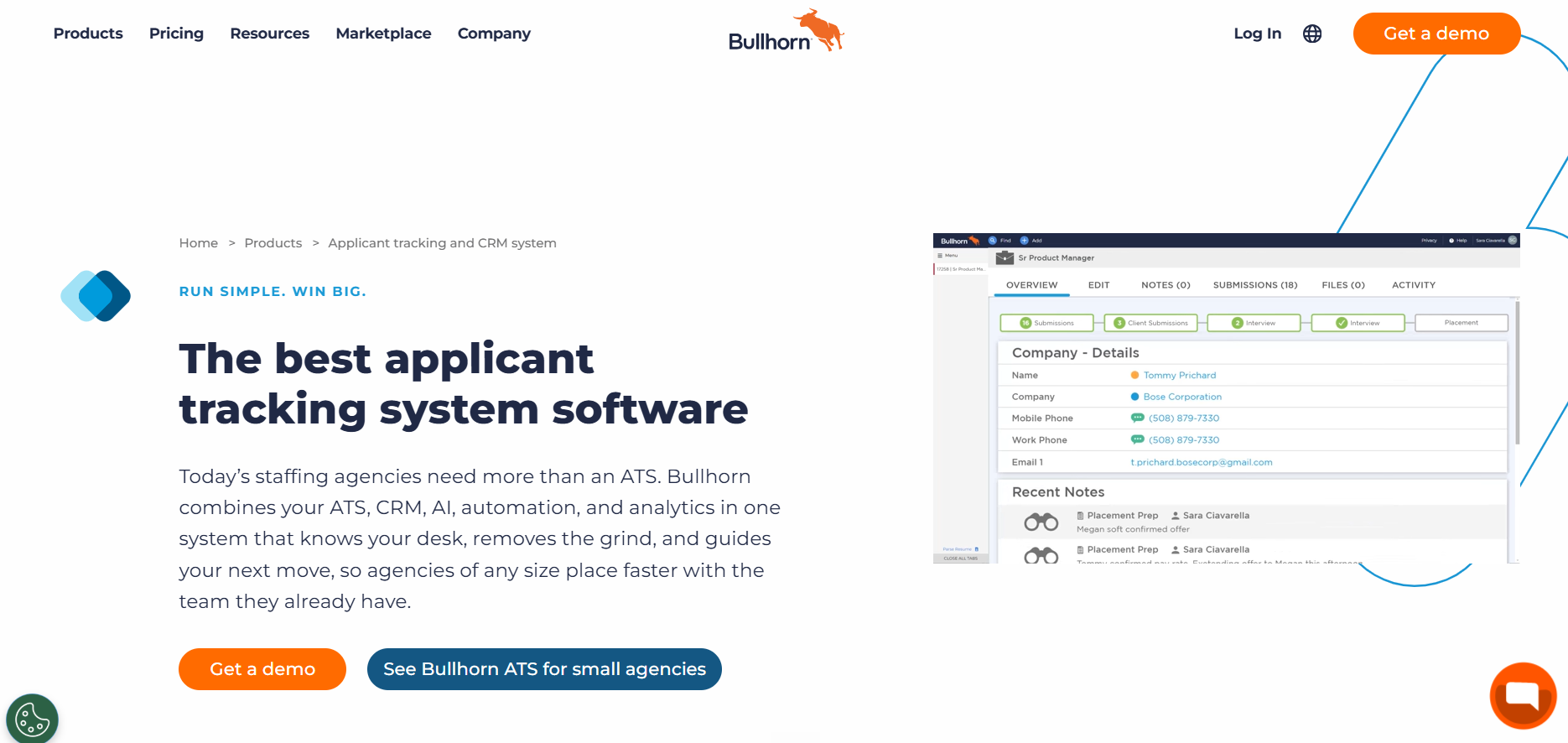
Bullhorn is an applicant tracking system and CRM built for staffing and recruiting firms. Candidates, jobs, shifts, and clients are managed in one platform, with CRM functionality covering client relationships and business development. Email integration, workflow automation, mobile access, and reporting complete the front-office stack.
Key features
- Unified candidate and client management: Candidates, jobs, shifts, and clients sit in one platform, so recruiters and account managers work the same records.
- AI Search and Match: Ranks database candidates by fit and auto-builds Boolean strings from job descriptions, cutting search time on every requirement.
- Amplify recruitment AI: Drafts job postings, interview questions, and candidate summaries from prebuilt prompts, reducing writing work per requirement.
- Email integration: Two-way Gmail and Outlook sync parses resumes and creates notes and tasks from email, so activity is captured where it happens.
Best for: Agencies that want a staffing-native system of record and are prepared to assemble the rest of the stack around it.
Pricing: Bullhorn offers tiered pricing for small agencies, with Starter at $99/user/month and Core at $165/user/month. Pro, Max, enterprise, AI, and Recruitment Cloud plans are quote-based. Pricing scales by agency size and required AI, automation, CRM, workforce management, and Salesforce capabilities.
Ashby
Ashby is an all-in-one recruiting platform combining applicant tracking, CRM and sourcing, scheduling, and analytics in a single system. It supports structured hiring end-to-end, with automation configurable between each stage of the process. Advanced recruiting analytics and custom reporting run natively on the same data as the workflow.
Key features
- Applicant tracking: Manages the candidate pipeline and hiring workflow across every stage, so hiring runs on one structured process.
- CRM and sourcing: Combines relationship management and outbound sourcing in the same system, so pipelines persist between open roles.
- Advanced analytics: Custom reporting on hiring metrics runs on live workflow data, so drop-off by source and stage is visible without exports.
- Scheduling: Automates interview coordination between candidates and hiring teams, removing calendar work from the recruiter's day.
Best for: Internal recruiting teams that manage hiring by the numbers and want that reporting depth built in.
Pricing: Ashby offers a Foundations plan starting at $400/month for companies with up to 100 employees. Plus (101–1,000 employees) and Enterprise (1,000+ employees) are custom-priced based on company size, usage, and commitment. Ashby Analytics for existing ATS users is also quote-based and priced by usage.
Workable
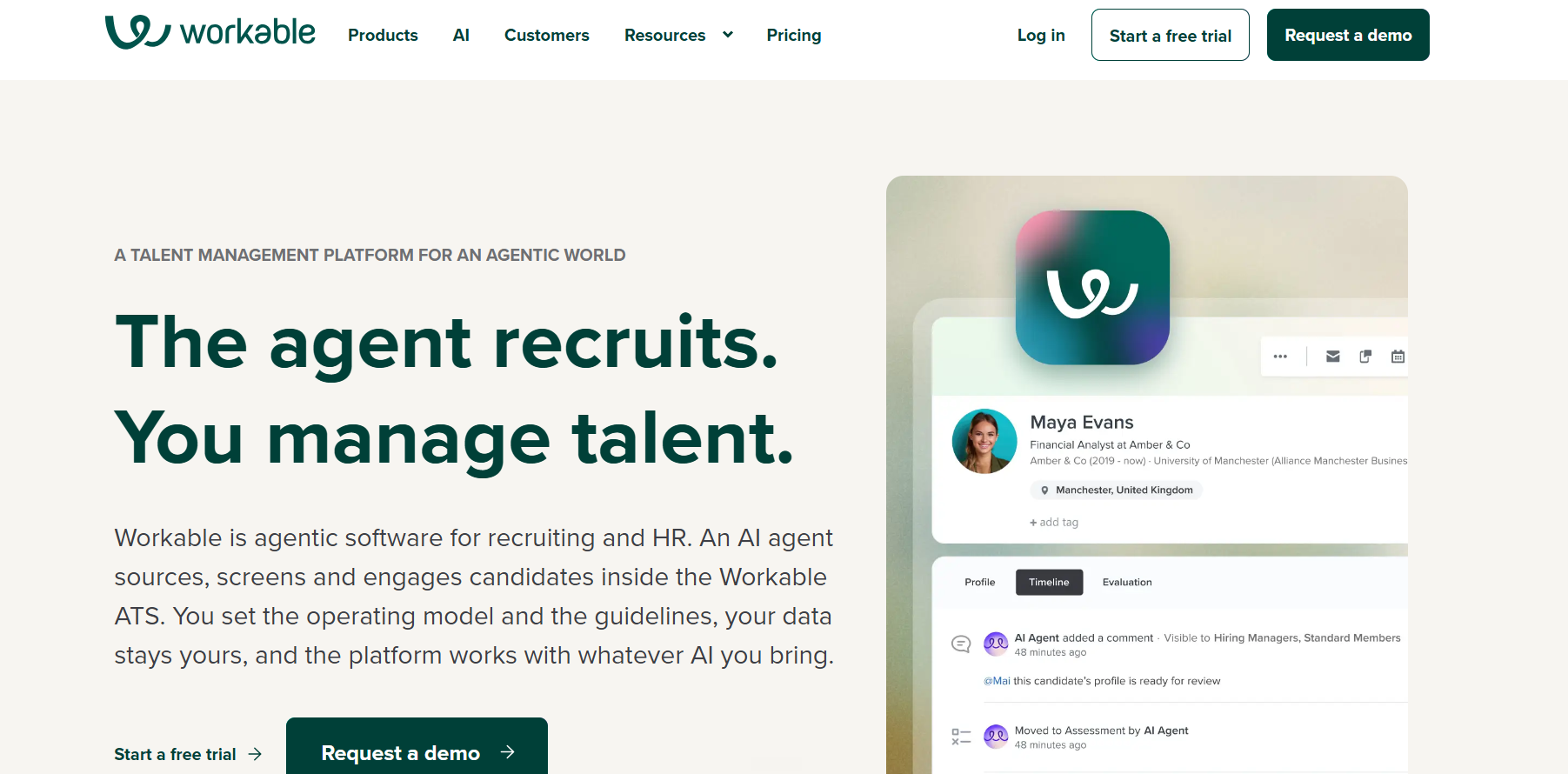
Workable is a hiring and employee management platform combining an applicant tracking system, a talent CRM, and an AI recruiting agent. The agent searches more than 400 million profiles, screens applicants against job criteria, and builds scored shortlists with transparent reasoning.
Key features
- AI recruiting agent: Sources from 400 million profiles, screens against job criteria, and scores shortlists with transparent reasoning, so small teams cover more ground.
- Job board distribution: Publishes to more than 200 job boards and social platforms across 100 countries from one posting action.
- Talent CRM: Centralizes candidate profiles with searchable filters and pipeline management, so past applicants stay reachable for future roles.
- Evaluation tools: Customizable interview kits, scorecards, and assessments standardize hiring decisions across everyone involved.
- Requisition management: Multi-level approvals, budget controls, and compensation benchmarking keep hiring inside agreed limits.
Best for: Small internal hiring teams that need a working system immediately, with the understanding that it is a starting point.
Pricing: Workable offers three annual plans: Standard from $360/month ($4,320/year), Premier from $599/month ($7,188/year), and Enterprise from $719/month ($8,628/year). All plans include recruiting and HR tools, while higher tiers add texting, video interviews, assessments, referrals, and enterprise features.
Why Staffing Firms Outgrow Generic Recruiting CRM Software
Generic recruiting CRM software solves many of the challenges involved in corporate hiring. Staffing firms, however, manage a two-sided business where candidate relationships have to stay connected to clients, job orders, and placements.
1. Candidate Engagement Alone Does Not Create Placement Readiness
A candidate can be fully engaged and still miss the following:
- Availability, because the notice period runs past the client's start date.
- Rate, because their expected number is above what this client has ever approved.
- Client alignment, because this account rejected a similar profile last quarter.
- Clearance, because background or credentialing has not been completed.
According to 2026 Gartner HR Research, 48% of candidates accepted their most recent job offer in 4Q25, down from 54% a year earlier and 85% two years earlier.
Placement readiness comes from reading engagement against live job requirements, client expectations, availability, prior placements, and recruiter judgment. A platform that measures only the first one is reporting on a fraction of the decision.
2. Disconnected Tools Make Recruiters Rebuild Context Manually
Most staffing firms add tools as new needs appear, and over time, recruiters become the integration layer. They switch between systems, search for missing information, and rebuild the context needed for every submission.
- Recruiters spend a meaningful share of the day reconstructing a full picture that no system holds.
- Candidate records stay incomplete, because logging the same interaction in three places is work nobody sustains.
- Relationship history becomes unreliable, which is the point at which recruiters stop trusting the database and start trusting their memory.
The last consequence is the expensive one. Once the team works from memory, the firm's institutional knowledge lives in people, and every departure removes a piece of it permanently.
3. Admins Need Configurable Workflows Without Parallel Systems
Admins need configuration because recruiting processes change faster than release cycles. Clients add approval steps, new practice areas need different pipeline stages, and compliance requirements shift.
A platform absorbs those changes when the people who run the desk can make them:
- Workflow templates that attach automatically based on job or client criteria.
- User-defined stages that reflect how each desk actually operates.
- Permissions granular enough to control rate and margin visibility by role.
- Approval flows that route without manual follow-up.
- Data quality controls that hold as volume increases.
- Reporting that adjusts when the workflow does.
When a platform cannot absorb a change, the change happens anyway, in a spreadsheet beside the system. The parallel system starts as a workaround and becomes the record of truth for whatever the platform could not hold.
A recruiting application built on Salesforce lets admins work from an architecture the business already governs, using the same tooling and the same permission model as the rest of the org, which is what keeps the workaround from being necessary in the first place.
4. Executives Need Pipeline Data They Can Tie To Margin And Growth
Pipeline data becomes executive data at the moment it connects to money. Placement volume, recruiter productivity, gross profit, client coverage, redeployment rate, and revenue by team.
Producing these numbers takes a week, involves exports from two systems, and arrives with caveats attached, which means the decision was already made on an estimate.
A leader who cannot see gross profit by recruiter in real time cannot reallocate coverage mid-quarter, cannot identify which desks are trading margin for volume, and cannot forecast with confidence.
Where Asymbl Fits For Salesforce-Based Staffing Firms
Asymbl Recruiter Suite was built for staffing firms that want Talent Relationship Management to run inside the same environment where the rest of the business already operates.
Recruiter Suite As Talent Relationship Management For Staffing
Recruiter Suite connects sales, recruiting, and talent into one operating environment, which removes the data divide that forces recruiters to reconstruct context manually:
- Job Management. Every requirement from open to filled, with workflow templates attaching automatically by criteria and multi-board posting from one record.
- Interview Management: Configurable templates and question guides, with structured feedback from everyone involved inside and outside the firm attached to the record.
- Offer and Placement: Offers tracked and placement outcomes recorded in the same system as the work, with revenue and gross profit visible by recruiter and team in real time.
- Contact Management: Candidate and client relationships held at the firm level, with segmented lists, in-platform email, and communication history captured automatically.
- Reporting and Administration: Placement and pipeline analytics, field-level access control, and approvals that route automatically.
Asymbl Intelligence As The Context Layer For Better Decisions
Asymbl Intelligence captures the judgment, context, pattern recognition, and signals that accumulate across every workflow and outcome, then makes that available to every human teammate and every digital worker on the platform.
Talent Intelligence is where staffing teams touch it directly. It reads pipeline history, interview feedback, assignment outcomes, and unstructured documents into a continuously improving model of fit, replaces Boolean syntax with natural language search, and surfaces talent across available, in-contact, and prior placement pools.
The third pool is the redeployment engine. Placement quality stops depending on who remembers what, which is the difference between a firm whose performance scales with its systems and one whose performance scales with its longest-tenured recruiters.
Digital Workers That Extend Recruiter Capacity With Governance
Digital workers absorb the repeatable parts of the recruiting cycle, including candidate identification, outreach at scale, interview scheduling, feedback summarization, and nurturing.
Asymbl treats digital workers the way it treats human hires. Each has a defined role, a human manager, measurable KPIs, guardrails on what it can and cannot do, and logged, auditable actions.
Asymbl's own two-person recruiting team ran 100 hires in 100 days, processing 17,000 applications, pre-screening 1,800 candidates, and scheduling 800 interviews. Across the function, Asymbl's five recruiting digital workers reclaim 21 hours a week for recruiters at a projected 26x return.
The Competitive Advantage of Connected Talent Data
Most software becomes less valuable as organizations become more complex. More recruiters create more records, more clients create more relationships, and more placements create more data to maintain.
Candidate management should work in the opposite direction:
- Every recruiter should make the platform better for the next recruiter
- Every client interaction should improve future searches
- Every placement should make redeployment easier
- Every interview should strengthen future candidate evaluations.
The objective is to build an operating system where every piece of work increases the value of everything that follows.
If your recruiters still rely on multiple systems to piece together candidate, client, and placement information, it may be time to rethink the foundation supporting your business. Book a demo to see how Asymbl unifies Recruiter Suite, Talent Intelligence, and AI-powered recruiting workflows.
FAQs
Candidate relationship management software centralizes candidate records, communication history, and engagement activity so a firm can build and maintain talent relationships continuously, between requirements as well as during them.
An applicant tracking system governs the workflow for candidates already moving toward a specific job, tracking stages, approvals, and compliance. Candidate relationship management software covers everyone else, including past applicants, prior placements, silver medalists, and passive talent the firm nurtures between requirements.
Staffing firms operate a two-sided market, matching client demand against talent supply, and the client side determines whether a candidate relationship converts to revenue. Recruiting CRM software holds both sides on one record, so recruiters submit with account context and leaders read pipeline against margin.
Look for pipeline views that carry context alongside status. Each candidate should show attached jobs, prior submissions by client, current availability, engagement history, and the owner of the next action. Teams should be able to define stages, layouts, and workflow templates without a development cycle, and admins should own that work directly.
Redeployment depends on knowing a contractor's availability before the assignment ends and reaching out from the last real conversation instead of a cold start. Engagement history supplies that continuity, including prior outreach, responses, client feedback, and assignment performance.
.webp)
AI Candidate Matching: From Rankings to Real Reasoning
Most AI resume matching reads documents without context. See how AI candidate matching changes with real signals

The Right Fit Starts With a Conversation.
See what working together could look like.
.webp)