
Every resume that reaches your firm turns into a record in your database. The quality of that record decides whether a recruiter can find the person again. Many staffing firms hold hundreds of thousands of records that recruiters can't search or re-engage. Recruiters lose trust in the database and go back to sourcing on LinkedIn.
Buyers usually compare resume parsing software on a single accuracy score, usually somewhere in the high nineties. The score shows how well a tool reads text off a page, and nearly every vendor does that well now. The harder job comes after extraction. A contractor's overlapping assignments have to become a record your recruiters can search, trust, and submit.
In this blog, we will look at where resume parsing still breaks and what weak records cost a staffing firm. We'll then walk through six checks to run before you buy and compare seven vendors against them.
Where Resume Parsing Still Struggles Today
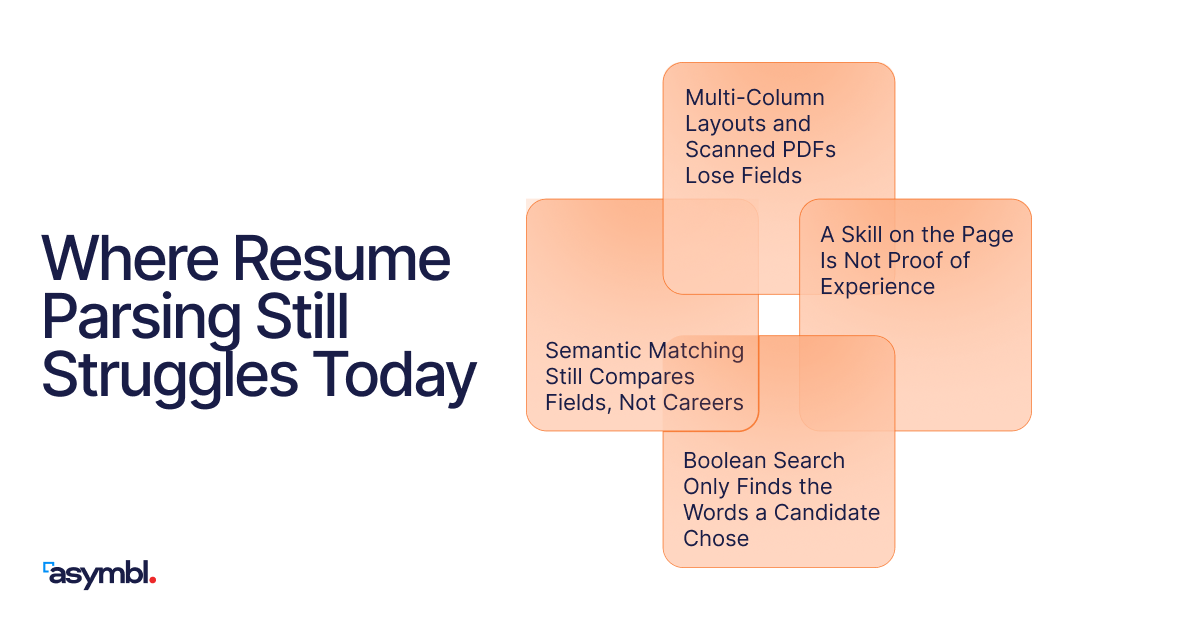
A parser can fail in two places:
- It can build the record badly
- It can build a good record that search never surfaces.
The first two problems below happen as the parser writes the record. The last two happen when a recruiter searches for it.
1. Multi-Column Layouts and Scanned PDFs Lose Fields
A typical parser expects to read a resume from top to bottom in a single column.
Sidebars, tables, and two-column designs break that order, so the parser skips some fields and merges others.
Scanned PDFs add a second problem. Optical character recognition (OCR) has to turn the image into text first, and small errors slip in, like "2019" becoming "2O19."
Staffing firms can't control the format talent sends. Templates vary by trade, by country, and by job board. The result is a database that looks complete while many records are missing skills and dates. Those gaps never appear in a report, since each record still counts toward your database size.
2. A Skill on the Page Is Not Proof of Experience
Finding the word "Python" on a resume is easy for any AI resume parsing software. Knowing what it means is harder. Six years of professional work and a weekend course look the same once they become a skill tag. According to 2026 Deloitte Global Human Capital Trends, 95% of executives are concerned about the accuracy of candidate skills data.
Recruiters feel the same doubt, so they open the original resume before sending a profile to a client. Each of those checks adds minutes to a submission the client is timing. A parser that only captures keywords leaves the hard judgment, and the delay, with your recruiter.
3. Boolean Search Only Finds the Words a Candidate Chose
Boolean search only returns a record when the resume uses the recruiter's exact words. A resume can parse perfectly and still never show up. Talent describes their work in their own language, while job orders use the client's language. A search for "ETL developer" (extract, transform, load) misses the person who wrote, "built and maintained data pipelines."
Even one skill can appear three ways, such as React, ReactJS, and React.js. Nothing warns the recruiter about these misses. Results also depend on who writes the best search strings, so quality varies from desk to desk. After enough empty searches, recruiters stop trusting the database and source externally instead.
4. Semantic Matching Still Compares Fields, Not Careers
Semantic search solves the vocabulary problem. It understands that "data pipelines" and "ETL developer" describe similar work. It still only compares resume fields with job fields, though. It can't see that a client passed on this person last year. It also misses the two contracts they finished early and the redeployment that followed with no gap.
Your best recruiter remembers those details, and none of them appear on the resume. Your firm already stores this history as pipeline activity and placement outcomes. Search that ignores it leaves the strongest predictor of a good placement out of the match.
What Weak Parsed Data Costs a Staffing Firm
Weak parsing costs a staffing firm money long before anyone checks an accuracy report. The cost shows up as empty searches, slow submissions, and clients who start calling other firms first. Five costs appear most often, starting at the recruiter's desk, reaching the client, and ending with compliance risk.
1. Talent Already on File Can Stay Hard to Find
When a record parses poorly, the search that should surface it comes back empty. Your firm then sources that person again and pays to acquire them twice. Nobody reports these misses, since an empty result looks like there was no one to find. The database keeps growing while the number of people recruiters can reach stays flat.
A redeployable contractor can finish an assignment and go unnoticed while your team posts the same job on a board. Leadership sees rising sourcing spend on talent the firm already has. Lost redeployment revenue never appears as its own line item, so the problem is easy to overlook.
2. Verification Time Slows the First Submission
Recruiters rarely trust a parsed record without checking it first. They fix the fields that parsed wrong. They also re-check the fields that parsed right, since there's no way to tell the difference without opening the resume. On a shared req, those minutes decide who gets paid.
The client often sends the same job to several firms, and the first strong submission usually wins. A competing firm can submit while your recruiter is still confirming a job title. Across a full desk, the checking adds up to hours every week. Faster parsing only pays off when recruiters trust the result enough to skip the double-check.
3. Duplicate Talent Records Split One Person's History
The same person often reaches your firm through several channels. A job board application, a referral, and a sourcing tool can create three records with different spellings and email addresses. Standard deduplication only catches exact matches, so these near-duplicates stay in the system.
A recruiter might then contact someone a colleague placed last month. Merging creates its own risk. A system that keeps only the newest record can erase the assignment history that made the person redeployable. Duplicates inside an applicant tracking system (ATS) also split interview notes across copies, so no single record tells the full story.
4. Client Hiring Managers Lose Confidence in Weak Shortlists
Client hiring managers judge your firm by the profiles you send. Parsing errors reach them as your mistakes. A title that doesn't match the work, or back-to-back contracts that read as job hopping, weakens the submission. A skill mentioned once and presented as expertise does the same. Two or three weak shortlists are often enough for a hiring manager to stop opening yours first.
When several firms work the same req, the client leans toward whoever submits clean, accurate profiles. Many clients are also cutting their vendor lists and expecting more for the same fee. Winning back a lost account costs far more than any parsing license.
5. Compliance Risk from Inconsistent Candidate Records
When recruiters build records differently from person to person, your firm struggles to explain how it screened anyone. Clients increasingly audit their staffing suppliers and ask that question directly. Parsers also pull in data you may not want, such as graduation years that can hint at age. Those details land in fields nobody decided to keep.
Every duplicate record adds its own retention timeline, which complicates data privacy requests. Explaining which field shaped a decision, and where that field came from, is hard to piece together after the fact. Firms that build an audit trail into the process from day one have a much easier answer.
How to Evaluate Resume Parsing Software Before You Buy
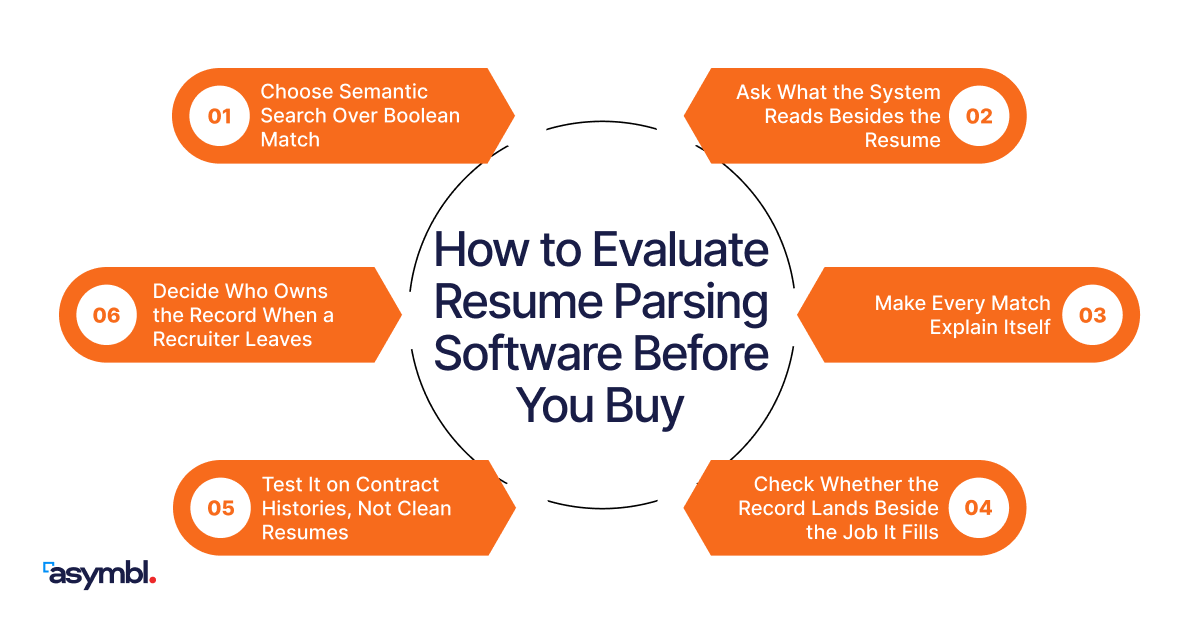
Every vendor quotes an accuracy score, and each score comes from the vendor's own test set. The numbers can't be compared, and they say little about what happens after extraction. The six checks below focus on how a parsed record performs once your recruiters start using it.
1. Choose Semantic Search Over Boolean Match
Strong search works the way recruiters talk. A recruiter should describe a role in plain language and get relevant people back, even with loose wording. The system should also recognize skill variants like React and ReactJS without any extra setup.
One practical test uses ten roles you filled last year. Written as plain sentences, those roles should return the people you actually placed. The same roles written as Boolean strings make a useful comparison. When plain-language search wins, search quality stops depending on which recruiter writes the best strings.
2. Ask What the System Reads Besides the Resume
A resume is one document, written by the person it describes. Your firm knows far more about that person than the resume shows. Pipeline history, interview feedback, assignment outcomes, and recruiter notes build up on every desk. Much of it goes unused once a placement closes.
A system that reads only parsed fields can judge the document. A system that also reads your firm's history can judge the person, including how they performed for your clients. Many vendors answer this question by talking about better extraction. Their answer shows how far the product goes past the parser.
3. Make Every Match Explain Itself
A match score on its own gives a recruiter very little to work with. Recruiters need to see why the person fits, requirement by requirement. The breakdown gives them a clear case to make to the client. Each parsed value should also link to its source text on the resume, so recruiters can check it in seconds.
Explainable AI candidate matching also gives your compliance team a record of why someone ranked where they did. The concern goes well beyond recruiting. According to the 2026 Deloitte State of AI in the Enterprise, 46% of companies worry about AI model quality, consistency and explainability. Recruiters tend to ignore rankings they can't question.
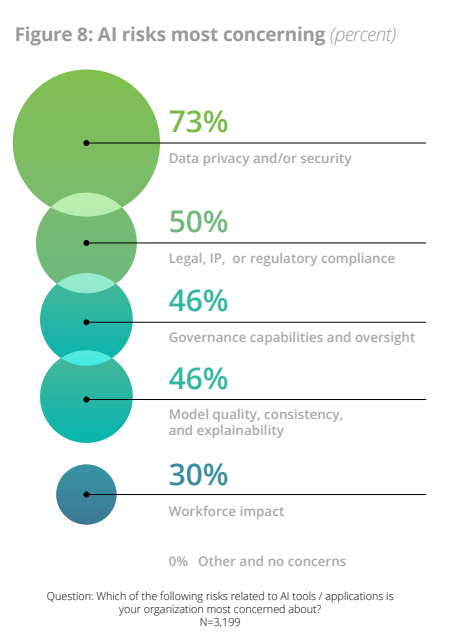
Source: 2026 Deloitte State of AI in the Enterprise
4. Check Whether the Record Lands Beside the Job It Fills
A parsed record is most useful when it lives in the same system as the job order it could fill. Talent, job orders, pipeline activity, and client data work best when your ATS and CRM are connected in one environment, under one security model. Many firms instead run separate tools connected by middleware and overnight syncs.
According to the 2025 IBM CEO Study, half of CEOs say rapid investment left them with disconnected, piecemeal technology. A recruiter can then fix a title in the ATS while the matching tool still searches yesterday's version.
Software upgrades can also break the connections between tools. Keeping them running takes engineering hours that never appear in the license quote.
5. Test It on Contract Histories, Not Clean Resumes
Vendor demos usually run on clean, single-column resumes. Your intake looks different, especially on a contract desk. The most useful test set is a hundred of your own resumes. It should include long contract histories, overlapping assignments, career breaks, and scanned files.
A strong resume parser keeps each employer, title, and date together as one unit. It also leaves a field blank when the information is missing. Some parsers fill gaps with plausible guesses, which is worse than a blank since nobody thinks to check them. Bulk resume parsing should also hold up at your Monday intake peak, when volume is highest.
6. Decide Who Owns the Record When a Recruiter Leaves
Parsed records only build value if they stay with your firm. Some systems store relationships and history at the recruiter level. When that recruiter resigns, much of what they knew leaves with them.
Firm-level ownership keeps every record, note, and relationship in place for the next recruiter. The same principle applies to any AI trained on your data. A model that learns from your pipeline, feedback, and outcomes should belong to your firm.
According to the 2025 IBM CDO Study, 78% of data leaders call using proprietary data a top strategic objective for differentiation. Owning your records lets your database grow more valuable every year.
Best Resume Parsing Software Platforms
The seven resume parsing tools below come up most often when staffing firms shortlist software for parsing and matching.
Six are full staffing systems, and one is a specialist parser that works inside the ATS you already run. Rule-based and AI parsing are combined in most of them, so extraction alone rarely separates them. The bigger differences show up in search, matching, and where the parsed record ends up.
1. TargetRecruit
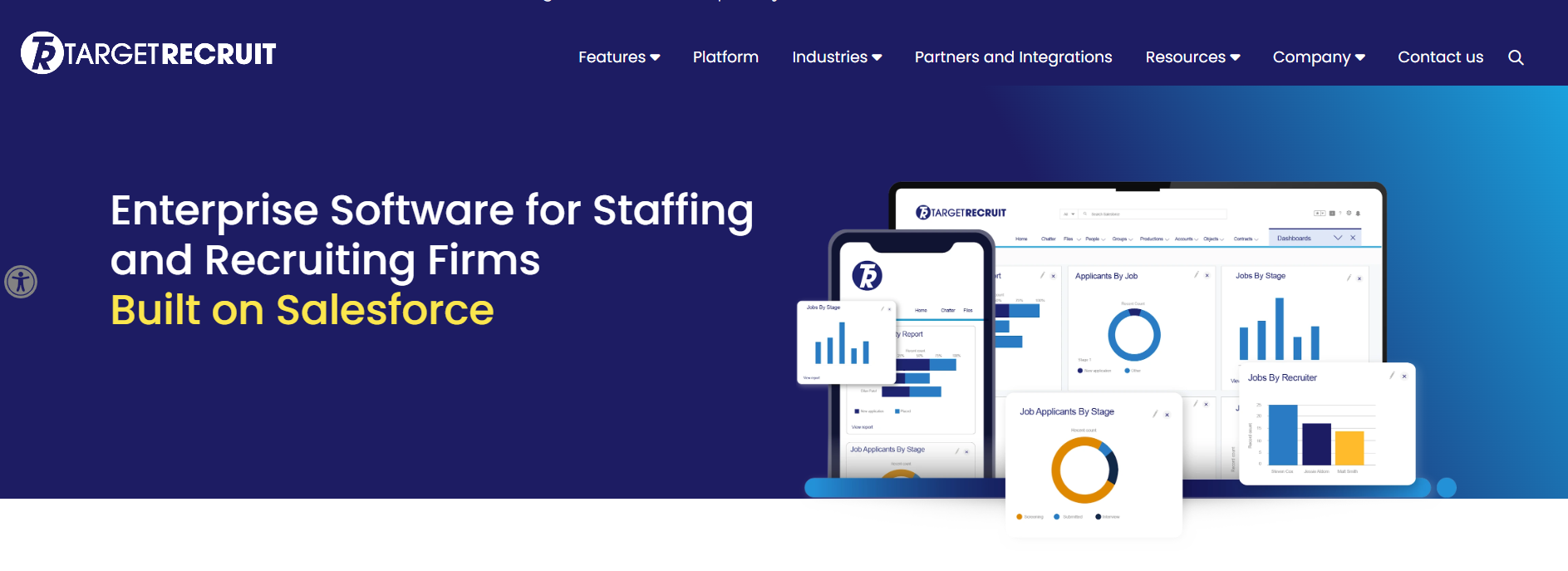
TargetRecruit is an ATS and staffing software suite built on Salesforce. It covers front-office, middle-office, and back-office work for staffing and recruiting firms in one system. Recruiters use it to source, engage, and place talent and to manage client relationships. Back-office tools handle pay and billing once a placement starts. It serves commercial, professional, and healthcare staffing firms. Its TR Intelligence suite adds AI assistants and copilot tools to recruiter workflows.
Note: Bullhorn acquired TargetRecruit in August 2025 and says it will continue to support existing TargetRecruit offerings.
Key features:
- Resume parsing: Parsed resumes automatically update employment and education history fields on the job applicant record. Recruiters stop retyping work history manually for each new resume.
- Duplicate detection: The system scans each uploaded or parsed resume against the talent pool. If the person already exists, it updates that existing record.
- Quick Review search: Recruiters filter talent search results with custom filters and view resumes in a formatted or keyword-highlighted display. Admins can configure the page layout.
- Copilot resume summaries: Copilot summarizes resumes and builds talent summaries that map qualifications against the job description. It also generates tailored interview questions from job history.
- AI shortlisting: TR Intelligence reviews applicant profiles against your criteria and generates a recommended shortlist. With approval, it emails shortlisted talent available interview slots.
TargetRecruit keeps talent, job orders, and clients in one system under one security model. Parsed records land right next to the jobs they could fill. For extraction, it works with Daxtra, a specialist provider of resume extraction software.
The fit is strongest for firms whose sales, recruiting, and operations teams already share one CRM.
Matching is the area to look at closely. Automatch works from preferences your recruiters set, and TR Intelligence shortlists against criteria you define. Its published material doesn't describe learning from placement or assignment outcomes. Firms that rely on redeployment will want to know how past results shape future rankings.
2. Asymbl
Asymbl is The Workforce Orchestration Company™. It brings people, AI, and software together as one hybrid workforce for staffing and recruiting firms. Its software is built around how staffing firms find, match, and place talent.
Recruiter Suite is its modern recruitment platform that combines ATS capabilities with sourcing, candidate relationship management (CRM), automation, analytics, and AI. Talent Intelligence parses resumes and matches talent to open jobs. Rosa, a Digital Recruiter, is a pre-built AI digital worker with a defined job to be done, working alongside your recruiters. Every Asymbl product runs on Asymbl Intelligence, which makes a firm's data usable across its systems.
Key features:
- Resume and job parsing: Talent Intelligence automates talent profile creation from resumes and job descriptions. Batch processing handles high-volume intake automatically, so recruiters skip manual data entry.
- Natural language search: Recruiters search for talent in plain language, with type-ahead suggestions, faceted filters, and reusable queries. Relevant results surface even when the search is imprecise.
- AI matching engine: A reasoning engine evaluates talent on fit, likelihood, and confidence, the way a recruiter would, rather than with a percent match score. Matches draw on interview history, placement outcomes, and client feedback, and each one shows how the talent's qualifications map to what the role demands.
- Bias flags and audit trail: Talent Intelligence flags biased terms before a search runs and asks the recruiter to refine the query. It captures each full query, so you have an audit trail of every search and how it changed.
- Rosa's application screening: Rosa scores inbound applications against job criteria using Talent Intelligence. The strongest talent surfaces for recruiter review.
Asymbl focuses on what happens after a resume is parsed. Recruiter Suite connects your ATS and CRM, so each talent record sits next to the job orders, pipelines, and clients it relates to. Relationships stay at the firm level, not the recruiter level. Talent Intelligence then matches against what your firm already knows about each person. Rosa screens inbound applications inside the same system.
Every application gets a response, and every strong candidate gets seen. The best fit is a firm whose parsing already works and whose submissions are still too slow.
3. Avionté
Avionté is staffing software for high-volume staffing agencies. It connects front-office and back-office work in one shared system of record. Recruiters and sales teams use it to win clients, fill job orders, and place temporary and contract talent. Back-office teams use the same system for time capture, payroll, and client billing. It supports light industrial, clerical, healthcare, and professional staffing firms. Agencies ranging from boutique firms to multi-branch businesses use Avionté to run the full placement lifecycle.
Key features:
- Resume Parsing: Avionté automatically parses uploaded or received resumes into structured talent profiles. It stores skills, work history, and experience in standardized fields for recruiting and onboarding workflows.
- AI Auto Matching and Talent Rediscovery: The AI Matching Agent scans the talent database and surfaces top-fit people, with a match reason for each one. Recruiters can adjust how skills, location, and pay are weighted.
- Avionté PIXEL: This AI-enhanced messaging app runs 24/7 pre-screening interviews and scores web applicants. It schedules live recruiter interviews based on pass/fail results.
- Time Capture to Payroll: Time capture connects directly to payroll, so hours flow from timesheets into pay runs. It supports hourly, salary, temp, contract, shift-based, and blended rate pay models.
- Client Invoicing: Avionté generates client-specific invoices from approved time, rates, and custom billing rules. Placement data feeds payroll and billing without switching systems.
Avionté carries the parsed record past the submission into time capture, payroll, and client billing. It suits high-volume light industrial, clerical, and healthcare desks best. Firms placing large contingent workforces get one system from job order to payroll, including multi-state tax filing.
Its AI Matching Agent ranks existing talent for each open job and shows why each person was selected, so recruiters can rediscover people already on file. Recruiters can weight skills, location, and pay. For firms that redeploy heavily, the open question is whether assignment performance and client feedback count too.
4. Bullhorn
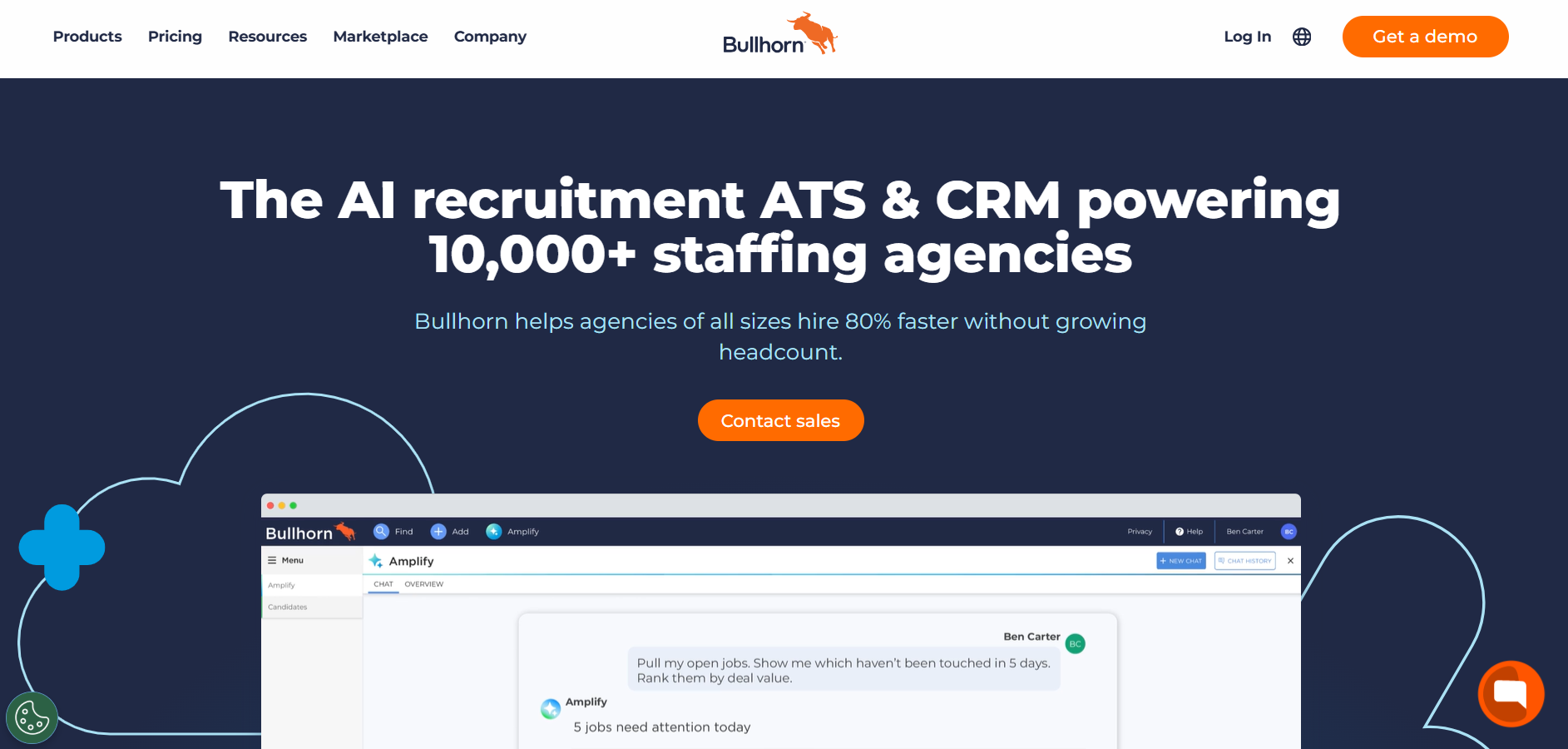
Bullhorn is recruitment software built for staffing and recruiting agencies. It combines an ATS and a CRM in one cloud product. Recruiters use it to track talent, client contacts, and job orders in a single database.
Bullhorn works with agencies of every size across professional staffing, healthcare, and executive search. More than 10,000 companies use the software worldwide. In 2024, Bullhorn acquired Textkernel, an Amsterdam-based developer of AI parsing software. Bullhorn is adding Textkernel technology to its ATS parser for all customers throughout 2026.
Key features:
- Automatic resume parsing: Resumes sent to a designated Bullhorn inbox become talent records automatically. An existing email address updates the matching record, so recruiters avoid duplicate profiles.
- Textkernel-powered parser: The updated parser reads scanned files, multi-column layouts, and 29 languages. Bullhorn reports that it captures up to 40% more skills from each resume.
- Two-way search and match: Textkernel by Bullhorn matches talent to jobs and jobs to talent. Recruiters can search in natural language.
- Recruitment automation: Bullhorn Automation sends personalized email, text message (SMS), and chat outreach, books interviews, and automates talent consent for privacy compliance.
- ATS and CRM in one system: Recruiters manage talent, jobs, shifts, and clients together, with reporting and analytics on performance. A marketplace of 300+ pre-connected partners extends the stack.
Many staffing firms use Bullhorn's parser without ever choosing it, since it comes with the ATS. Its ATS resume parser writes straight into records already tied to job orders and pipelines. The Textkernel rollout adds specialist parsing technology, with particular strength on skills and non-English resumes.
Firms that need CV parsing software across several countries gain the most from that change. Bullhorn also suits firms that want one vendor and no separate connection project. Cost deserves attention early.
AI search and match, real-time analytics, and Amplify Chat come in the Pro tier and above, so firms on the Core tier need to upgrade to get them. Records parsed before the rollout keep their old fields until someone re-parses them.
5. Ceipal
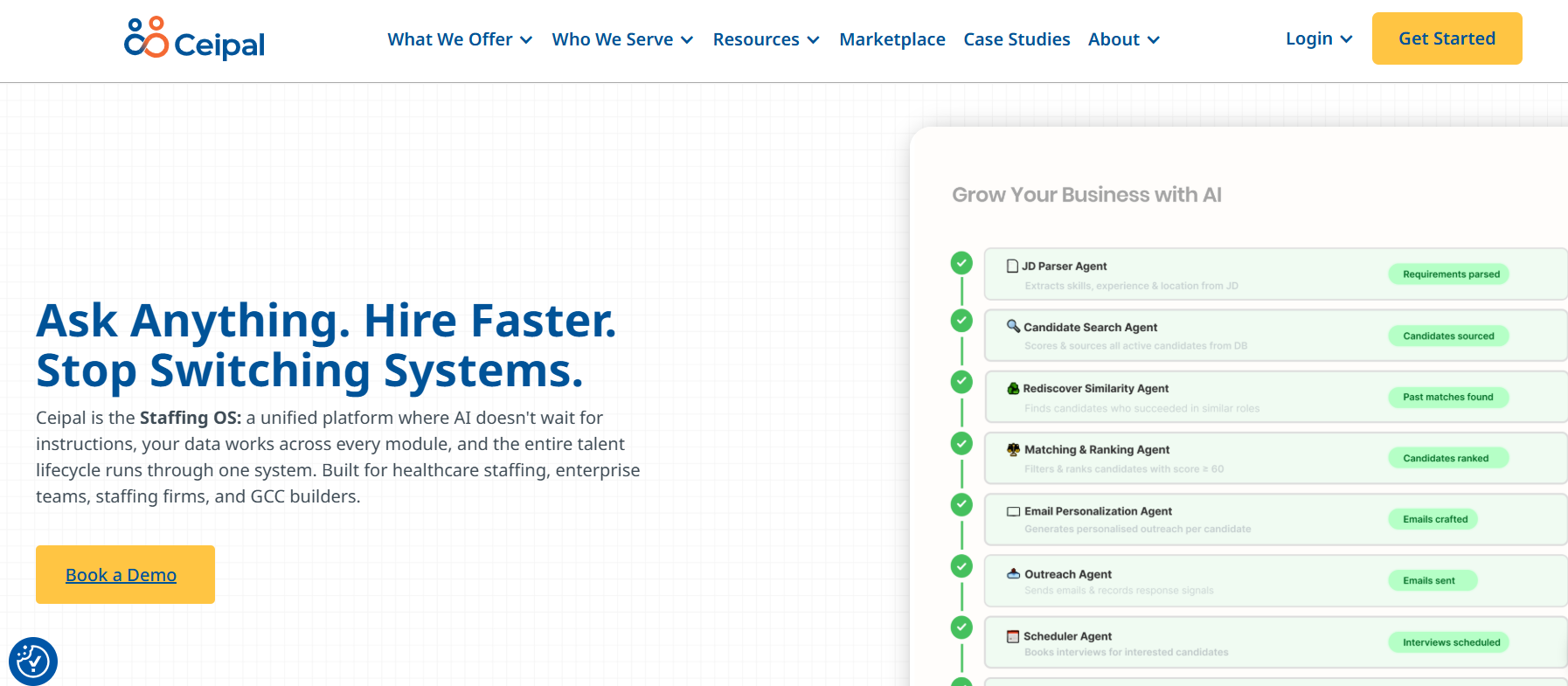
Ceipal is an AI-powered talent platform built for staffing firms and corporate hiring teams. It combines an ATS, a VMS, and workforce management in one product. Staffing agencies use it to source, match, and place talent across IT, general, and healthcare staffing.
Ceipal also supports corporate recruiting teams and companies building global capability centers. Recruiters and workforce teams work from one shared data set across every module. The company markets it as a staffing operating system for the full talent lifecycle.
Key features:
- AI resume parsing: Ceipal’s AI collects resumes from job boards and parses them automatically, keeping the talent database stocked.
- Candidate matching and ranking: AI recommends talent for each job requisition and ranks them by compatibility, so recruiters see the strongest fits first.
- Pre-submission AI scoring: Before every submission, Ceipal’sAI scores talent against job requirements for skills, experience, financial fit, and availability.
- Job board and portal connections: Ceipal connects to more than 50 job boards and VMS portals. Recruiters post a job across boards in one click.
- Talent Bench matching: Recruiters view vendor jobs under AI matching directly from the Talent Bench module. Folders organize bench consultant records for quick access.
Ceipal parses resumes pulled from job boards automatically, and a Gmail add-on handles bulk parsing. It fits best where contract placements run through VMS portals and managed service provider (MSP) programs. The ATS and VMS share one data set, so supplier activity and submissions stay on the same record.
Talent Bench keeps consultants between assignments visible for redeployment. Ceipal publishes less about how its match scores are explained. Firms placing contractors with overlapping assignments will want to see how a score breaks down. They'll also want to know whether past placement outcomes affect it.
6. Loxo
Loxo is an AI recruiting platform built for recruiting agencies, staffing firms, and executive search firms. It combines sourcing, outreach, relationship management, and applicant tracking in one system of record. Recruiters can search an 850-million-person talent graph that Loxo built itself, using plain-language queries.
The same workspace lets them find contact details, add prospects to pipelines, and launch outreach campaigns. Loxo markets it to growing firms that want their whole recruiting workflow in one tool.
Key features:
- Automatic resume parsing: Loxo extracts job titles, skills, and education from resumes into the system automatically. Recruiters skip manual data entry for each new resume.
- Natural Language Search: Recruiters search with plain text, Boolean strings, or filters. One search covers their private database and Loxo's talent graph, with semantic matches ranked first.
- Contact Info Finding Agent: This AI tool finds personal phone numbers and email addresses so recruiters can contact sourced talent directly.
- Loxo Outreach: Multi-stage email and SMS sequences send personalized messages with automated follow-ups. Outreach GPT drafts tailored messages from the job description and talent profile.
- Stage automations: Moving talent between configurable pipeline stages triggers client and talent communication, scheduling, outreach campaigns, and AI-assisted submittal summaries.
Loxo connects its recruitment CRM and parser to its own sourcing tools, so discovered talent and applicants share one pipeline. Executive search firms get the most value, along with firms whose main challenge is finding people.
Parsing a profile Loxo discovered is a different job from parsing resumes sent through your own job ads. For most staffing firms, the second group makes up most of the volume, especially during the Monday intake peak.
Loxo's product pages say little about how its parser handles long contract histories. Firms with large contract desks will want to confirm that before signing.
7. Daxtra
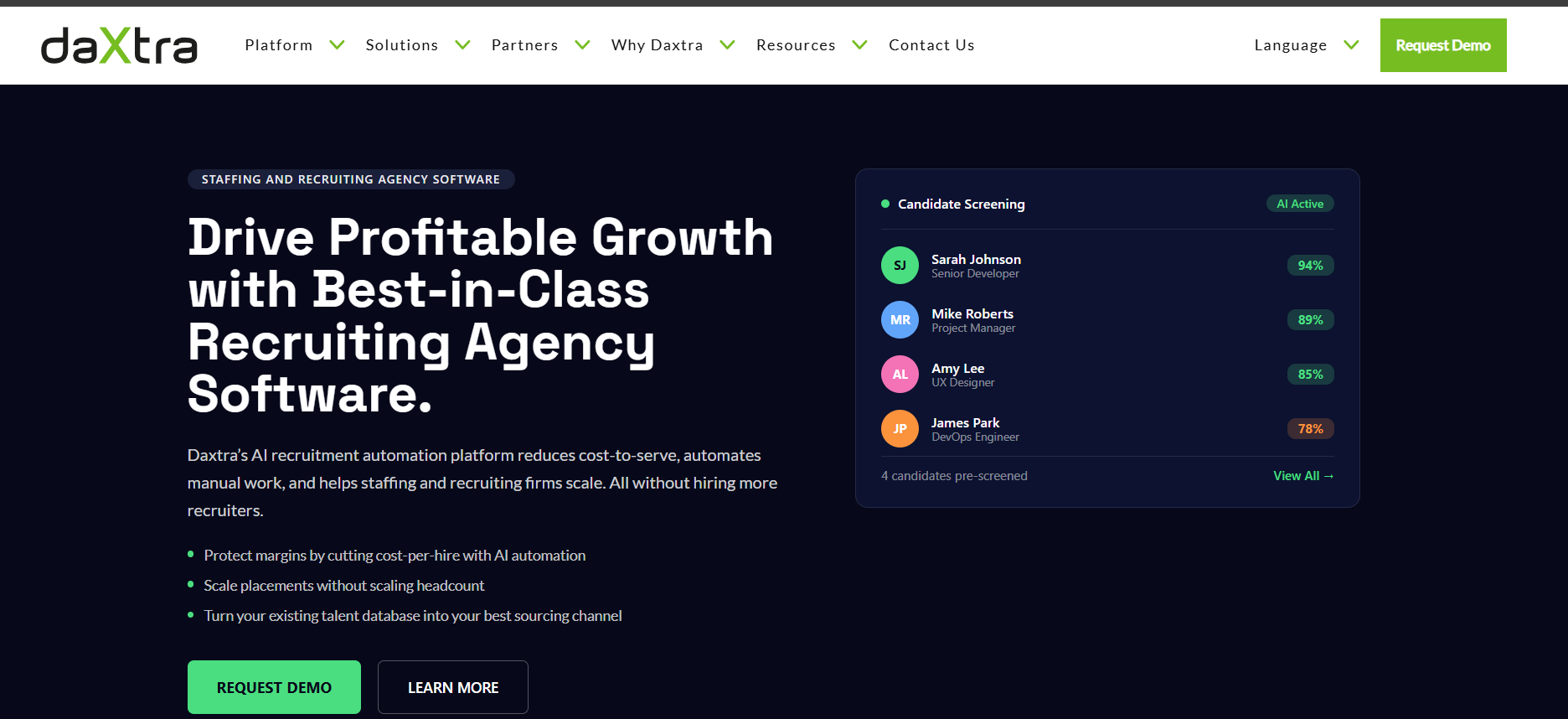
Daxtra is a resume parsing and search company built for staffing and recruiting firms. It parses more than 100 million resumes a month in 40+ languages. It sits beside your ATS instead of acting as one, and connects to it through 400+ ATS and CRM integrations, including Bullhorn. Staffing agencies and executive search firms use it to load, clean, and search the talent data they already hold.
Key features:
- Resume and job parsing: Daxtra Parser extracts more than 150 fields from each resume and also parses job descriptions. It reads resumes in 40+ languages.
- Daxtra Capture: Capture parses resumes from email, job boards, career sites, and the ATS automatically. It keeps talent records clean, current, and deduplicated.
- Semantic search and match: Daxtra Search ranks talent from your own database and external job boards against open roles in seconds. Recruiters can surface people already on file before posting another job ad.
- SmartScore ranking: Launched in June 2026, SmartScore scores each resume from 0 to 10 against a job requirement. Every score comes with a plain-English explanation of the factors behind it.
- Developer Components: HR technology vendors can build Daxtra's parsing and matching into their own products through its developer components and API.
Daxtra suits firms that want stronger extraction and search without changing their ATS. Its 20+ years of parsing specialism show most on multilingual intake and high resume volumes. SmartScore adds the explainable ranking that Check 3 asks for, with each score tied to the factors that drove it.
The parsed record still lands in whatever ATS or CRM the firm runs. Daxtra says it trained SmartScore on more than six million resumes and hiring outcomes from over 20 years of its own deployments. The training set is separate from its parsing volume, which runs past 100 million resumes a month. Ask how your firm's placement and assignment outcomes feed into the ranking, since that history usually lives in the ATS rather than in Daxtra.
Choose Resume Parsing Software That Grows Smarter With Every Placement
The resume parsing software you choose this year shapes what your database knows three years from now. A tool judged only on extraction gives you the same database in 2029, just larger. A system that learns from outcomes gives you one that remembers every placement in between. It knows which contractors finished early and which clients asked for them by name.
The gap between those two databases widens every quarter. It also protects your firm when people move on. A recruiter who joins next year can start with what your best producer spent a decade learning.
Firm-level ownership makes that possible. Recruiter Suite keeps relationships and history at the firm level, so records stay when a recruiter leaves. Talent Intelligence, running on Asymbl Intelligence, learns from each placement outcome and carries it into the next match. Asymbl is The Workforce Orchestration Company, and we help staffing and recruiting firms bring people, AI, and software together as one hybrid workforce. We create the software, we put the AI to work, and we have the consulting expertise to orchestrate it all.
Book a demo and bring your hardest contractor resumes. We'll show you how each record carries through from the first search to the placement outcome.
FAQs
Resume parsing software reads an unstructured resume and converts it into structured fields such as contact details, employers, titles, dates, and skills. It extracts the text, using OCR for scanned files, then labels each value and writes it to a talent record that recruiters can search and match against job orders.
Rule-based resume parsing uses fixed patterns, keyword lists, and templates to find fields. AI resume parsing uses machine learning and language models to interpret meaning and context. Rule-based extraction is faster, cheaper, and predictable on standardized resumes. AI parsing handles varied input better, including unusual layouts, inconsistent section names, and different languages. Modern tools typically combine both, applying rules where formats are predictable and models where they are not.
Resume parsing software is usually priced in one of two ways. It comes bundled into an ATS subscription, or it's sold separately through an API. Standalone APIs typically charge per parse, per page, per credit, or through a monthly volume plan. The mix makes quotes hard to compare directly. Per-page pricing can double the cost of a two-page resume. The fairest comparison converts every quote into cost per thousand resumes at your actual monthly intake volume.
Re-parsing your existing database is usually worth it after switching parsers. Older records keep the fields their original parser produced. Without it, search and matching run on two different data standards. A sample run comes first, because re-parsing can overwrite fields recruiters corrected manually. Active and redeployable talent should go first. Your team should also confirm how the system handles duplicates and keep the original attachment linked to every record.
Recruiting operations should own the resume parsing decision, with IT validating security, data residency, and the upkeep of system connections. Parse quality shows up first as recruiter hours, search results, and submission speed. Operations measures these daily, while IT rarely sees them. IT's role is confirming the tool meets data protection requirements and estimating the engineering effort to keep connections current. A joint scorecard written before demos keeps both teams judging vendors on the same criteria.
Job description parsing converts a job order into structured requirements, such as skills, experience level, location, and pay range. Matching compares two records, so a well-parsed resume scored against a loosely structured job order still produces weak results. Parsing both sides into the same skill vocabulary lets the system compare like with like. It can then show which requirement drove each ranking.
The Candidate Tracking System Built for Modern Hiring
Understand what applicant tracking is, how candidate tracking software works, and where most platforms break at the seams

The Right Fit Starts With a Conversation.
See what working together could look like.
