

.webp)
The recruiting application you put inside Salesforce and the one you bolt on look identical in a demo. But eighteen months in, they're different functions. A Salesforce ATS system is a recruiting application built inside the Salesforce org you already run on, and whether it's built in or bolted on is the decision that determines what it can do.
According to the 2025 Gartner Survey of HR Leaders on AI Adoption, 88% of HR leaders say their organizations have not realized significant business value from AI tools, even after adoption.
The gap is rarely the model and most often the architecture behind it. Most organizations evaluating a Salesforce ATS ask whether the integration is smooth or if it is AI-ready.
Unfortunately, most of them don’t realize that the integration is often a constraint rather than a solution because:
- Sync schedules introduce lag.
- Field mappings leave data out.
- Every recommendation, report, and AI output the platform produces is only as reliable as the last successful sync, which means the recruiting function is permanently operating on an approximation of its own data
That approximation is the reason AI underdelivers, reports arrive late, and strategic questions go unanswered. It is an architectural gap that Salesforce-based ATS systems aim to address.
A Salesforce-based ATS and a Salesforce-connected ATS are not the same system. One extends the Salesforce data model from inside the org, while the other exchanges snapshots across a boundary that it can never fully close.
In this blog, we will examine why recruiting cannot live in a system separate from the CRM, what a Salesforce-based architecture makes possible that a connected ATS cannot, and what the evaluation questions are that a standard ATS checklist never covers.
Why Recruiting Cannot Live in a Separate System from Your CRM
The context gap between Applicant Tracking Systems and the CRM often shows up quietly, in the placement that went to a competitor, the candidate who turned down the offer, or the quality-of-hire number nobody can defend. By the time the cost is visible, the workarounds have become the workflow.
Challenges of Staffing Firms
Every placement a staffing firm makes is influenced by the client relationship behind it. It means the relationship is the asset, and the placement is the moment the asset gets monetized.
When the ATS is a separate system from the CRM, the recruiter matching a candidate to a job order is working with one half of the picture and reconstructing the other half from memory, from another tab, or from a phone call to whoever owns the account.
- The account manager's most recent client conversation lives in the CRM.
- The candidate's interview history, assignment outcomes, and prior placement notes live in the ATS.
- Revenue targets and margin context for the account live in a third place, often a reporting tool or a shared spreadsheet.
The recruiter who is about to submit a candidate needs all three to make the call that fits the client's actual situation, and the system gives them none of them in a single view.
The submission goes out. The recruiter who happens to have the deepest client relationship submits a better one. The pattern that determines firm-level performance becomes individual recruiter performance, and the firm cannot scale beyond the strongest producers it can hire and retain.
The same pattern shows up in redeployment, which is where the architectural cost becomes most expensive. The redeployments that are missed never appear as a line item. The firm sources net-new talent for roles its existing bench should have filled, and the margin lost is invisible because it never had a chance to show up on the P&L.
When the strongest recruiter on a desk leaves, the relationships they spent years building leave with them. The next recruiter starts the client relationship over. The candidate who would have been a perfect fit for the client's next requirement is now a stranger to the firm's new owner of the account.
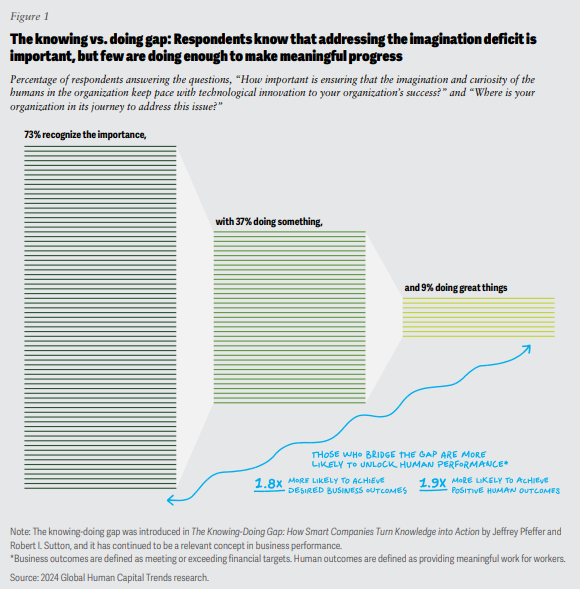
According to the 2024 Deloitte Global Human Capital Trends Research, 73% of business and HR leaders recognize the importance of aligning human capabilities with technological advancements, while only 9% report progress in achieving that alignment.
Challenges of Corporate Teams
Corporate talent acquisition teams are measured on outcomes that the recruiting platform alone cannot produce. For example:
- Quality of hire requires post-hire performance data.
- Retention impact requires tenure and exit signals.
- Strategic contribution to business performance requires hiring outcomes to be readable against revenue, workforce planning, and growth targets.
None of that signal originates inside the Applicant Tracking System. All of it has to reach the ATS for the function to be measured on the metrics leadership is asking for, and a fragmented architecture is the structural reason the signal never arrives on time or in the form it would need to be in.
When the ATS is a separate system from the rest of the business, the path home for that signal is a quarterly reconciliation project. Every reporting conversation about quality of hire produces a number that the team has caveats for, delivered a quarter after the decisions the number was supposed to inform.
The system switching pattern carries a separate cost that rarely gets attributed to the architecture.
- ATS for the candidate pipeline.
- Salesforce for the hiring manager's account, if the company runs CRM internally, and the hiring manager has CRM data attached to them.
- An email tool for the communication history that captures the actual decision conversation.
- HRIS for the post-hire signal.
Each switch costs seconds. Across a recruiter's day, those seconds add up to hours spent moving between systems that should have been one view. The function pays the integration tax in capacity, not in license fees, and the cost is so embedded in the daily workflow that nobody attributes it to the architecture that created it.
Strategic recruiting becomes harder to defend the longer the architecture stays fragmented. Leadership asks for the metrics, while the team produces them slowly and approximately.
The function gets read as administrative rather than strategic because the architecture cannot deliver the strategic answer at the speed at which the question is being asked.
What Happens To Your Recruiting Data Depends On Where It Lives
Two recruiting applications can run identical workflows and produce fundamentally different functions. The difference is not visible in the demo, does not appear on the feature checklist, and rarely surfaces in the sales conversation.
It shows up six months after go-live, when the team tries to scale, add AI, or answer a strategic question that the platform should be able to answer and cannot. The variable that determines what the platform can produce is where the data lives.
A Quick Comparison: ATS Connected To Salesforce vs. ATS Living Inside It
Every sync schedule is a bet that the data will be fresh enough when the decision gets made. Sometimes it is, but the problem is that the gaps accumulate in places nobody monitors, a debrief note that never mapped back, or a contractor status that was updated on Monday and landed in Salesforce on Thursday
The table below shows where the two architectures diverge across the seven dimensions that determine what the recruiting function can actually produce:
| Dimension | ATS Connected to Salesforce (Integration) | Recruiting Built Inside Salesforce |
|---|---|---|
| Where recruiting data lives | Separate system. Records synced to Salesforce on a schedule | Inside the existing Salesforce org alongside CRM and business data |
| Data freshness | Dependent on sync frequency; stale data is a constant risk | Always current. No sync required |
| CRM and recruiting visibility | Requires bridging two systems or pulling from both | Native: client records, job orders, and candidate history in one view |
| AI and intelligence foundation | AI operates on synced data. Gaps where sync has not completed | AI operates on live data |
| Agentforce and digital labor readiness | Agentforce requires a separate data connection to the ATS | AI agents run inside the same org. No external data integrations required |
| Institutional knowledge retention | Knowledge is distributed across two systems. Neither has the complete picture | Full relationship history in one environment. Every debrief and outcome is accessible |
| Sync failure impact | Recruiting data in Salesforce goes stale. Recommendations may surface placed or unavailable candidates | No sync to fail. Data state is always accurate and live |
The ATS connected to Salesforce through integration results in a compounding cost that never appears on a budget line. It is paid in a recruiter capacity for every system switch, manual reconciliation, and verification check before acting on a recommendation.
It's recruiter time that was supposed to go toward relationships, pipeline building, and closing. The capacity that was supposed to be freed by the platform is being consumed by the overhead that the platform's architecture created.
Why Data Boundaries Compound Into Intelligence Gaps That Get Harder To Close Over Time
A system boundary looks like a small problem on day one, with small challenges like a field that does not sync or a timestamp that lags by an hour.
Each gap appears fixable, and most teams fix the visible ones with custom integration work or scheduled jobs that reconcile records overnight. Initially, it looks like the boundary has been closed, but it’s just moved underneath the workflow, where the cost is no longer visible to anyone running operational reports.
Three Operational Patterns
The cost compounds in three operational patterns that the team gets used to without naming them.
- Recommendations are verified against the source record every time, because the team learned the hard way that the intelligence layer surfaced placed candidates as available, or showed contractors as on assignment when they had rolled off the prior Friday.
- Reporting numbers are reviewed on every executive deck because the team cannot promise the numbers are current.
- AI features are toggled off because the recruiters who tried them learned the recommendations could not be trusted, and the toggle was the only mechanism the team had to stop the noise.
In a 2026 McKinsey Research on Enterprises implementing AI at scale, 8 in 10 companies cite data limitations as a roadblock to scaling AI agents in the enterprise.
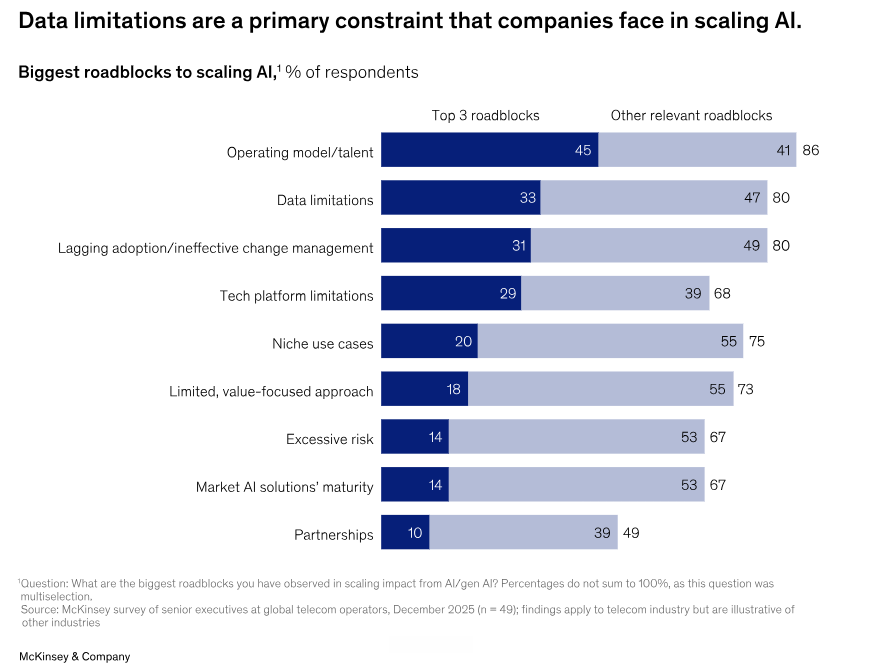
Success with agentic AI depends on a data architecture that can support increasing levels of autonomy, coordination, and real-time decision-making.
AI features added on top of a connected ATS run against what the sync captured, not what the organization actually produces in real-time. For example, a matching engine is only as good as the last successful sync.
Although the intelligence looks like it is working, the data underneath it is partial, and the team that learns this starts verifying everything before acting, which is the moment the intelligence layer stops being intelligence and becomes more work.
From Applicant Tracking to Talent Relationship Management
Applicant tracking systems were built to organize inbound applications, move candidates through a defined workflow, and document the hiring decision for compliance.
Talent is harder to find than ever, passive candidates outnumber active ones, and the best hire for a role that opens today may have interviewed for a different role eighteen months ago.
HR functions are no longer treating candidates as one-off records to be processed against a requisition and archived when it closes. They are treating them as long-term relationships to be built, maintained, and acted on over time.
It is turning the applicant tracking system into a talent relationship management platform.
What a Salesforce ATS system is and what it can actually do beyond applicant tracking
A Salesforce ATS system is a recruiting application built on the Salesforce platform, giving organizations the ability to manage job requisitions, candidate pipelines, interview workflows, and hiring outcomes inside the same environment they use for sales, client management, and business operations.
Core capabilities of a Salesforce-based ATS system:
.png)
- Job management: One place to manage every requisition from open to filled, with workflow templates that attach automatically based on role criteria, multi-board posting from a single record without manual re-entry across platforms, and process updates that push across active jobs so the team is always running the current workflow rather than the one configured six months ago.
- Pipeline management: A real-time view of every candidate across every role, with bulk actions, candidate processing from any source, and pipeline movement that triggers downstream workflow without manual handoffs.
- Interview management: Standardizes evaluation without adding friction.
- Templates and question guides configured for any role type.
- Structured feedback collection captures evaluations from everyone involved, inside and outside the firm.
- Materials, ratings, and notes attach to the candidate record automatically, so the full evaluation is visible to everyone making the decision.
- Offer and placement close the loop in the same environment that the rest of the workflow ran in.
- Contact management keeps every relationship at the firm or team level, with segmented contact lists, in-platform email, and automatic communication history capture, so the relationship lives at the organization rather than in an individual recruiter's inbox.
- Reporting and analytics run on the same Salesforce data, with built-in dashboards on placement activity, pipeline health, and recruiter performance.
What the Salesforce ATS adds beyond any standalone ATS is connection. Candidate data sits in the same system as client data. Recruiting pipeline visibility runs alongside revenue records. Every recruiter action is captured in the same environment that holds every other business signal the organization produces.
The system stops being a recruiting silo and becomes one slice of the organization's operating model, which is the architectural property that makes everything downstream possible.
How Organizations Already on Salesforce Should Evaluate Recruiting Applications
A first-time ATS buyer is evaluating pricing, integration count, ease of use, and feature coverage.
An organization that already owns Salesforce has a different set of questions to ask, because the platform decision has already been made, and the recruiting application decision is now about whether to take full advantage of the environment the organization paid for or to introduce a new data boundary inside it.
If your ATS and Salesforce are running as two separate systems, are these the problems you are already dealing with?
Every pattern below is what the boundary between a connected ATS and the Salesforce org looks like when it hits daily recruiting operations.
- For staffing firms, it shows up in missed redeployments and submissions made without client context.
- For corporate teams, it shows up in quality of hire numbers nobody can defend and hiring manager feedback that never reaches the next search.
Organizations recognizing more than one of these are paying the integration tax right now, in capacity, margin, and the strategic credibility the function carries inside the business.
| Problem | Users | What It Actually Costs You |
|---|---|---|
| Client context is missing at the moment a placement decision is made | Staffing firms | Submissions go out without account manager conversation history, prior placement outcomes, or margin context. The placement that would have deepened the account or protected the margin gets missed because the intelligence to make it was sitting in another system. |
| Redeployment opportunities are invisible because bench candidates and client job orders live in different systems | Staffing firms | Contractors roll off assignment, and the firm sources net-new talent for requirements that its existing bench should be filling. Margin lost to missed redeployment never appears as a line item because it never had a chance to show up on the P&L. |
| Quality of hire cannot be measured because post-hire performance data lives in the HRIS, not the recruiting platform | Corporate teams | Every reporting conversation about quality of hire becomes a manual pull from three systems, reconciled in a spreadsheet, delivered a quarter after the decisions it should have informed. TA cannot prove strategic value in the metrics leadership asks for. |
| Hiring manager feedback is not connected to the candidate record, where recruiting decisions are made | Corporate teams | Debrief notes live in email threads, meeting transcripts, or a separate evaluation tool. The next time the hiring manager opens a similar requisition, the recruiter has no visibility into the previous feedback, and the same misalignment shows up in the new search. |
| Recruiters are switching systems to get information that should exist in one view | Both | Each switch costs seconds. Across a week, hours. Across a year, the equivalent of a full recruiter the firm never hired. The integration tax is paid in capacity, not in licenses, which is why it rarely gets attributed to the architecture that created it. |
| Reporting requires manual reconciliation across two platforms to answer one business question | Both | Leadership asks a question. The answer takes a week to produce, has caveats, and arrives after the decision was made on a guess. The function gets read as administrative because the architecture cannot deliver the strategic answer at the speed at which it was asked. |
The evaluation questions Salesforce organizations should be asking that a standard ATS checklist never covers
The table below pairs the questions a first-time ATS buyer is asking with the questions a Salesforce organization should be asking instead.
| Standard ATS Buyer Asks | The Salesforce Organization Should Ask |
|---|---|
| What job boards does it post to? | Does this application live inside my Salesforce org or sync to it from outside? |
| How many integrations does it have? | Does it extend my existing Salesforce data model or create a parallel one? |
| What does implementation cost? | Can my recruiters see CRM and candidate data in the same view without switching systems? |
| How long does onboarding take? | Does the intelligence improve based on my own placement and hiring history? |
| What is the pricing model? | When we are ready to add digital workers, do they run inside this same Salesforce org? |
Organizations that evaluate only on the left column buy systems that satisfy the checklist and recreate the data boundary, and the rest of the business has been working to close. Organizations that evaluate on the right column buy systems that take advantage of the foundation the rest of the business is already running on.
AI-readiness: whether the recruiting application shares a data foundation with Agentforce
Salesforce Agentforce is an AI platform built into Salesforce that enables organizations to build, deploy, and manage autonomous AI agents directly within the Salesforce environment.
These agents can perceive context, reason against live Salesforce data, and take independent actions across business workflows without requiring a separate AI platform, data pipeline, or integration layer.
Since Agentforce runs natively inside the Salesforce org, agents operate on the same data, security model, and governance framework as the rest of the business.
A recruiting application that connects from outside cannot inherit the native architecture of a Salesforce-based ATS system. Before any Agentforce agent can act on recruiting data, a pipeline has to be built between the ATS and the Salesforce org.
However, the pipeline introduces latency, freshness risk, and an integration to maintain, version, and re-test every time either side of the connection changes. The agent ends up reasoning against snapshots, instead of live records, and the architectural advantage the organization paid for when they invested in Salesforce gets diluted before the first AI task has run.
According to the 2025 BCG Research on the Widening AI Value Gap, only 5% are achieving AI value at scale, while 60% report little to no material value from their AI investments despite substantial spend.
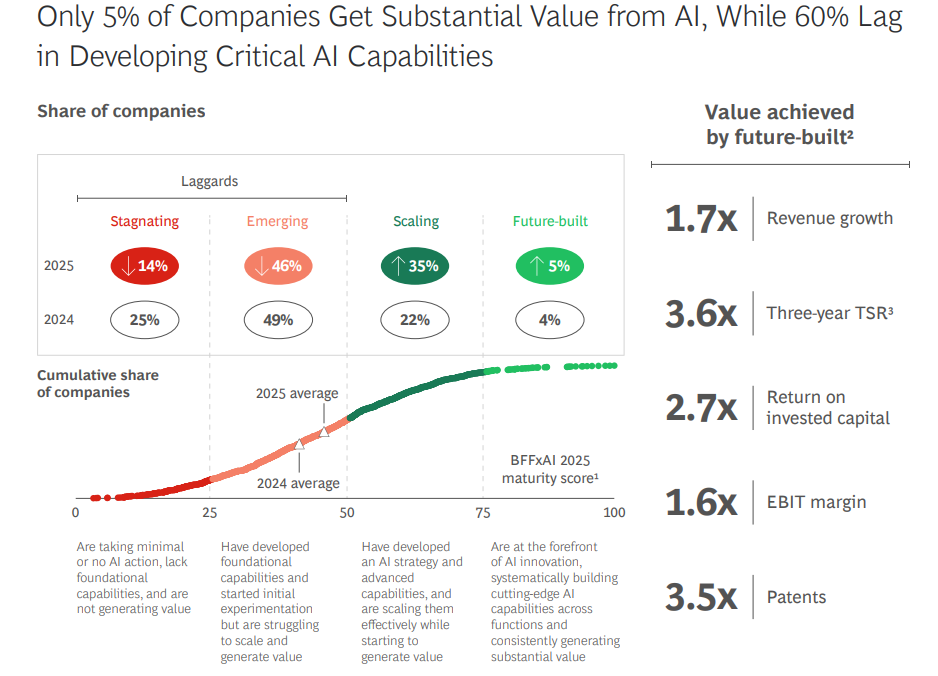
The dividing line between the 5% and the rest is often the data foundation the model has to operate against, and the architectural decisions the organization made when they bought the systems the AI is running on.
The AI-readiness question is therefore not whether the recruiting application has AI features, because every modern recruiting application has AI features. The question is whether the AI that those features run on is operating against live, unified data inside the org, or against synced snapshots that may or may not reflect the current state of the team's work.
Whether the application extends your existing Salesforce data model or builds a second one beside it
Every Salesforce organization has a data model. The objects, fields, relationships, and records that define how business information is structured. Adding recruiting to that environment can extend the model directly, or it can sit beside it as a parallel model that the org references through a sync.
The choice determines whether the recruiting application is a part of the business's data architecture or a separate system that exchanges data with it.
Salesforce-based ATS
A Salesforce-based recruiting application extends the data model. Candidate, Job, Placement, Interview, and the relationships between them sit alongside Account and Contact in one schema.
Every record honors the same security model, the same field-level governance, the same reporting framework, and the same access controls as the rest of the org.
Salesforce admins manage the recruiting application through the same tooling they use to manage the CRM, which means the platform expertise the organization already invested in extends to the recruiting environment without retraining or hiring.
Salesforce-connected ATS
An ATS that connects to Salesforce maintains its own data model in a separate system and pushes records across as a sync.
As the ATS evolves and adds fields or changes its data structure, the sync has to be updated to match, which means a recruiting application change becomes a Salesforce integration change, with a development cycle and a re-test attached.
The structural question to ask of any recruiting application is whether it extends the model or builds beside it. The applications that extend the model inherit everything Salesforce has built, and the organization compounds the value of that investment with every additional capability the platform delivers.
The applications that are built beside it inherit nothing, and the organization pays to bridge the gap continuously for as long as the application is in production.
Asymbl Recruiter Suite: Talent Relationship Management Built on Salesforce
Recruiter Suite is the foundation Asymbl built specifically for organizations that want recruiting to operate inside the Salesforce environment they already run on. It extends the existing data model rather than maintaining a parallel one.
.png)
Recruiting workflow, candidate data, client records, Talent Intelligence, and Digital Recruiter all operate on the same Salesforce foundation, with the same governance, security, and AI substrate as the rest of the business.
Unified Talent Relationship Management (TRM)
Recruiter Suite manages the full talent relationship management cycle in one Salesforce-based environment, from first sourcing contact through placement, hire, and the outcomes that follow.
- Job Management: One place to manage every requisition from open to filled, with workflow templates that attach automatically based on role criteria and multi-board posting that runs from a single record.
- Pipeline Management: A real-time view of every candidate across every role, with bulk actions and inbound application processing from any source without leaving the platform.
- Interview Management: Configurable templates and structured feedback from everyone involved, with all materials attached to the candidate record automatically, so the full evaluation is visible to everyone making the decision.
- Offer and Placement: Closes the loop in the same environment that the rest of the workflow ran in, with revenue and gross profit tracked per recruiter for staffing firms and offer outcomes recorded for corporate teams.
- Contact Management: Every candidate and client relationship sits at the firm level, not the individual recruiter level. Communication histories attach automatically. Institutional knowledge stays in the platform when a recruiter leaves.
Talent Intelligence
Talent Intelligence is the Recruiter Brain that powers search, matching, and decision support inside Recruiter Suite.
It reads pipeline history, interview feedback, assignment outcomes, hiring manager preferences, and unstructured data the recruiter has captured, and turns the full record into a continuously improving model of candidate fit.
Natural language search replaces Boolean expertise, which means the recruiter who knows the role but does not know Boolean syntax can find the right candidates the way they actually think.
AI fit analysis scores candidates against jobs and jobs against candidates against the actual context the organization has accumulated, instead of the keyword overlap a parsing engine can produce.
Since Talent Intelligence operates on the same Salesforce data that the rest of the workflow uses, every recruiter interaction becomes a signal that the next decision can draw on.
The intelligence layer also reads candidate availability signals continuously, placement likelihood scores update as the data underneath them changes, and the system surfaces silver-medalist candidates the moment a similar role opens, instead of waiting for someone to remember the name.
The reasoning engine is doing the connecting work that the recruiter used to carry out mentally between systems.
Digital Recruiter
Digital Recruiter is the pre-built digital worker that acts on the Recruiter Suite foundation. It handles:
- Job description generation from guided prompts and custom templates
- Intelligent candidate outreach at scale with content tailored automatically to each individual based on profile and role
- Application screening against the full Talent Relationship Management record
- Interview scheduling with real-time availability and rescheduling handling
- Structured interview summaries and candidate insights, and offer letter drafting for recruiter review.
Every action runs inside the same Salesforce org as the human recruiting team, on Agentforce, with full candidate and pipeline context, shared governance, and a single audit trail.
Digital Recruiter processed 17,000 applications, pre-screened 1,800 candidates, scheduled 800 interviews, and helped a two-person Asymbl recruiting team hire 100 people in 100 days, with a 47% increase in fill rate and an estimated $575K in hiring cost savings.
The recruiting team focused on relationships and judgment, while the digital worker handled the volume on the same record, with no separate data plane to maintain.
The capacity gain came from architecture as much as from automation. The agent could act on the recruiting work because the recruiting work was already running on the foundation the agent was built to read.
Revenue and placement visibility
For staffing firms, Recruiter Suite surfaces gross profit, fill rates, and redeployment signals in real time on the same records the front office is working in.
A recruiter looking at a contractor near the end of the assignment sees the open job orders that match the contractor's profile, the client's redeployment acceptance history, the margin implications, and the account manager's recent client conversations, all in one view.
Operations leaders track placement activity and pipeline health with built-in analytics on the same data the team is generating, not on a sync that landed at 3 AM and may have missed half the day's activity.
Bench candidates, client job orders, and the matching signal between them sit on the same data foundation. The recommendation that surfaces a redeployment opportunity reads across all three.
The match the firm would have missed in a fragmented architecture surfaces automatically, on the day the contractor becomes available, while the requirement is still open.
Margin that would have leaked to net-new sourcing stays inside the existing bench, and the redeploy that is the highest-margin placement type in staffing becomes a function of data rather than memory.
Quality of hire and post-hire connectivity
For corporate TA teams, Recruiter Suite connects recruiting outcomes to the business data TA is accountable for.
Since the recruiting application runs in the same Salesforce architecture as the rest of the business, hiring decisions connect to CRM data, post-hire performance signals captured in Salesforce, and workforce planning inputs without an export.
Quality of hire reporting stops being a quarterly reconciliation project and starts being a query against live data.
Hiring manager feedback attaches to the candidate record, where the next hiring decision will read it automatically.
Compliance, bias mitigation, audit trails, and regulatory controls are built into every workflow inside the same security framework the rest of the org operates under, which matters more for corporate TA than for any other audience, because corporate teams own the final hiring decision and the regulatory exposure that comes with it.
Conclusion
Most architecture decisions are reversible, but they come at a cost. The recruiting application a team picks today sets the limitation on what the function can do for the next five years, and removing that limitation later means a re-implementation, a data migration, and the disruption everyone was trying to avoid the first time.
That is what makes the inside-versus-connected question worth slowing down for. The gap between the two widens over time.
A recruiting application inside the Salesforce org gets better as the org's data grows, as Agentforce matures, and as every recruiter action adds a signal that the next decision can draw on.
A connected ATS holds steady, a sync behind the work it is meant to support. Two teams that looked identical at go-live become two different functions, and the divergence only shows up once it is expensive to reverse.
Ask your recruiters how many systems they had to open to make a single placement decision.
The answer gives you clarity about your architecture. Asymbl Recruiter Suite, Talent Intelligence, and Digital Recruiter all operate from one unified Salesforce data foundation. Book a demo to see how Asymbl Recruiter Suite helps to unify your HR operations.
FAQs
Salesforce ATS system is a recruiting application built inside the Salesforce org, extending the existing data model. A standard ATS runs separately and syncs records across, reasoning against the last successful sync rather than live data
A built-in application extends the Salesforce data model directly. A connected application maintains a separate model and syncs records across, with stale data and integration overhead as permanent costs.
Yes, when recruiting is built inside the Salesforce org. Agentforce agents operate on live recruiting data directly. A separate ATS requires a data pipeline first, introducing latency and freshness risk.
When recruiting runs inside Salesforce, post-hire performance, retention signals, and hiring manager feedback reach the same data layer, making quality of hire a live query rather than a quarterly reconciliation.
.webp)
12 Recruitment Metrics Every TA Team Should Be Tracking
Modern recruitment metrics need pipeline readiness and capacity. See 12 talent acquisition metrics that matter beyond speed.

The Right Fit Starts With a Conversation.
See what working together could look like.
.webp)