

.webp)
Staffing firms are being asked to place more with the same team, protect margins on tightening cycles, and grow revenue without adding headcount. Corporate recruiting teams are being asked to cut costs, reduce time-to-fill, and prove strategic value with data that their current systems cannot actually produce.
Both are absorbing these pressures at once, while the best candidates in the market get harder to find, faster to lose, and more expensive to replace than ever.
According to 2026 Gartner HR research, only 31% of recruiting teams use labor market data to inform their talent strategy. The data exists, but the infrastructure to act on it does not.
In this guide, we talk about conventional talent recruitment strategies and why they are failing under the modern hiring pressures.
What Passes for Recruitment Strategy Today
Most recruiting strategies are a collection of tactics adopted at different points, in response to different pressures, with no shared system underneath them. For example:
- Job board subscriptions.
- A referral program.
- An EVP campaign.
- Interview guides.
- A compensation benchmark.
1. Posting and Praying on Job Boards
Posting to job boards remains the default first move for most teams in both staffing and corporate TA. Application volume keeps coming in. Some of it converts, but most of it does not.
However, application volume is not the same as qualified candidates. Most applicants do not match or advance. The best candidates in the market rarely apply cold.
For staffing firms, job board sourcing is a recurring cost line with diminishing returns as recruiter capacity gets consumed sorting low-fit applications.
For corporate talent acquisition teams, the same volume problem hides quality of hire because the candidates who would have made the difference were never in the funnel to begin with.
2. Referrals, EVP, and the Branding Push
Referral programs produce strong hire quality when they fire. Conversion is inconsistent and depends on individual employee participation, instead of system design.
Employer brand and EVP (Employee Value Proposition) initiatives generate inbound interest, but what happens to that interest after the first contact determines whether it converts.
For staffing firms, the brand is the relationship a recruiter has built with a candidate over time. The relationship lives with the individual recruiter, not the firm.
Both teams invest in employer brand and still miss predictable results, because the infrastructure to capture and act on the inbound interest these programs generate is not connected to where sourcing and screening actually happen.
3. Interview Kits and Assessment Layers
Standardized interview guides and skills assessments add structure, reduce evaluation bias, and improve consistency at the assessment stage.
Structure in assessment does not fix the sourcing and screening that came before it. Corporate TA teams often invest significantly in interview rigor and still report uneven quality of hire, because candidates entering the structured process were not matched on the right criteria to begin with.
For staffing, assessment data gathered during one placement cycle rarely informs how a candidate is matched the next time. It lives in one recruiter's notes, rather than in a shared intelligence model.
4. Compensation Adjustments and Flexibility
For both staffing and corporate teams, comp and flexibility have become prerequisites rather than differentiators. Most strong candidates expect competitive salary ranges and remote or hybrid options before they engage.
This is a market-positioning decision. Treating it as a recruitment strategy without the execution infrastructure to capitalize on it means attracting candidates into a process that still loses them mid-funnel.
Why Conventional Talent Recruitment Strategies Fall Short for Modern Hiring
Every tactic in the playbook requires good data, shared context, available recruiter capacity, and institutional knowledge that does not leave when a person does. Most organizations have these tactics, but are missing what makes them reliable.
1. Candidate Data That Can't Be Trusted
Every strategy in the playbook, such as pipeline building, skills matching, and passive sourcing, runs on candidate data. Most teams have that data scattered across an ATS, a CRM, email threads, spreadsheets, and recruiter notes that never made it into a system.
For staffing firms, a database full of stale profiles means redeployment opportunities get missed. Firms source net-new talent for roles their existing bench should be filling, adding cost without adding margin.
For corporate TA, fragmented candidate history means no reliable way to measure quality of hire, no way to prove what actually worked, and no structured pipeline to draw from when a critical role opens fast.
2. Context Lost Between Hiring Stages
A candidate's journey from first sourcing contact to offer involves multiple stages, multiple people, and, in most organizations, multiple systems. Each handoff loses something.
For staffing, when a top producer leaves, their relationships and placement history walk out with them. Nothing was captured at the firm level. Clients have to start over with a recruiter who does not know the account.
For corporate TA, candidates who engaged with employer brand content arrive in the ATS and get treated identically to cold applicants because the two systems never share data, and the relationship context is invisible.
3. Recruiter Capacity Consumed by Admin Work
Recruiters at staffing firms and corporate TA teams alike lose a significant portion of each week to tasks the system should handle, such as
- Scheduling
- Follow-up
- Data entry
- Status updates
- Pipeline reporting.
The ratio of administrative to strategic work has shifted in the wrong direction.
According to the 2024 Talent Acquisition Technology Trends by Deloitte, 60% of frontline workers, including recruiters and hiring managers, report dissatisfaction with the technology their employer provides, and 56% say they use personal technology to perform their work effectively.
Although the recruiters are far more capable, the tools they are running on were designed for record-keeping rather than driving decisions.
4. Strategy Tied to the Person, Not the Platform
The best recruiters on every team make decisions that newer team members cannot explain or replicate because the signal they are drawing on is invisible in the system.
They remember:
- Which candidates performed well on specific assignment types?
- What did a hiring manager say in a debrief?
- Which combinations of background and trajectory tend to produce successful placements for a given client?
Their judgment lives in their head. However, when that recruiter leaves, the firm loses the institutional knowledge that was making the strategy work.
Both staffing and corporate teams are making high-stakes placement decisions with only a fraction of the information they have already collected, because nothing has connected it, interpreted it, or made it available to the team as a whole.
Talent Pipeline Development
Talent pipeline development is the ongoing process of identifying, engaging, and nurturing qualified candidates before a role opens. Rather than sourcing reactively when a requisition is approved, recruiting teams build segmented pools of warm talent organized by skills, location, career stage, and engagement history.
A developed talent pipeline means candidates are already known, partially vetted, and receptive to outreach when headcount is approved, compressing time-to-fill and improving the quality of candidates entering the hiring process.
Most organizations interpret talent pipeline development as "build a list of interested candidates," but a list is not a pipeline.
1. Why Most Pipelines Collapse After Fill
A pipeline that only exists while a requisition is open gets built reactively and abandoned once the role is filled. The next time a similar requisition opens, the team starts sourcing from scratch.
A real pipeline compounds over time. It requires a system that treats talent as a longitudinal relationship, instead of a transaction tied to a specific requisition.
Silver medalists, the strong candidates who were two weeks behind the hire, are rarely kept warm. They go cold, and the next time a similar role opens, no one remembers them, or the data is not surfaced, and sourcing starts over.
This is a structural choice, not a capacity issue, because the system resets as it was built around the requisition.
2. Redeployment: The Staffing Firm Advantage
For staffing firms, the highest-margin placement is a redeploy. A candidate already vetted, known to the firm, available for the next assignment, ready to bill.
Most firms know this in principle, yet underperform on redeployment in practice, because the systems that track assignment history, engagement signals, and availability status cannot surface the right candidate at the right moment.
A talent pipeline strategy for staffing firms is, at its core, a redeployment strategy. Activation creates the margin, and most firms have the data they need to activate already.
3. Warm Talent Before the Requisition Opens
Corporate talent acquisition teams under pressure to reduce time-to-fill cannot build a pipeline reactively. By the time a critical role receives headcount approval, the pipeline needs to already exist.
Warm talent communities, segmented by skills, location, career stage, and engagement history, compress the sourcing stage significantly and improve the quality of candidates entering the process.
A passive candidate in a nurtured pipeline responds to outreach differently than one receiving a cold message, because the relationship context is already built
According to the 2023 BCG Report on Decoding the Global Talent, 74% of employees worldwide are approached multiple times per year about new job opportunities, and 39% are approached every month.
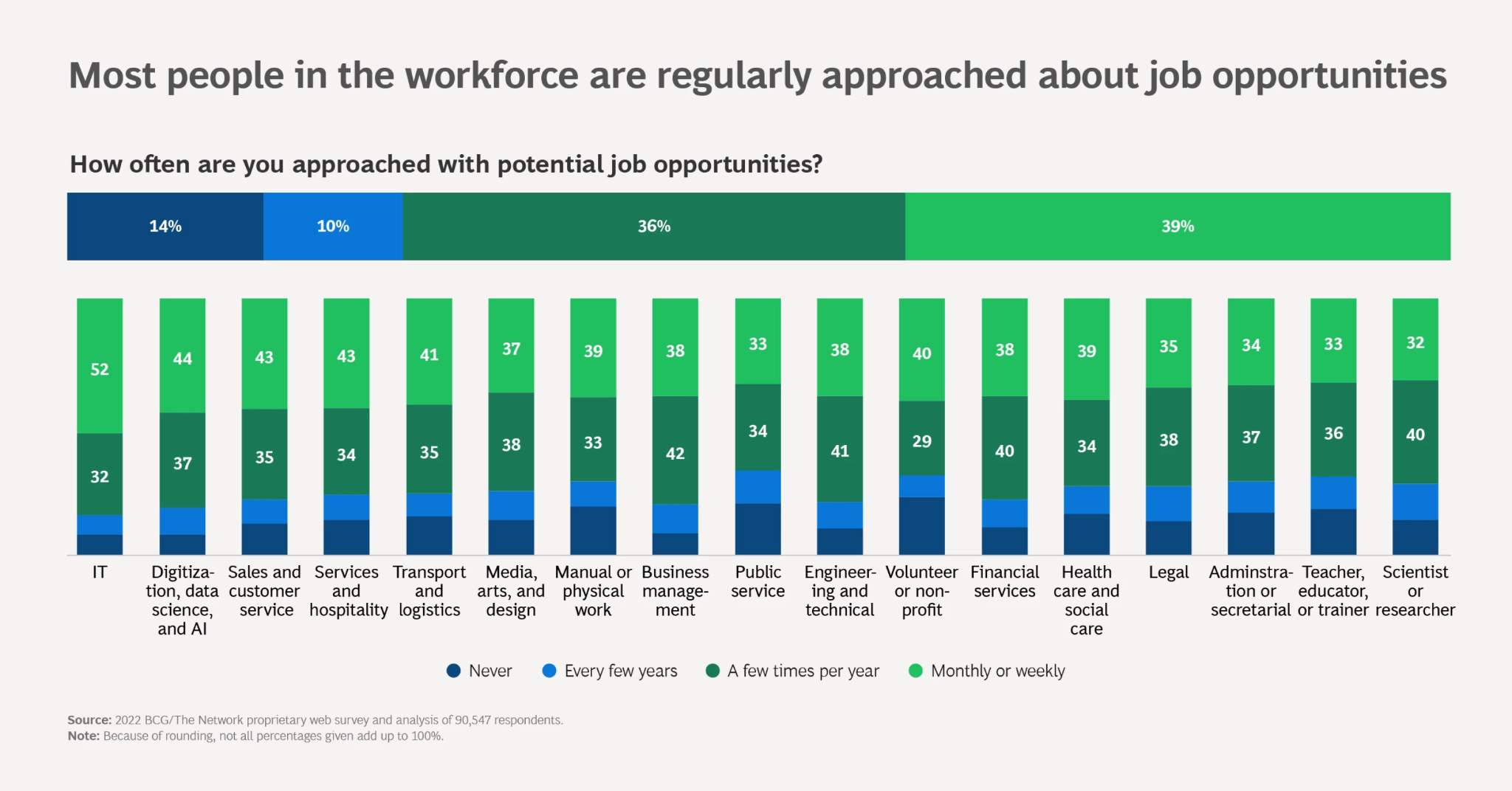
The passive market is saturated with outreach, while the potential of the active pipeline goes untapped.
4. From Contact Record to Active Relationship
A contact record is not a relationship. Most ATS systems store the former and treat it as the latter.
Real pipeline health requires tracking engagement signals, knowing which candidates are warm, and surfacing who is available and well-matched for roles that have not opened yet.
Asymbl Talent Intelligence is the Recruiter Brain that powers this view. It scores candidates continuously against pipeline history, interview feedback, and assignment outcomes, instead of just resume keywords. The pipeline becomes a prioritized, intelligent asset rather than a static list.
Asymbl Digital Recruiter, the pre-built digital worker, runs on the same intelligence that helped Asymbl hire 100 people in 100 days with a 2-person recruitment team.
Best Talent Recruitment Strategies in 2026
The strategies below cover three interconnected decisions:
- How you evaluate candidates
- How you source them, and
- What operating model you run both through.
Each one builds on the last.
Skills-Based Hiring Beyond the Keyword
Most organizations adopt skills-based criteria and then route them through a Boolean search engine, which returns literal keyword matches. Routing skills-based criteria through a Boolean search collapses the principle into keyword overlap. The candidates the criteria were meant to surface stay hidden.
According to a 2022 Taking a Skills-based Approach to Building the Future Workforce Report by McKinsey, hiring for skills is five times more predictive of job performance than hiring for education, and more than two times more predictive than hiring for work experience.
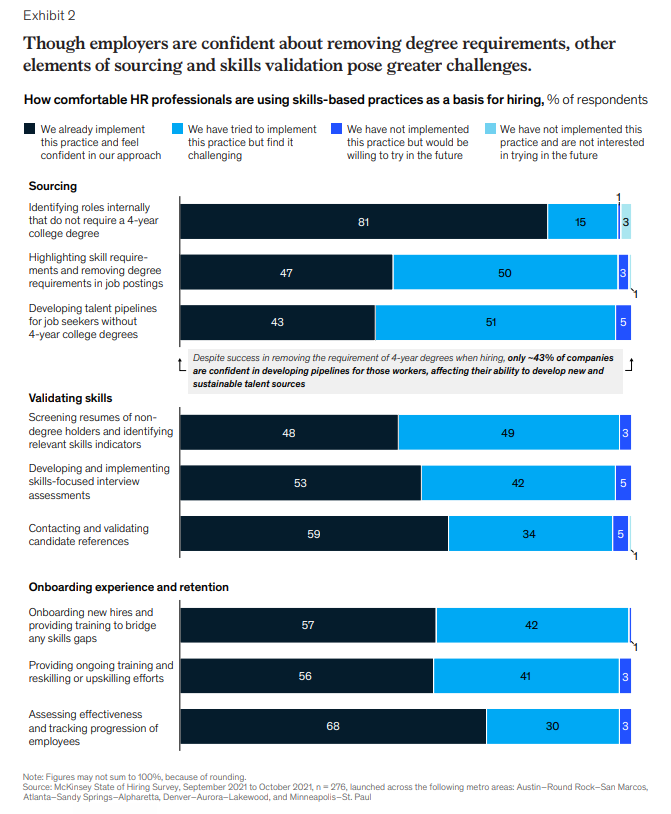
Organizations that adopt the skills-based hiring approach and run it on Boolean infrastructure are leaving most of that predictive value on the table.
1. What Boolean Search Can't See
A search for "Java developer" returns profiles with the word Java. It does not return the candidate whose last three placements were in Java environments, whose interview feedback flagged strong systems design, and whose hiring manager from two years ago said they would hire her again.
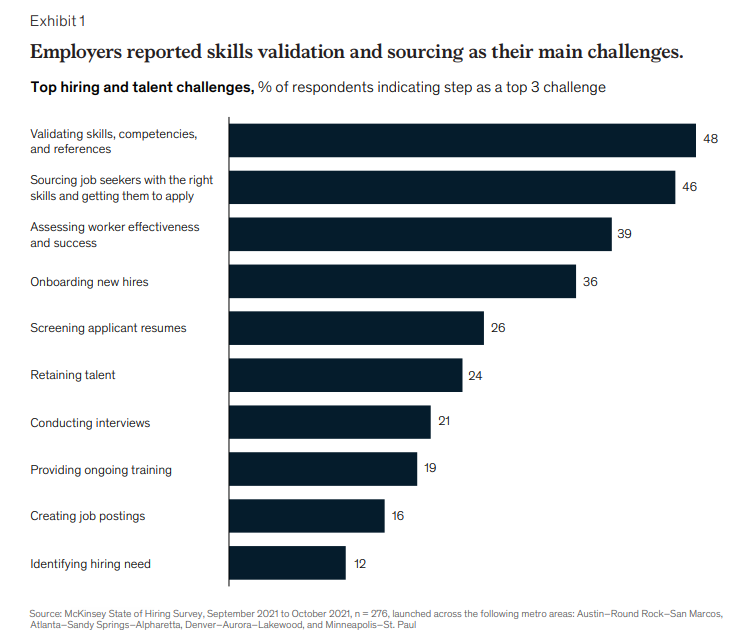
Skills-based hiring at scale requires a search infrastructure that reasons about fit the way a great recruiter does, instead of one that pattern-matches field to field.
2. Semantic Matching and the Full Data Model
Semantic search goes beyond keyword matching to evaluate the meaning and relationship between a candidate's profile and a role's requirements. It narrows the gap between what the recruiter asks and what the system surfaces.
Semantic search alone still only sees what is on the resume. A resume captures a small fraction of what makes a candidate likely to succeed.
Talent Intelligence incorporates:
- Pipeline history
- Interview feedback
- Assignment outcomes, and
- Unstructured data into a continuously improving model of candidate fit.
It evaluates talent the way a recruiter would, instead of the way a database would. The intelligence is available to every member of the team, not just the senior recruiter who has been doing this for 15 years.
3. Skills Data Staffing Firms Already Own
Staffing firms are sitting on performance data that the rest of the team doesn’t often use. For example:
- Assignment completion rates
- Client feedback
- Skills tested in real work contexts over real timelines.
Most staffing platforms cannot surface that data at search time because it gets archived with the placement record and never informs the next matching decision.
Talent Intelligence connects assignment history, placement outcomes, and engagement data to candidate matching, so firms stop sourcing talent they already have.
Corporate TA: Skills Gaps Before They Stall
Corporate talent acquisition teams are increasingly asked to fill roles that did not exist 18 months ago because of how the talent market is evolving. For example:
- Emerging functions.
- AI-adjacent roles.
- Specialized technical positions.
They move faster than traditional sourcing pipelines can respond.
Skills gap analysis against an existing talent pipeline helps TA leaders anticipate those needs rather than scrambling when headcount approval arrives.
Talent Intelligence gives corporate TA teams AI-powered analysis and placement likelihood scores for every candidate. The next critical role becomes a sourcing exercise that the team can execute against a known pipeline.
Multi-Channel Sourcing With One Record
Modern sourcing fails as a record problem before it fails as a channel choice. Each channel produces candidates and data simultaneously. In most organizations, the data has nowhere reliable to go.
1. The Channel Sprawl Problem
Modern sourcing spans job boards, LinkedIn, referrals, email campaigns, events, talent communities, and internal databases, often managed across different tools that do not share records.
Each channel produces a data trail of opens, clicks, responses, and re-engagements. In most organizations, that trail evaporates because it has no home in the recruiting system of record.
For staffing recruiters managing multiple clients and roles simultaneously, channel sprawl creates coordination overhead that consumes the time sourcing was meant to save.
For corporate TA running brand campaigns, the engagement data that those campaigns generate, the candidates who engaged, downloaded, or registered, often does not connect to the ATS. The inbound yield from brand investment cannot be measured or activated.
2. Active vs. Passive: An Infrastructure Decision
Active candidates apply, but passive candidates need engagement, context, and a reason to move over time.
Passive sourcing at scale requires a candidate database that is current, searchable, and connected to engagement history. Without that foundation, every passive campaign starts from scratch.
Active recruiting requires fast routing and structured screening to convert volume into a qualified pipeline. Without unified data, application intake produces noise instead of a signal.
3. Scaling Personalized Outreach to a Talent Pool
Passive candidates do not respond to generic outreach. Personalization quality is the primary variable in passive engagement rates, and personalization at scale is impossible when candidate data is fragmented across systems.
For staffing firms, outreach to a talent pool that includes assignment history, role preferences, and engagement timing produces targeted messages that convert. Generic outreach to the same pool produces silence.
For corporate TA, personalized outreach to passive candidates who have already engaged with employer brand content produces materially better response rates than cold campaigns, because the relationship context is already partially built.
Asymbl Digital Recruiter scales this work without adding headcount. The digital worker handles personalized outreach to large talent pools, with content tailored automatically for each individual based on profile data and role requirements.
4. What Unified Sourcing Looks Like in Practice
When every sourcing channel feeds a single candidate record, engagement signals accumulate instead of evaporating. Every touchpoint enriches the picture.
Recruiter Suite is the foundation that makes this possible, with one place to manage every candidate across every source, with full communication history, pipeline movement, and outcome data attached to the same record.
Talent Relationship Management (TRM) as Strategy
Talent Relationship Management (TRM) is the discipline of managing relationships with candidates across the full talent lifecycle using connected data, intelligent matching, structured workflows, and digital labor.
1. TRM vs. ATS: Two Different Starting Points
An applicant tracking system (ATS) is software that manages job applications and candidate records within a single hiring cycle. It organizes recruiting around the open requisition, moving candidates through pipeline stages from application to offer.
When the requisition closes, the ATS work is finished. Candidate history stays in the database but does not carry forward as active intelligence, which means every new role starts the sourcing and screening process from the beginning.
Most teams are running TRM strategies, pipeline development, passive nurturing, skills-based matching, on ATS infrastructure, and here’s the difference between the two:
| Capability | Requisition-Centric ATS | Relationship-Centric TRM |
|---|---|---|
| Primary object | The job opening | The candidate relationship |
| Candidate history | Lives inside a job record | Persists across every requisition and outcome |
| Pipeline | Built reactively when a job requirement opens | Continuous, segmented, nurtured |
| Engagement data | Captured in email threads or lost | Attached to the candidate record |
| Search | Boolean keyword matching | Semantic and outcome-based scoring |
| When the recruiter leaves | Relationships walk out | Relationships stay at the firm or team |
| Reporting | Requisitions filled, time-in-stage | Quality of hire, redeployment rate, pipeline velocity |
2. The Staffing Firm Case for TRM
Staffing firms place candidates across multiple clients, multiple roles, and multiple cycles.
A candidate's value to the firm is not determined by a single placement because it compounds over time, with each assignment adding context about what they do well, which client environments they thrive in, and when they are likely to be available next.
The recruiter who knows which candidates redeploy well in specific assignment types, which clients have high redeployment acceptance rates, and how to read availability signals from a contractor nearing the end-of-assignment is already practicing TRM. The problem is that knowledge is not captured at the firm level.
Asymbl Recruiter Suite captures it. Every relationship lives at the firm level, every communication history attaches automatically to the contact record, and every assignment outcome feeds the next matching decision. When a top producer leaves, the relationships stay.
3. The Corporate TA Case for TRM
Corporate TA teams are under pressure to cut costs, reduce time-to-fill, and prove recruiting's strategic value, with data that most of their current systems cannot produce.
Recruiter Suite is the foundation that makes that data accessible with:
- Pipeline views
- Structured interviews
- Hiring manager collaboration, and
- Offer tracking all live in one Salesforce-based environment.
Recruiting data lives in the same architecture as revenue data, workforce performance data, and the business metrics they are accountable for.
Talent Acquisition leaders can connect hiring velocity to growth forecasts, track quality of hire against post-hire outcomes, and report to the business in terms it already understands.
4. When TRM Is the Operating Model, Not a Feature
The organizations that sustain hiring quality over time are not the ones that added TRM as a module. They are the ones that restructured recruiting around the candidate relationship, treating pipeline, sourcing, and assessment as interconnected stages of a single ongoing relationship instead of isolated transactions.
The restructuring requires unified data, persistent engagement history, matching intelligence that draws on outcomes instead of keywords, and digital workers that handle volume so human recruiters can focus on judgment and relationships.
Asymbl Recruiter Suite and Digital Recruiter
Talent recruitment strategies only work when the infrastructure underneath them is built to support them. Unfortunately, most of them are not. Here’s how Asymbl changes that:
One Platform for the Full Hiring Lifecycle: Recruiter Suite
Recruiter Suite is the foundation that unifies sourcing, pipeline management, interviews, offers, contacts, and reporting in a single Salesforce-based environment.
- Job Management gives recruiters one place to manage every requisition from open to filled.
- Pipeline Management gives the team a real-time view of every candidate across every role.
- Interview Management standardizes evaluation without adding friction.
- Contact Management keeps every relationship at the firm or team level, with full communication history attached to each record automatically.
Talent Intelligence, the Recruiter Brain, powers search and matching inside Recruiter Suite.
- It scores candidates against jobs and jobs against candidates using AI fit analysis built on pipeline history, interview feedback, and assignment outcomes.
- Natural language search replaces Boolean expertise.
Every member of the team works from the same intelligence model.
Digital Recruiter, Rosa, acts on this intelligence foundation. Job description generation, intelligent candidate outreach, application screening, interview scheduling, structured interview summaries, and offer letter drafting all run inside Recruiter Suite.
The digital recruiter works alongside human recruiters, with full candidate and pipeline context, governed and auditable from day one.
100 Hires in 100 Days: How Did Asymbl Do It?
Asymbl is Customer Zero for its own platform. The recruiting team runs Recruiter Suite, Talent Intelligence, and Digital Recruiter in production every day.
In its first 100 days of production, Digital Recruiter helped Asymbl hire 100 people with a 2-person recruitment team. The digital worker processed 17,000 applications, pre-screened 1,800 candidates, scheduled 800 interviews, and saved an estimated $575K in hiring costs. Fill rate increased 47%. ROI for the launch year landed at 15x.
The pipeline work that made it possible was systematic.
- Candidates flowed through one record.
- Engagement data accumulated.
- Matching ran against outcomes.
The two humans focused on relationships and judgment calls, while the digital worker handled the volume.
Built for Staffing and Corporate Recruiting
Asymbl's platform serves two audiences with fundamentally different economic models on the same architecture.
For staffing firms, Recruiter Suite unifies sales and recruiting into one operating environment.
- Every relationship stays at the firm level.
- Redeployment becomes a function of data rather than memory.
- Talent Intelligence connects assignment history to candidate matching, so firms stop sourcing talent they already have.
For corporate TA teams, Recruiter Suite is the talent relationship management foundation that connects to the CRM data, post-hire outcomes, and business metrics TA leaders are accountable for.
Digital Recruiter handles the high-volume work, so human recruiters focus on quality of hire and hiring manager relationships. Bias mitigation, audit trails, and regulatory compliance are built into every workflow.
Conclusion
Recruiting has always been relationship work. However, what is changing is the scale at which those relationships can be maintained, the depth at which candidates can be understood before the first conversation, and the speed at which everything a team has learned gets applied to the next decision instead of sitting in someone's head or a closed requisition record.
The team that thrives in that environment builds systems that carry the context, so they can focus entirely on the judgment calls that actually require a human.
Ask yourself how much of what your best recruiter knows actually lives in your system. If the answer is "not much," that is not a people problem, but an operating model problem.
Book a demo to see how Asymbl Recruiter Suite, Talent Intelligence, and Digital Recruiter can turn what your team knows into something the whole team can act on.
FAQs
TRM organizes recruiting around the candidate relationship, where history, engagement, and outcomes persist across every requisition. An ATS organizes around the job opening and resets when it closes.
Active recruiting converts inbound applicants through fast routing and structured screening. Passive recruiting engages candidates not looking for a switch, which requires a current database connected to engagement history.
Staffing firms can drive consistent redeployments by activating data they already own, such as assignment history, availability signals, and client feedback that need to surface at search time, not sit archived in a closed placement record.
Skills-based hiring needs a search infrastructure that reasons about fit, not keywords. Boolean search loses most of the predictive value of skills-based criteria at the first step.
.png)
Talent Pipeline Management: Give Every Stage an Owner
A recruiter who leaves takes an unowned pipeline. Talent pipeline management gives each stage entry rules, exit rules, and an owner. Find out how Asymbl builds it

The Right Fit Starts With a Conversation.
See what working together could look like.
.webp)