


.webp)
When hiring volume compresses time, recruiting stops behaving like a sequence of individual decisions and starts behaving like an operating system problem.
For staffing firms, the pressure shows up as competing client orders, thinning margins, and missed redeployment. For corporate teams, it shows up as quality risk, candidate drop-off, uneven hiring manager feedback, and a brand to protect while the requisition count climbs.
Most teams respond by adding more sourcing, more automation, and more bulk hiring strategies, while the workflow underneath stays the same. Most of that just scales the flaws already in the process. The teams that scale well redesign the work underneath the speed before they try to move faster.
In this blog, we will examine why high-volume recruiting breaks traditional workflows, how the problem differs between staffing firms and corporate teams, and what a screening and hiring model needs to hold up at scale.
Why Recruiting Workflows Break Under High Volume
.webp)
High-volume recruiting changes the nature of the work because processes that depend on recruiter memory, manual prioritization, and constant coordination become increasingly fragile as hiring demand scales.
Understanding where those bottlenecks appear is the first step toward designing a workflow that can sustain high-volume recruiting.
1. Volume Changes the Work Before It Changes the Headcount
At low volume, a recruiter can personally carry the context for every candidate, including:
- Who interviewed well last quarter
- Which hiring manager hates a certain resume format
- Which contractor is rolling off in three weeks.
As hiring volume grows, you are expected to manage far more coordination without any headcount. Hence, managing candidates turns into managing candidate journeys and recruiting workflows.
The recruiter is trying to keep forty pipelines from colliding, and the work of holding context in their head starts crowding out the work of actually moving candidates forward in the pipeline.
2. Manual Prioritization Stops Working When Every Role Feels Urgent
When every hiring manager, client, or business unit insists their role is critical, urgency becomes noise. Without explicit priority logic living somewhere other than a recruiter's inbox, the process bends toward whoever follows up most often.
The highest-value work slips while the most persistent requester gets prioritized. A staffing firm works the order from the account manager who follows up three times a day, while the higher-margin order with a patient client gets delayed. A corporate team fills the role attached to the vocal director, while the role tied to the revenue plan waits.
Priority that lives in individual heads cannot be audited, cannot be handed off, and cannot survive a busy Thursday. The workflow needs the priority rules written down and applied consistently, or volume will keep making the wrong call for you.
3. Candidate Context Gets Lost When Pipelines Move Too Fast
A recruiter processing a hundred applications a day does not have time to reconstruct a candidate's full history from three fragmented systems. So they act on whatever information is available in front of them.
A candidate who would have been a strong redeployment gets sourced again from scratch. A silver-medalist from a search two months ago never surfaces for the role they would fit today. The workflow could not surface the candidate context at the speed the volume demanded.
4. Recruiters Become Traffic Controllers Instead of Relationship Builders
Screening updates, scheduling, follow-up messages, status changes, client submissions, and reporting requests all expand to fill the day. In aggregate, it turns a recruiter into a traffic controller who spends the day routing tasks, instead of talking to the candidates and building relationships.
The recruiter looks busy, the calendar looks full, and the relationship building that actually closes candidates gets squeezed into the margins. Human judgment and relationship building are the parts of the same workflow, but they are sacrificed first when the coordination load increases.
5. Quality Drops When Screening Rules Live in Individual Judgment
High-volume recruiting depends on repeatable and scalable quality judgment. When screening criteria live only in your memory or your hiring manager's preference, every decision is different from the other, and the signal degrades as volume rises.
For example, there are six recruiters staffed across a role family, and each one interprets the skill “strong communication skills" a little differently. Each weighs a gap in employment history their own way. At ten hires, the variance might not make a big difference.
However, at two hundred, it produces measurable quality drift, and nobody can point to where the standard slipped because it was never written down.
Hence, the workflow needs a shared definition of “qualified” that holds across recruiters, so human judgment gets spent on the genuinely hard calls instead of re-litigating the basics on every candidate.
High-Volume Recruiting: Two Very Different Business Problems for Staffing Firms and Corporate Teams
The workflows, economics, stakeholders, and definitions of success differ between staffing firms and corporate teams.
Staffing Firms
A staffing firm runs a talent engine where every placement is a revenue event. The pressure is a two-sided market problem:
- Matching supply to demand across many clients at once
- Protecting the margin on each match.
- Balance Competing Client Priorities: Your recruiters usually work across multiple client orders with competing urgencies, revenue value, margin, start dates, and relationship stakes. The order with most urgency is not always the order that pays best or protects the most important account. Without priority logic that weighs all of those inputs together, the desk optimizes for volume of activity and leaves margin on the table.
- Redeploy Known Talent Before Starting Every Search Cold: Redeployment is where staffing firms create speed without restarting the entire sourcing motion. Known talent already carries history, performance data, availability, compliance readiness, and assignment preferences.
When a contractor rolls off on Friday, and the firm sources a new candidate on Monday for a role that person could have filled, the margin lost never appears as a line item because it never had a chance to show up on the profit and loss statement.
- Protect Margin While Increasing Fill Speed: Filling faster does not always mean operating better. A desk can get busier while the margin gets thinner, because the workflow cannot tell fast activity apart from profitable placement work. Speed that ignores margin is just a quicker path to a lower-value book of business.
- Match One Candidate Across Many Possible Orders: One qualified candidate may fit multiple roles, clients, shifts, locations, or assignment types. A role-first workflow evaluates only whether the candidate fits the order in front of the recruiter, so it routinely misses the stronger placement sitting one client over.
The best match requires reading the candidate against every open order at once, which is precisely the read a manual process cannot perform at volume.
- Keep Sales, Recruiting, Compliance, and Delivery in the Same Motion: High-volume staffing is a front-office coordination challenge.
- Sales owns client demand
- Recruiting owns talent movement
- Compliance owns readiness, and
- Delivery owns fulfillment.
When those four functions run on disconnected systems, the signal that should flow between them stalls at every boundary, and the firm pays for the gap in response time and missed placements.
Corporate Teams
.webp)
Corporate talent acquisition faces volume inside one business, across departments, locations, or role families. Revenue is not tied to each hire, so the pressure lands on quality, experience, and the credibility of the function itself.
- Hire Faster Without Weakening Quality: The corporate challenge is speed with consistency, held together under a compressed timeline. Leadership wants the roles filled yesterday and wants every hire to hold up at the ninety-day mark. Those two demands pull against each other, and the mass recruitment process has to satisfy both without letting either collapse.
- Protect Candidate Experience Under Compressed Timelines: Delayed responses, unclear next steps, repeated questions, and inconsistent communication all lead to candidate drop-off. At scale, candidate experience becomes an employer brand risk that shows up in offer acceptance rates and public reviews. The faster the pipeline moves, the more the experience depends on the system rather than the individual recruiter remembering to follow up.
- Keep Hiring Managers Aligned Across Many Similar Roles: The same role family produces different decisions when every hiring manager reads the criteria their own way. Structured intake and clear decision timelines are what keep interpretation from drifting.
Without them, upstream speed collapses the moment the pipeline reaches a hiring manager who evaluates by instinct.
- Standardize Screening Without Flattening Good Judgment: Standardization protects consistency. Rigid filters erase nuance and screen out strong candidates who do not match a keyword. The right model separates repeatable qualification, which can be governed and automated, from human evaluation, which needs room to weigh context a filter cannot see.
- Prove Speed, Quality, and Workforce Impact Together: Corporate talent acquisition cannot lean on time-to-hire alone. Leadership cares about workforce readiness, retention, quality of hire, and whether recruiting supports the business plan. A function that can only report how fast it moved, and not whether the hires worked out, gets read as administrative rather than strategic.
High-Volume Recruiting vs. Low-Volume Hiring
The workflow challenges discussed above do not affect every hiring team equally. Their impact depends largely on hiring volume. Understanding how high-volume recruiting differs from low-volume hiring helps explain why the same process can feel efficient in one scenario and unmanageable in another.
Low-Volume Hiring Optimizes for Individual Decision Quality
Low-volume hiring gives teams room to slow down. Recruiters can spend enough time with each candidate, hiring managers can customize the evaluation steps for a specific role, and exceptions can be handled manually without impacting the pipeline velocity.
The whole point is getting one decision as right as possible, and the workflow is built to protect the care that decision deserves. Manual context works here because there is enough time to reconstruct it. Individual judgment works here because there are fewer decisions to keep them consistent.
High-Volume Recruiting Optimizes for Efficiency, Consistency, and Prioritization
High-volume recruiting has to make the process stable before it can make the process fast. Stability comes first because speed on an inconsistent process just produces wrong outcomes sooner.
Four things have to hold at once:
- Candidates need clear, timely next steps so they do not drop off while waiting.
- Recruiters need priority signals so they work the right role first.
- Screening needs consistency so quality does not drift across decisions.
- Leaders need visibility so they can forecast and defend the function.
The Cost of Treating High-Volume Hiring Generically
The common response to high-volume pressure is more sourcing, more automation, or more AI. Each improves a step in the process without changing how the process decides what to work on first, so the original constraint stays intact underneath the new process.
Generic Process Design Creates False Efficiency
Efficiency that speeds up a broken step just moves the wrong work faster:
- Faster Screening Can Still Produce Worse Matching: A faster screening process only helps when the criteria are strong. Screening against weak requirements, outdated assumptions, or incomplete context just advances the wrong candidates more quickly. The team celebrates a lower time-to-screen while the interview-to-offer ratio gets worse.
- More Automation Can Still Leave Recruiters Owning the Same Bottlenecks: Automation often removes clicks while leaving the recruiter responsible for the same decisions, escalations, and follow-ups. The process looks more efficient on paper while the recruiter's cognitive load stays exactly where it was.
Adding AI To Broken Processes Scales the Existing Flaws
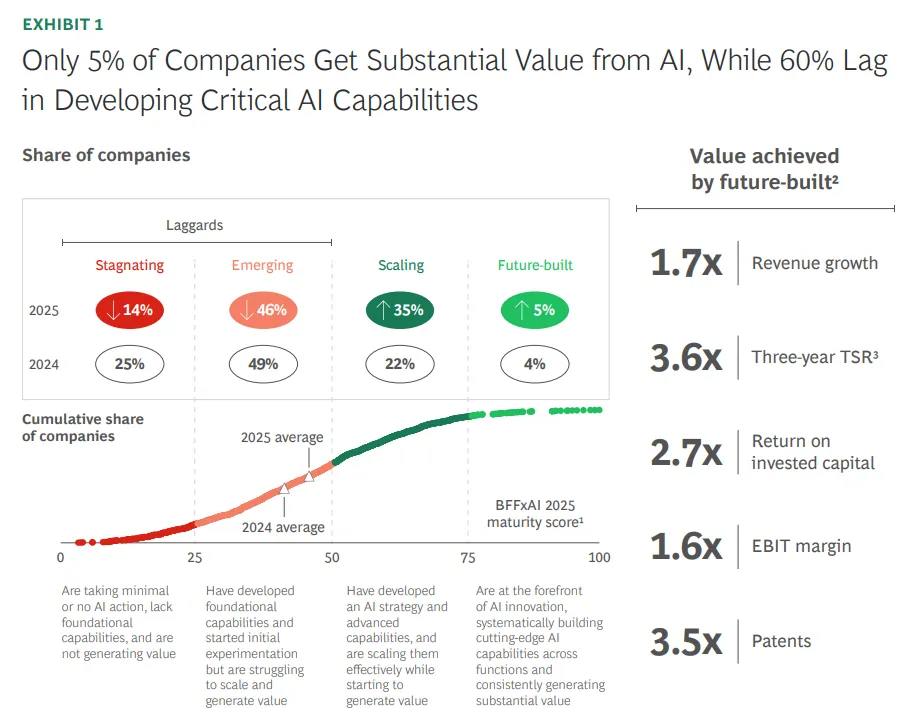
Between 2024 and 2025, the share of companies systematically building AI capability across functions and consistently generating substantial value moved from 4% to 5%, according to the BCG “Widening AI Value Gap: Build for the Future 2025” Report.
- AI Is Treated as a Tool Instead of a Digital Worker: A digital worker has a defined job, success criteria, boundaries, escalation paths, and performance expectations, the same way a human hire does.
- Screening Logic Runs Without Feedback Loops: Screening improves only when the system learns from outcomes. Client feedback, hiring manager decisions, placement success, assignment completion, retention, and performance signals should all refine future decisions. When the screen runs open-loop, it repeats the same mistakes at scale and never gets sharper, no matter how much volume passes through it.
- Candidate Data Stays Fragmented Across Systems: Fragmented data limits both the digital worker and the human. A digital worker cannot make strong recommendations from partial or incorrect context, and a recruiter cannot make fast decisions when a candidate's history is scattered across disconnected tools.
- Intelligence Never Compounds Across Roles, Clients, or Hiring Cycles: High-volume recruiting should get smarter every time the team fills a role. When systems only store activity, every search starts too close to zero. When systems retain signal, each cycle makes the next decision stronger. The compounding is the entire point of running volume through one connected model instead of a series of disconnected searches.
Staffing Firms Lose Revenue When Priority Logic Lives Outside the System
For a staffing firm, priority logic that lives in a recruiter's head is revenue exposure. Every judgment call about what to work first is a margin decision made without the full picture in view.
- Client Urgency Competes With Margin: A staffing firm needs to see urgency alongside margin, fill probability, relationship value, and available talent, all in one view, so the desk works the order that protects the business.
- New Orders Compete With Redeployment: New orders pull attention away from talent the firm already knows. Redeployment should be the first signal a recruiter sees when a matching order opens, because it is the highest-margin placement type the firm has. When redeployment is invisible, the firm pays to source what it already had on the bench.
- Recruiter Activity Competes With Placement Quality: High activity makes a desk look productive while weak matches keep costing margin. Activity only matters when it produces stronger placement outcomes. A firm that measures movement instead of margin will always look busy on the days it is losing the most money.
Corporate Teams Lose Quality When Speed Becomes the Only Visible Metric
When time-to-hire is the only number leadership watches, the whole function optimizes for it, and everything the number cannot see gets sacrificed to make it look good.
- Candidate Experience Becomes Inconsistent: In high-volume corporate hiring, candidate experience has to be supported by the system, or it becomes dependent on whichever recruiter happens to have a free minute. Inconsistent experience at scale is how a strong employer brand erodes one ignored candidate at a time.
- Hiring Manager Feedback Becomes the Constraint: Recruiters can move candidates quickly right up until the process hits a hiring manager bottleneck. Unstructured feedback, unclear decision rights, and slow review cycles erase every hour of upstream speed. The pipeline is only as fast as the slowest decision it depends on, and that decision usually sits with a hiring manager who was never given a structure to make it faster.
- Screening Standards Drift Across Teams: When many recruiters and hiring managers work similar roles, small differences in interpretation become large quality gaps. Structured criteria, shared scoring, and governed exceptions keep the process consistent without stripping out the judgment that hard cases need.
How to Tell When a Role Needs a High-Volume Recruiting Model
The transition to high-volume recruiting is usually gradual. Workloads increase, timelines shrink, and coordination becomes more difficult until the existing process starts to strain. The indicators below help determine when it is time for a different operating model.
Step 1: Identify Whether Demand Is Repetitive, Time-Compressed, or Multi-Role
High-volume recruiting shows up in patterns. Recurring client orders, seasonal ramps, multi-location demand, campus hiring, call center hiring, field hiring, and expansion across similar role families all lead to the same operational challenges.
If you are filling the same profile many times, on a deadline, across locations or clients, you are running high-volume work whether or not you have named it that. Naming it is what lets you stop applying a model built for single, careful decisions.
Step 2: Separate Judgment Work From Repeatable Execution Work
The first design move is deciding what humans should own and what digital workers can execute.
- Repeatable execution:
- Screening against known criteria
- Scheduling
- Interview reminders
- Status updates
- Candidate routing.
- Human judgment:
- Exceptions
- Close relationship calls
- Offer strategy
- Final decisions.
Step 3: Define Priority Logic Before Automating the Workflow
Staffing firms need rules for urgency, margin, client value, fill probability, redeployment, and readiness. Corporate teams need rules for business impact, quality risk, hiring manager readiness, candidate stage, and timeline pressure. Write the rules first, agree on them, and then let the workflow enforce them.
Step 4: Build Screening Criteria Around Outcomes, Not Resume Volume
Screening should start from what successful work looks like after the hire or placement, then work backward. Working backward means assignment fit, client requirements, availability, compliance, competencies, quality signals, and structured evaluation criteria.
Criteria built around resume volume ask how many applicants can be processed, while criteria built around outcomes ask which applicants become successful hires. The second question is harder to answer and far more valuable, because it ties the screen to the result the business actually cares about.
Step 5: Decide Which Metrics Prove Scale Is Working
The right metrics show whether scale is producing better outcomes or just more motion.
- Staffing firms: fill rate, redeployment rate, gross profit, submittal-to-start ratio, and client response time.
- Corporate teams: candidate conversion, interview-to-offer ratio, drop-off rate, offer acceptance, and quality of hire.
Step 6: Design the Human and Digital Worker Handoff
A scalable model needs clear handoffs between human recruiters and digital workers. Digital workers handle structured execution, while humans handle judgment, escalation, relationships, and decisions.
The handoff points have to be designed on purpose, so work moves cleanly across the line instead of falling into the gap between them.
The 2024 Accenture “Work, Workforce, Workers: Reinvented in the age of Generative AI” Report found that 94% of workers are ready to build generative AI skills, while only 5% of organizations are training them to do it at scale.
Asymbl: High-Volume Recruiting Built Around Talent Relationship Management
High-volume recruiting needs connected talent data, reusable signals, explicit priority logic, digital workers with defined responsibilities, and human recruiters focused on the work that genuinely requires them.
Asymbl calls this workforce orchestration: designing, managing, and scaling a blended workforce of human and digital workers so they operate as one.
In recruiting, that discipline is Talent Relationship Management, managing candidate relationships across the full lifecycle with connected data, intelligent matching, structured workflows, and digital labor.
Recruiter Suite Connects Sales, Recruiting, and Talent in One Operating Environment
Asymbl Recruiter Suite is built on one Salesforce foundation for managing talent relationships, job workflows, candidate movement, and reporting.
For staffing firms, gross profit, fill rates, and redeployment signals surface in real time on the records the front office already works in, so the highest-margin placement becomes a function of data rather than memory.
For corporate teams, recruiting outcomes connect to the post-hire and business data the function is measured on, so quality of hire becomes a live query instead of a quarterly reconciliation.
Talent Intelligence Turns Existing Candidate Data Into Reusable Signal
Asymbl Talent Intelligence turns candidate history, relationship data, activity, and outcomes into signals that support better matching, prioritization, and screening.
It reads pipeline history, interview feedback, assignment outcomes, and hiring manager preferences, then evaluates candidate and job data the way a recruiter would rather than matching keywords the way a parser does.
Natural language search replaces Boolean expertise, so the recruiter who knows the role can find the right people the way they actually think. The reasoning engine surfaces the silver-medalist the moment a similar role opens and flags the redeployment candidate the day the contractor becomes available, instead of waiting for someone to remember the name.
Every recruiter interaction becomes a signal the next decision can draw on, which is how intelligence compounds across roles, clients, and hiring cycles instead of resetting to zero on every search.
Digital Recruiter, Rosa, Expands Screening and Coordination Capacity With Defined Digital Work
Asymbl Digital Recruiter, Rosa, is a pre-built digital worker that handles the repeatable execution consuming recruiter time at high volume. Screening, outreach, scheduling, and workflow movement become defined digital work with a job description and success criteria, running on the same environment as the human team, rather than scattered automation the recruiter has to babysit.
Rosa, A Digital Recruiter, gave a two-person recruiting team the capacity to hire 100 people in 100 days, processing 17,000 applications, pre-screening 1,800 candidates, and scheduling 800 interviews, with a 47% increase in fill rate and a 26x return on investment.
The recruiters focused on relationships and judgment, while the digital worker handled the volume. This is the human and digital handoff from Step 6, running in production on one data foundation.
Make High-Volume Recruiting Sustainable
High-volume recruiting rewards the teams that stop treating volume as a recruiter capacity problem to be solved with more headcount or more tools. Scale is an operating model question.
The teams that clear it design the work around priority, signal, human judgment, digital execution, and feedback, and they do it before the volume arrives rather than after it breaks something.
Ask:
- Whether your priority logic lives in a system or in someone's head
- Whether a candidate's full context reaches the recruiter at the moment of decision or a week later
- Whether your screening gets sharper every cycle or repeats the same misses at greater speed.
The answers tell you whether you have a high-volume model or a low-volume workflow being pushed past what it was built to carry.
If your recruiters are spending more time coordinating than closing, the constraint is the operating model around them. Asymbl brings human and digital recruiters onto one talent data foundation.
Book a demo to see how Asymbl empowers teams to screen and hire at volume without losing quality.
.webp)
How to Measure AI ROI: A Framework for Outcomes-Based AI Implementation
Discover how outcomes-based thinking and Asymbl's Design, Onboard, Coach framework turn AI investments into measurable workforce ROI.

The Right Fit Starts With a Conversation.
See what working together could look like.
.webp)