

Staffing firms often research the same talent markets repeatedly instead of building a reusable view of the people they already know, the companies they come from, and where qualified talent is available.
Recruiters search, screen, submit, and close a role, but much of the market knowledge gathered during that process gets buried in ATS records, recruiter notes, inboxes, and individual memory.
Talent mapping turns scattered information into a structured view of a target talent market. It connects people to skills, experience, employers, availability, engagement history, and prior interactions so recruiters can identify relevant talent before a job order becomes urgent.
This guide explains why talent maps often fail to become useful recruiting assets, how to build one step by step, and how staffing firms can turn accumulated talent intelligence into faster, more proactive recruiting.
What Prevents Recruiters From Building a Useful Talent Map Early
The recruiting history staffing firms log in their CRM doesn’t convert into a usable market view as efficiently and often as it should. The following reasons explain why:
1. Talent Discovery Often Starts Only After a Requisition Arrives
Staffing recruiters start defining the talent market for the first time only after a client releases a job order.
- Define the target market
- Search for talent
- Check internal records
- Decide who is worth a first call
For a hard-to-fill role with a tight deadline, research begins at the same moment the client expects visible progress. Other firms are often working on the same job order in parallel.
Competition for talent has decreased since its post-pandemic peak, but hiring still moves fast. According to Gartner’s “Voice of the Candidate Survey Analysis (Q1 2025): Competition, Talent Attractors, and Onboarding”, 44% of prospective candidates received multiple job offers. The same research also revealed that 35% of surveyed candidates backed out after accepting the offer.
Every day spent learning the market instead of contacting already engaged candidates pushes submission further out because the recruiter capacity goes into understanding the target market’s:
- Skills
- Experience
- Expectations
- Pay range
Proactive talent mapping moves that discovery earlier, so the search opens with a market the firm already understands.
2. Existing Talent Data Does Not Always Reflect Current Fit or Availability
A talent record captures:
- Roles changed
- Experience gained
- Projects undertaken
The target candidate may have also grown more open to a move, or talked to the firm again without anyone updating the file. A database can hold thousands of potentially relevant people without making clear who actually fits today.
For example, a specialist who did hands-on work two years ago may now lead a small team and be actively looking for a switch. The record is neither open nor closed in the system, just stale.
3. Talent Knowledge Is Spread Across Recruiters, Systems, and Past Searches
Talent knowledge is often attached to the candidate record itself, but it never reaches a note field a search would ever find.
For example, one recruiter knows why a candidate turned down a role last spring, a compensation gap that has likely since closed. Another has interview feedback from a search that closed months ago, and an account owner remembers a client responding well to that candidate once.
This feedback is often not logged into the note field in the CRM, so there’s a blind spot. The candidate might be worth reaching out to when a similar job order comes in. However, all this candidate context exists in different systems:
- Individual recruiters’ inboxes
- ATS notes
- Recruiter memories
So, the firm doesn’t have a consolidated view of the candidate’s engagement journey with their recruiters. This fragmentation increases further as the underlying database grows.
For example, two recruiters on the same client can independently source the same candidate, each unaware of the other's relationship. The client often notices before either recruiter does.
Talent mapping depends on what one recruiter happens to log in the system instead of collective context accumulated by both the recruiters. Finding the context that is not logged in the shared system means finding the right person, asking the right question on the right day.
When that recruiter is out for a week, works another search, or leaves the firm, the knowledge is effectively gone.
4. Hard-to-Fill Markets Are Often Researched From Scratch for Each Requisition
A recruiter builds a list for one requisition, works the search, and moves on once the role closes. When a similar job order returns, a new round of research starts again. This churn compounds a market already moving faster than most firms can track internally.
According to an October 2024 Gartner survey of 190 HR leaders, 48% agreed the demand for new skills is evolving faster than existing talent structures and processes can support.
How to Build a Talent Map That Supports Proactive Recruiting: Step-by-Step Guide
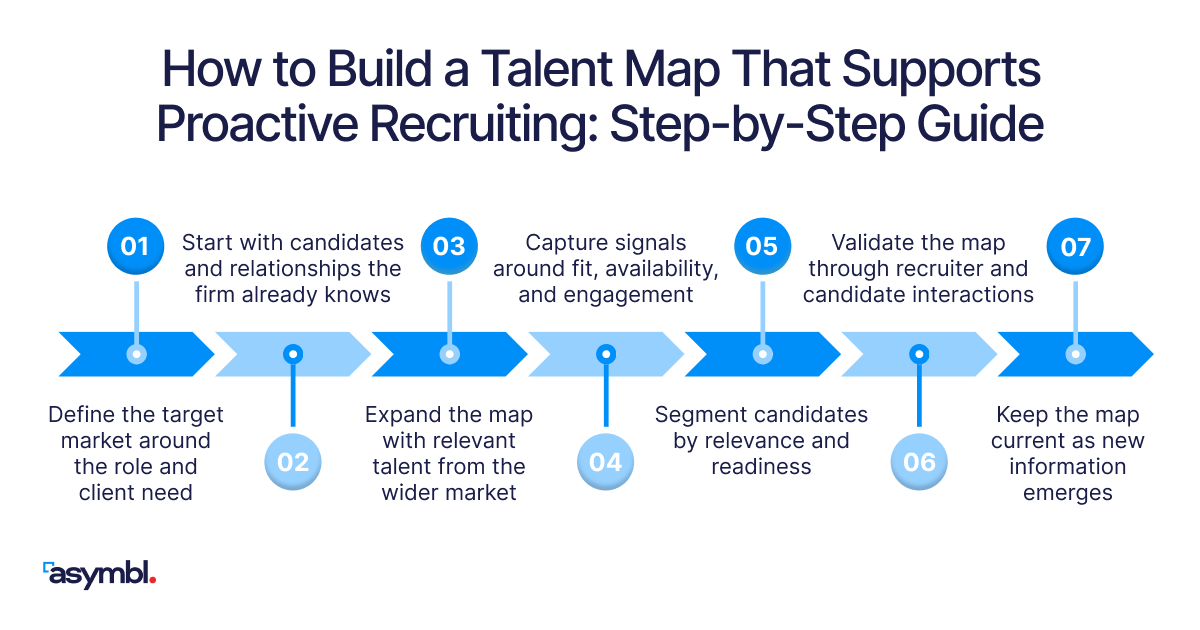
Proactive recruiting means building the talent map deliberately instead of reconstructing it each time a role opens. The process moves from a market definition to a prioritized group of people the firm can realistically engage. It draws on both external research and the relationships the firm owns.
Step 1: Define the Target Market Around the Role and Client Need
Talent mapping starts with a market defined clearly enough to know who belongs in it. The boundaries can include:
- Role type
- Skills
- Experience
- Industry
- Geography
- Relevant employers
- Adjacent backgrounds connected to the client need
For recurring staffing demand, the market should extend past one live requisition, so the talent map stays relevant and updated across similar future roles.
Setting the boundary too wide produces a list nobody can work through, while setting it too narrow leaves the map dependent on a handful of names. This list dries up the moment two of them take other jobs.
Step 2: Start With Talent and Relationships the Firm Already Knows
The quickest placement from a talent map is usually the one the firm placed two years ago because the firm already paid for this information once through a prior search.
- Previously engaged people
- Silver medalists
- Former placements
- Prior submissions
- Referrals
- Sourced passive talent
These candidates are often more placement-ready than anyone realizes until someone actually looks. Their records can carry conversations, interview feedback, reasons for declining, prior client interest, and placement history. A fresh external search cannot produce that context on day one, no matter how good the sourcing tool is.
According to Accenture’s 2025 “360° Value Report,” referrals accounted for 24% of Accenture’s overall hires.
Step 3: Expand the Map With Relevant Talent From the Wider Market
The internal database doesn’t cover the entire talent market, especially for difficult or specialized roles. External research extends the view into:
- Target companies
- Adjacent industries
- Related functions
- Other geographic markets worth tracking
Professional networks, industry associations, and alumni groups from specific training programs can all surface people who fit a niche market. These are people who have never applied anywhere or shown up in a prior search. This expansion needs to stay tied to the target-market definition.
Step 4: Capture Signals Around Fit, Availability, and Engagement
Talent maps get more useful once recruiters understand people through:
- Profile
- Experience
- Career progression
- Prior interactions
- Interview feedback
- Engagement
- Availability
These factors influence how recruiters prioritize a person. These signals separate someone who looks relevant on paper from someone likely to become a credible submission for the client.
Step 5: Segment Talent by Relevance and Readiness
Different candidates in the talent map exist at different levels of relevance and relationship maturity. Treating them as equally reachable wastes the time spent building the map because some are strong matches the firm already knows well. Others fit the market but need more engagement before they are ready.
Segmentation gives recruiters a clear order of action, separating high-priority talent from longer-term prospects and lower-confidence possibilities. A simple three-tier structure like:
- Ready now
- Warm but not currently looking
- Adjacent but worth tracking is often enough
It turns a long list into a simple, workable list.
Step 6: Validate the Map Through Recruiter and Talent Interactions
- Research builds the first view of the market
- Candidate engagement adds more context
- Interviews and calls clarify actual responsibilities, achievements, interest in moving, compensation expectations, geography, and timing
These details are hard to infer from a profile or a resume. Every interaction can confirm or challenge an assumption about the person or the market itself.
A conversation might reveal that a person the research flagged as senior wants to step back into a hands-on role. It might also reveal that a company assumed to pay below market rate raised compensation twice this year, and surface a name the original research never found at all.
The talent map gets more accurate as recruiter judgment and direct feedback add to the original research.
Step 7: Keep the Map Current as New Information Emerges
Talent markets keep changing after a firm builds the initial map because of:
- New conversations
- Interviews
- Submissions
- Placements
- Rejections
- Job changes
- Engagement signals
A working talent mapping process carries these updates forward, and the next search starts from the latest information. A map reviewed once a quarter on a fixed schedule is out of date for half the people on it.
Practical triggers work better than a calendar reminder to review the whole map. For example:
- An assignment approaching its end date
- A person reaching a final interview without being selected
- An already placed person resurfacing after eighteen months
This keeps the map current without turning into a standalone project. The map becomes an ongoing view of the market rather than a snapshot built for one job order and then forgotten.
How to Strengthen Your Talent Mapping Strategy
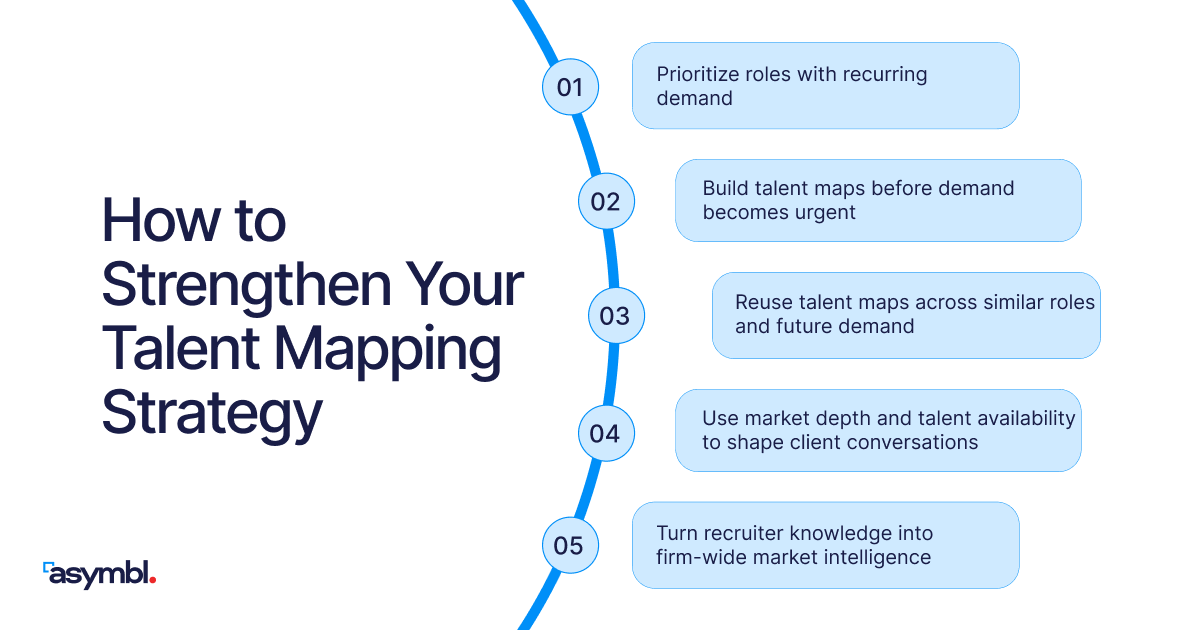
The best talent mapping strategy is to know which markets deserve your investment and how to compound what recruiters learn from working them.
1. Prioritize Roles With Recurring Demand
Three or four role types usually drive most of a firm's repeat placements, and they often appear across clients, require specialized skills, or consistently run short on available talent.
Focusing on the recurring roles enables recruiters to build deeper knowledge, track availability and readiness, and build stronger pipelines. Faster access to qualified talent changes the placement outcome.
A firm that fills the same three or four role types for most clients gets the best ROI from mapping those markets. Niche expertise beats spreading the same effort thin across every job order.
2. Build Talent Maps Before Demand Becomes Urgent
Recruiters who wait for a client request to start discovery are already behind the market. Building that visibility ahead of a client request makes a map worth the effort.
This applies especially to roles the firm expects to recruit repeatedly. This lets a firm open a new search already knowing the landscape. A firm that does this also spends less time rebuilding lists. It moves faster from order intake to qualified submission.
The upfront work happens on the firm's own schedule, during a normal week. This differs from the first frantic days of a client deadline. The timing changes both the quality of the research and who has time to do it well.
3. Reuse Talent Maps Across Similar Roles and Future Demand
A person who missed one role can still be valuable for another client or a future job order. Previous searches also produce market knowledge, covering which companies hold talent, availability patterns, compensation, and skill adjacencies.
This knowledge includes which profiles tend to progress through a process. None of it depends on whether that particular search ended in a placement. Carrying that knowledge forward means the next search starts from an established market view.
Consider a person turned down for a permanent role in January because the client wanted more leadership experience. This same person may be exactly right for a different client's individual-contributor search in June. The firm just has to remember that history instead of treating the earlier no as a dead end.
4. Use Market Depth and Talent Availability to Influence Client Conversations
A narrow qualified pool can signal that a client's requirements are constraining supply. This is evidence a recruiter can bring to a conversation, instead of an opinion the client has to take on faith.
A larger adjacent market can show that relaxing one criterion would open up the options considerably. This evidence reframes a client conversation about scarcity into one about tradeoffs the client actually controls. Availability and engagement patterns can also point to how competitive or difficult a search will be.
This changes how a recruiter sets expectations before the client hears them secondhand from a frustrated hiring manager. Recruitment market mapping becomes part of client advisory this way. It gives staffing consultants a clearer basis for discussing what the market can realistically support.
5. Turn Recruiter Knowledge Into Firm-Wide Market Intelligence
Previous conversations, interview feedback, talent preferences, client reactions, placements, and outcomes add up to a database of recruiting intelligence. This intelligence can improve future searches once it is consolidated at the firm level.
Different recruiters and account teams can then build on prior work. A recruiter who inherits a market from a colleague who left the firm should not have to start over. The relationships still matter even after the person who built them is gone.
Capturing why a person declined a role turns individual judgment into something the next search can use. So does capturing what a client actually meant by "senior enough."
How Asymbl Supports Proactive Talent Mapping
A talent map is only as strong as the systems holding it together. Market research, relationship history, and outreach capacity all have to work from the same system and context, or the map fragments right back into separate silos. Asymbl builds its Workforce Orchestration system toward exactly that kind of connected foundation.
1. Recruiter Suite Connects Talent, Client, and Recruiting Context
Asymbl Recruiter Suite is a Salesforce-based Talent Relationship Management (TRM) application that covers the full staffing hiring cycle, from sourcing through placement with the applicant tracking system (ATS) capabilities staffing firms expect. It unifies sourcing, matching, engagement, interviewing, and placement in one environment.
- Contact Management keeps every relationship at the firm level. It organizes talent and clients in one place and preserves a full communication history for every contact.
- For talent mapping, relationships and history stay connected to the jobs, clients, and workflows that make them commercially useful.
- Pipeline Management gives the team a shared, real-time view of every person across every open role. Recruiters see it in whatever layout they actually work from.
2. Talent Intelligence Surfaces and Prioritizes Relevant Talent
Asymbl Talent Intelligence runs a natural-language search instead of Boolean queries, so recruiters can search the way they actually think. Its reasoning engine evaluates fit the way a recruiter would. It weighs fit, likelihood, and confidence, rather than producing a flat percent-match score.
Job applicants are skeptical when artificial intelligence (AI) evaluates them. According to a 2025 Gartner Survey, just 26% of candidates trust that AI will evaluate them fairly, even though 52% believe AI already screens their applications.
A reasoning engine that explains fit, likelihood, and confidence addresses the candidate skepticism better than a black-box score ever could. The reasoning draws on the ATS, the customer relationship management (CRM) system, email, call, and interview history.
This comprehensive context allows recruiters to tell higher-priority talent apart from a broader pool. In a talent mapping process, that turns market coverage into a prioritized pipeline.
3. Asymbl Intelligence Brings Recruiting Signals and Context Together
Asymbl Intelligence is the platform running underneath Recruiter Suite and Talent Intelligence. It captures the judgment, context, and pattern recognition that build up across every workflow, decision, and outcome. This signal becomes available to every worker, human or digital, working from the same map.
For a talent map, a person's skills, communications, process history, and outcomes become context for the next decision. None of it has to sit as isolated notes from a requisition that already closed.
A note a recruiter wrote after a screening call two years ago becomes retrievable context. So does a client's offhand comment about wanting someone with a specific certification.
4. Rosa, a Digital Recruiter, Activates Mapped Talent Through Sourcing, Engagement, and Follow-Up
Rosa, a Digital Recruiter, handles the outreach and screening volume a talent map creates once a firm builds it. She scales personalized outreach to large talent pools, with recruiters setting the strategy while Rosa carries the volume.
She also screens applications against job criteria and manages interview scheduling, including logistics and rescheduling. This is the kind of coordination work that consumes a disproportionate share of a recruiter's day. It rarely moves a specific person closer to a placement on its own.
Once recruiters have identified and prioritized the right talent, Rosa can carry the execution needed to engage that pipeline. Recruiters then stay focused on relationships, judgment, and the client conversation.
Talent Mapping Turns Recruiting History Into a Repeatable ROI
A talent map goes stale fast if a firm builds it once and leaves it untouched. Keep your talent map updated through every recruiting activity.
This simple talent map management approach changes the outcome of recruiting logistics. A search that starts from an existing map needs less sourcing spend and fewer hours rebuilding context. It also takes less time to prove to a client that the firm understands the market.
The recruiters who benefit most work at firms that have already turned scattered recruiting history into a shared, current asset. This asset replaces private notes no one else can find.
Asymbl builds Recruiter Suite, Talent Intelligence, and Rosa to carry that work without adding to a recruiter's plate. Book a demo to see how a talent map and a digital recruiter turn into faster submittals on hard-to-fill roles.
FAQs
Talent mapping is the ongoing practice of researching and organizing a target talent market (the people, skills, employers, and availability in it) before a specific role opens, so recruiters can engage qualified candidates faster when demand arrives.
Candidate mapping is the tactical work of building a shortlist against one specific requisition, drawn mostly from active applicants. Talent mapping is the broader, ongoing research a firm keeps current before a role opens, covering active and passive people across an entire market.
Effective talent mapping tools connect internal recruiting history to external market research instead of treating them as separate steps, let recruiters search by fit and context rather than exact keyword matches, and preserve relationship history at the firm level so a map survives a recruiter leaving. Tools that only source new names without organizing what a firm already knows solve half the problem.
A workable first version can take shape in one to two weeks for a role the firm has filled before, since much of the map comes from existing records. A genuinely new or highly specialized market can take four to six weeks of combined internal review and external research.
Talent mapping works best as a shared responsibility rather than a side project for one person. Individual recruiters contribute the relationship context and market read only they have, while a shared system or designated owner keeps the map current and makes sure a departing recruiter does not take the market knowledge with them. Full-desk and split-desk firms both need this coordination, just through different workflows.
Yes. Talent mapping scales down to firm size by starting narrow: pick one or two markets the firm fills repeatedly, build from existing placements and submissions first, and expand externally only as time allows. A two-person desk doing this consistently for the markets it fills most often will out-map a larger firm that treats every requisition as a blank page.
The Best Staffing Software Solutions for Growing Firms
Choosing staffing software with billing built in? See which platforms run pay, bill, and recruiting on one record. Learn more

The Right Fit Starts With a Conversation.
See what working together could look like.
