

Chapter 1: The Foundation: Why Your AI Spend, Software Stack, and Recruiter Capacity Are One Workforce Decision
In 2025, the promise of AI was simple: speed, scale, quality, and growth without the extra headcount. The companies that believed in that promise announced layoffs, and investors rewarded the cuts. After deploying AI, those same companies found the anticipated returns didn't follow in 2026.
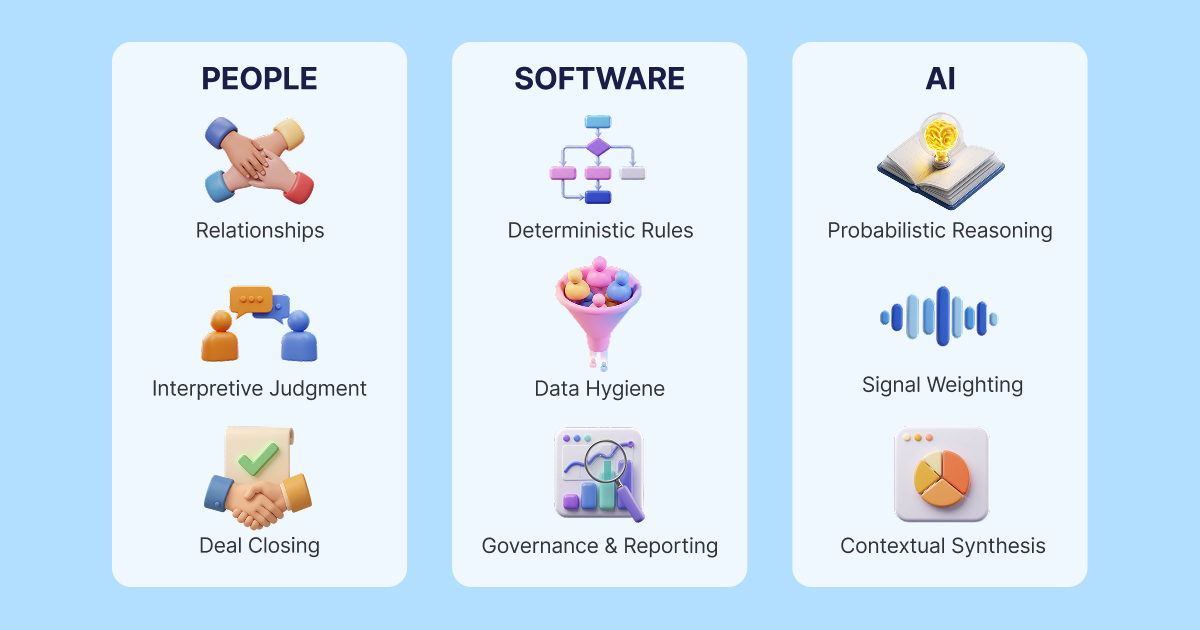
AI's potential doesn't exist in automating tasks or replacing workers one for one. AI ROI comes when you rethink how work gets done between your people, software, and AI. It requires redesigning the operating model and equipping people with new skills to succeed in a workforce where people and digital workers operate together.
Now, the companies that cut headcount, expecting AI to fill the gap, will be rehiring in 2027. They'll hire for evolved roles that fit a new way of working, and the talent they need is scarce, more competitive, and harder to reach:
- Correction Underway: Standard layoffs sit at a low 5.3% baseline, but AI-driven workforce cuts are triggering an immediate snapback. Robert Half (2025) found that 29% of hiring managers who eliminated roles due to AI have already rehired into those positions; and Forrester Research (2025) reports that 55% of employers who made those cuts now regret them.
- Staffing Firms Are the Way In: As displaced talent moves back into evolved roles, the U.S. Bureau of Labor Statistics (2026 Worker Displacement Report) reports that 67.6% of displaced workers have been reemployed.
Staffing firms can capture that demand, but not with systems and data most are running today. Every firm needs predictability, cost efficiency, and speed, yet three core challenges stand in the way:
- Systems don't connect. Recruiters work across a CRM, an ATS, and spreadsheets that don't share data. Each holds a fragment of the same candidate's story, and no single view brings them together.
- Data isn't enriched. Staffing firms sit on databases of hundreds of thousands to millions of candidate records that nobody trusts enough to search first. Recruiters default to sourcing from scratch because starting over feels safer than relying on what's already there.
- AI wasn't built for staffing. The AI tools available to most firms were designed for general business use, not for the specific workflows, relationships, and data structures that staffing operations depend on.
Before staffing firms can evaluate what to buy, what to build, or where AI fits, they have to understand how work should get done today, who or what should be doing each part of that work, and what's required to support their people and digital workers to deliver on it.
Designing How Work Gets Done: People, Software, and AI as One Workforce
Staffing firms that want to capture the rehiring wave can't start by shopping for technology. They need to start by defining how work gets done inside their firm. Leadership breaks work down by type, assigns the right worker (people, software, or AI) to each task, and builds the processes that let every worker deliver. Cost efficiency, speed, and productivity follow from getting those assignments right, well before any tool is added.
In August 2026, Stacia Garr argued in Harvard Business Review that AI investment is an organizational design decision. For staffing firms, that design decision starts with three workforce choices.
1. Where AI Belongs
AI can handle a wide range of digital work. Deciding where it belongs is what protects your investment. Deterministic software already handles repeatable workflows: candidate storage, rules-based routing, reporting, and governance. Forcing AI into these functions drives up consumption costs while duplicating capabilities you already pay for in your ATS. AI earns its cost in work that requires probabilistic reasoning: surfacing hidden talent patterns across large candidate pools and connecting incomplete data. The added challenge is that much of the AI on the market wasn’t built for staffing. Because it lacks the context to read recruiter workflows, margin structures, and candidate-client dynamics, staffing firms need AI expertise with staffing depth to guide where AI belongs and how to build it.
2. Capturing Full Value From Your Existing Tech
Staffing firms have already invested in software, and few are getting the full return on it. The first move is making the systems you own the place where work gets done. Existing software should be the first place you turn for data hygiene, process, rules, and governance. Once it's doing that work, any other gaps reveal whether you need better configuration, new software, or AI to do the work your software can't.
3. Redirecting Capacity to the Work People Were Hired For
Your people spend their hours on admin across selling, recruiting, reporting, and operations when data isn't reliable or teams haven't adopted the systems in place. Margin evaporates when people carry administrative work instead of building client relationships. Not every admin problem needs a digital worker. Automation inside the software you already own is often the cheaper, faster place to fix it. BCG's 2026 AI Radar survey found that only 6% of companies see meaningful value from AI, largely because productivity gains get reabsorbed before the work is redesigned. Designing the work around the right worker frees people to focus on the placements they're paid to make: candidate engagement, client acquisition, and deal closing.
Knowing What to Buy, What to Build, and What to Walk Away From
The AI staffing technology market is flooded with point solutions. From sourcing, to screening to scheduling to matching and analytics, every vendor promises to fix part of the problem. Each tool adds a subscription, an integration, and a new set of data that lives outside your core system. Individually, each purchase may seem reasonable, but together their disparate connections recreate the fragmentation your firm was trying to solve.
Deciding what to buy, what to build, and what to walk away from isn't a checklist. It traces back to the three choices above: how work should get done, who or what does each part of it, and what your people and digital workers need to deliver. The chapters that follow work through the operational challenges where those decisions play out: budget, connected data, speed, talent, redeployment, and scale, so you can define what to buy, build, or walk away from with the full picture in front of you.