

Chapter 3: Connected Data and Systems: Your Database Is an Asset or a Liability
The Pressure
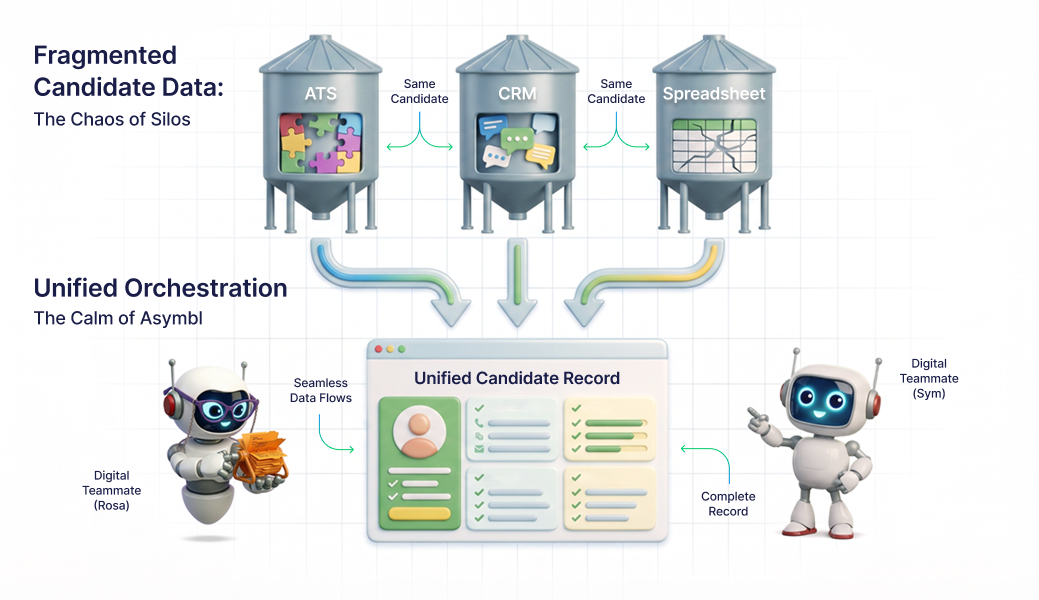
Staffing firms typically sit on years of candidate data spread across disconnected systems: an ATS managing active requisitions, a CRM managing client contacts, and spreadsheets that cover everything neither system handles.
While the data exists, recruiters know better than to over-rely on it. When systems don't talk to each other, recruiters default to beginning from scratch every time, and the institutional knowledge locked inside those records goes unused. As the hiring surge builds and firms need to re-engage candidates who've gained new capabilities during the downturn, that unused data becomes a competitive asset or a missed opportunity depending on whether anyone can search it.
The Key Insight
Data quality is a revenue leak that’s often dressed up as a technical afterthought.
Every duplicate candidate record, stale contact, and placement history living in a recruiter's personal notes represents revenue the firm can't systematically access. Connected data across a unified TRM system makes candidate history, client relationship context, and placement patterns visible to the whole firm, including the parts of it that never worked directly with a given candidate. When a recruiter leaves, the firm gets to keep the knowledge that recruiter built.
Data quality is a revenue leak that’s often dressed up as a technical afterthought.
Our Recommendation
Audit your candidate database before adding any AI capability. Identify the percentage of records updated in the last 12 months, the percentage with a complete placement history, and the percentage with contact information your team trusts.
AI tools are only as good as the data they run on. A connected TRM system with clean data compounds in value every day. A disconnected system with stale data produces results that undermine confidence in the entire modernization effort.
Data Quality Audit
Before you add AI, know what you're feeding it.
Total active candidate records: [input]
Updated in the last 12 months: [input] → [X]%
With a complete placement history: [input] → [X]%
With contact info your team would use without double-checking: [input] → [X]%
These are the numbers few firms have calculated. Gartner predicted that organizations would abandon 60% of AI projects through 2026 when the data it accessed wasn’t ready; and early indicators suggest the prediction is holding.
The audit takes days, not months, and it gives leadership a concrete baseline to measure improvement against once a connected system is in place.
Why Disconnected ATS and CRM Systems Are the Biggest Barrier to Modernization
Disconnected systems rarely get built on purpose. They accumulate, one point solution at a time, and at any given moment an ATS handles requisitions, a CRM handles client relationships, and a spreadsheet absorbs everything neither system was built to track.
Each addition solves an immediate problem and creates long-term issues: three systems that don't talk to each other, three versions of the truth about the same candidate, and a recruiter left to reconcile the differences by hand every time a record needs updating. That reconciliation work never shows up on a report, but it consumes hours every week and erodes trust in the data itself. Whether the fix is consolidating into one system or building a targeted integration layer across existing tools depends on the firm's infrastructure. The gap to close is the same either way: one candidate, one record, one version of the truth.
How Connected Systems Protect Institutional Knowledge Through Recruiter Turnover
A recruiter who has worked a desk for five years carries more than an activity log. They carry context: which contact makes hiring decisions at a client, which candidate turned down an offer for reasons that never made it into a note, which placement fell apart for reasons worth remembering next time. When a firm's client intelligence depends on which recruiter remembers what, the firm has built a single point of failure into its revenue model. A connected system removes that dependency by capturing context as it's created and attaching it to the record instead of the person.
Key takeaway:
A connected system captures recruiter context as it's created and attaches it to the candidate or client record instead of the recruiter's memory.
The Prerequisite Work Before AI Adds Value to a Staffing Operation
AI tools inherit the quality of the data underneath them.
Gartner projected that through 2026, organizations would abandon 60% of AI projects that aren't backed by AI-ready data. A matching algorithm trained on duplicate records and stale contact information will confidently produce bad matches at scale. That's worse than producing no matches at all, because it looks like progress while actively wasting recruiter time chasing candidates who aren't real prospects.
The prerequisite work is unglamorous: deduplicating records, updating stale contacts, and connecting systems that currently operate in isolation. That groundwork has to happen first, or every cost structure pays the price. AI consumption runs produce bad matches. The software investment loses credibility with the team. And recruiters burn allocation hours chasing candidates who aren't real prospects.
If I pulled a random sample of 20 records from your candidate database right now, how many do you think would have accurate, up-to-date contact information?