

Chapter 2: Budget: Reframe the Investment Before You Justify the Cost
The Pressure
Staffing is a margin business, and every dollar of overhead that doesn't generate a placement has to earn its place. With hiring demand building and the roles themselves evolving, that scrutiny is about to intensify. That scrutiny falls hardest on technology spend, when the ROI case lands on the desk of a founder or COO who's watched vendors overpromise and underdeliver. The evaluation usually starts by interrogating the price tag of a new platform, a number that never truly captures what the current way of working already costs across all three budget realities: AI consumption, software licensing, and recruiter time.
The Key Insight
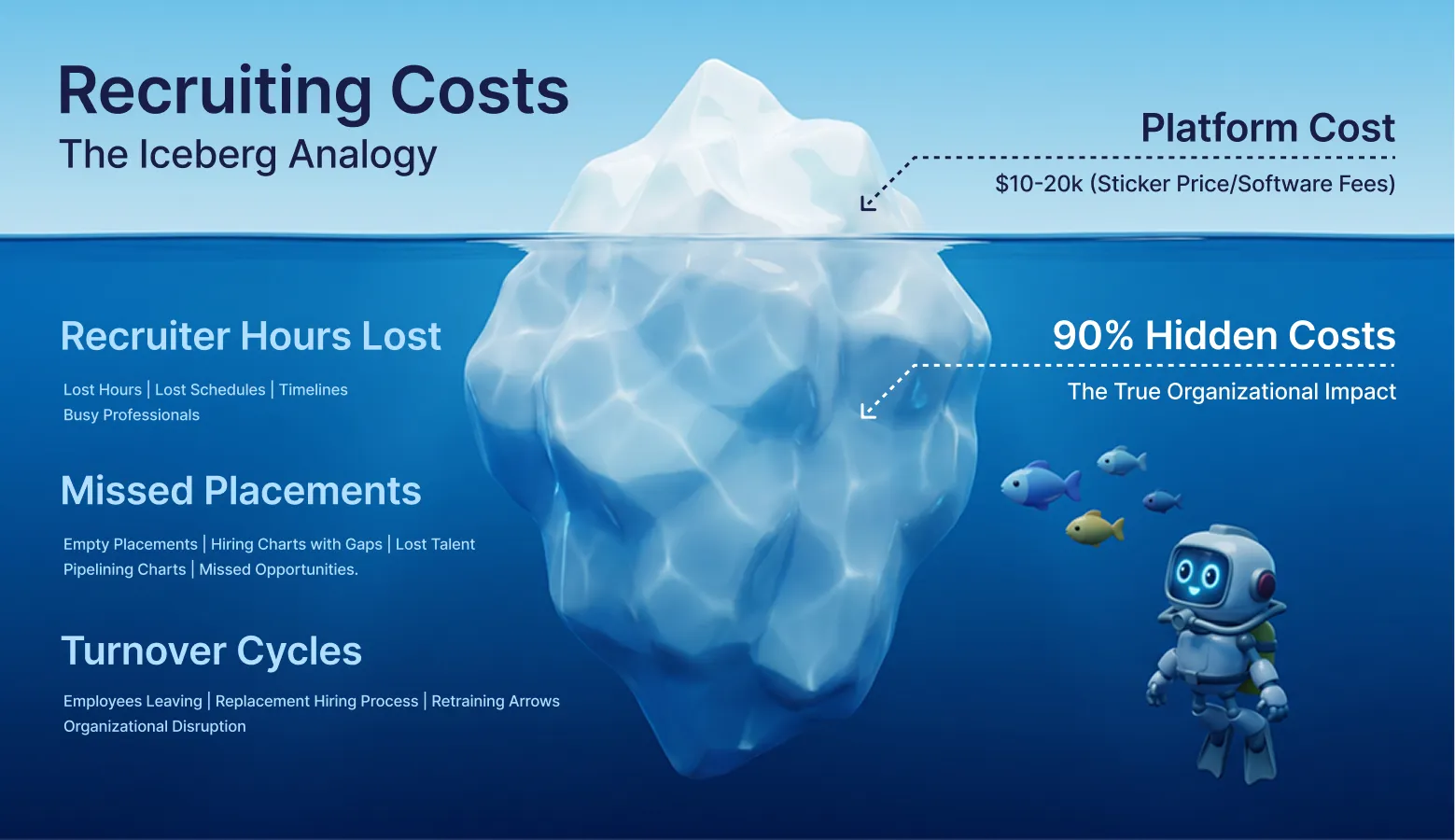
The sticker price of a firm’s current system is only the tip of the iceberg. The real cost sits below the surface: in recruiter hours lost to admin, placements missed while the pipeline crawls, and turnover cycles triggered when your best recruiters burn out doing work that should have been automated. A recruiter losing six hours a week to manual data entry loses roughly 300 hours a year, close to two months of full capacity that never touches a placement. Comparing what the operating model costs today, in hours, missed placements, and turnover, against what a modern operating model would cost tomorrow is the comparison that moves an ROI case forward.
The sticker price of your current system is only the tip of the iceberg.
Our Recommendation
Before approving or rejecting any modernization investment, complete a recruiter time audit. Track how your recruiters spend their week across three categories:
- Revenue-generating activity: placements, client relationships
- Administrative tasks: data entry, scheduling, sourcing management
- Reactive work: chasing information, managing system gaps
The gap between what you find and what you want will define your ROI case better than any vendor's calculator.
The Recruiter Time Check
- Do you know how many hours a week your recruiters spend on manual data entry?
- Have you calculated what a single placement actually costs, including recruiter hours, not just job board fees and ATS licensing?
- Has a recruiter left, or come close to leaving, over workload that should have been automated?
- Has a client gone to a competitor while your pipeline stalled?
Two or more checks means the sticker price on your invoice is the smallest number in the equation. One recruiter losing six hours a week adds up to roughly 300 hours a year, and that's before you multiply it across your whole team.
The Hidden Cost Model of Current Staffing Operations
Legacy systems rarely fail loudly. They fail through small, repeated friction: a recruiter re-entering the same candidate data into an ATS and a CRM, chasing a hiring manager for a status update, correcting duplicate records that never got cleaned up. None of that shows up on an invoice. All of it shows up in hours, and hours are the one resource a staffing firm can't get back. Multiply a single recruiter's weekly admin load across a team of ten, and a firm can be losing hundreds of billable hours a month to work that was never designed to be manual in the first place.
How to Calculate the True Cost Per Placement
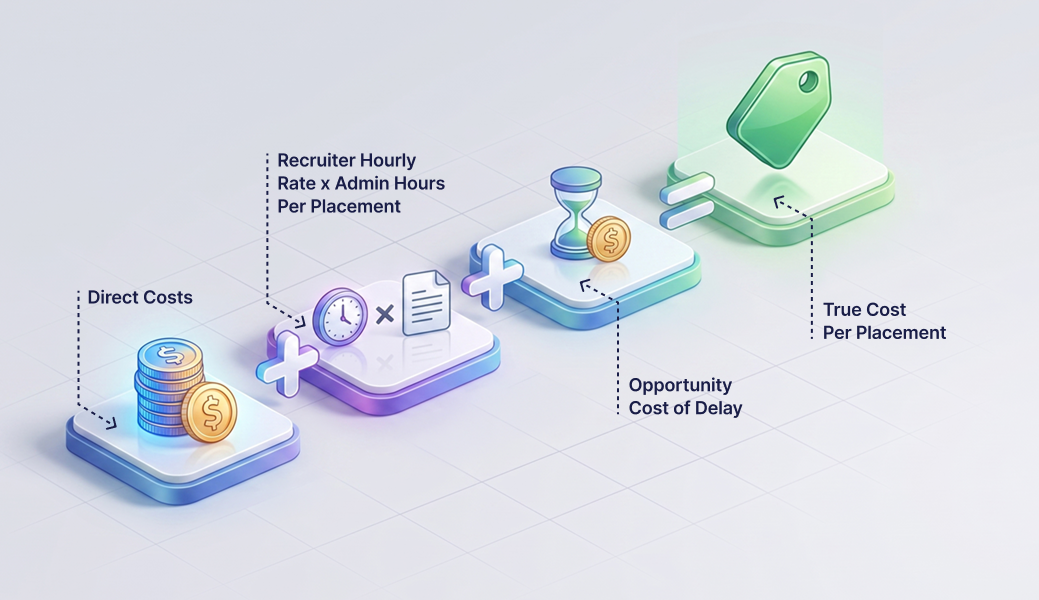
Many firms track the direct costs of a placement: job board fees, ATS licensing, sourcing tools. Few account for the labor costs buried inside the process. A more complete formula starts with a recruiter's loaded hourly rate, multiplied by the hours spent on admin for that placement, added to the direct software and AI costs, plus the opportunity cost of any delay when a client moved to a competitor while the pipeline stalled. That total, divided by placements made in a given period, is the number that reflects what a placement costs today. A placement doesn't generate revenue until the invoice goes out. The administrative work required to get there, timesheet capture, payroll reconciliation, approval routing, adds cost to every billing cycle that rarely shows up in a cost-per-placement calculation.
Building an Internal ROI Case Without Relying on Vendor Data
Vendor calculators are built to make a vendor's product look good, and experienced COOs know it. An ROI case built on a firm's own time audit and true cost per placement carries more weight with a CFO than any third-party benchmark, because the numbers are specific to that firm's team, workflows, and margins. Model two scenarios side by side: current cost per placement, and cost per placement if admin hours were cut in half. The difference between those two numbers, multiplied by placement volume, is the business case, built entirely from data the firm already owns.
The Right Questions to Ask Before Signing Any Technology Contract
- How is pricing structured: per seat, per placement, or per outcome?
- What is the realistic implementation timeline, not the sales timeline?
- Who owns the candidate data if the firm switches vendors later?
- Does the cost scale linearly with headcount, or does it compound?
- What is the time to first measurable value, and not time to go live?
One more consideration: not every operational gap requires a vendor contract. Some problems are better solved with a targeted build scoped to a specific workflow, delivered faster and cheaper than any enterprise purchase. The build-vs.-buy framework from the Foundation section applies here. The right question isn't just "which vendor" but whether the problem calls for a vendor at all.
Have you run a recruiter time audit in the last year? What did it show you about where the hours go?