

Chapter 7: Build the Operational Model for What Comes Next
The Pressure
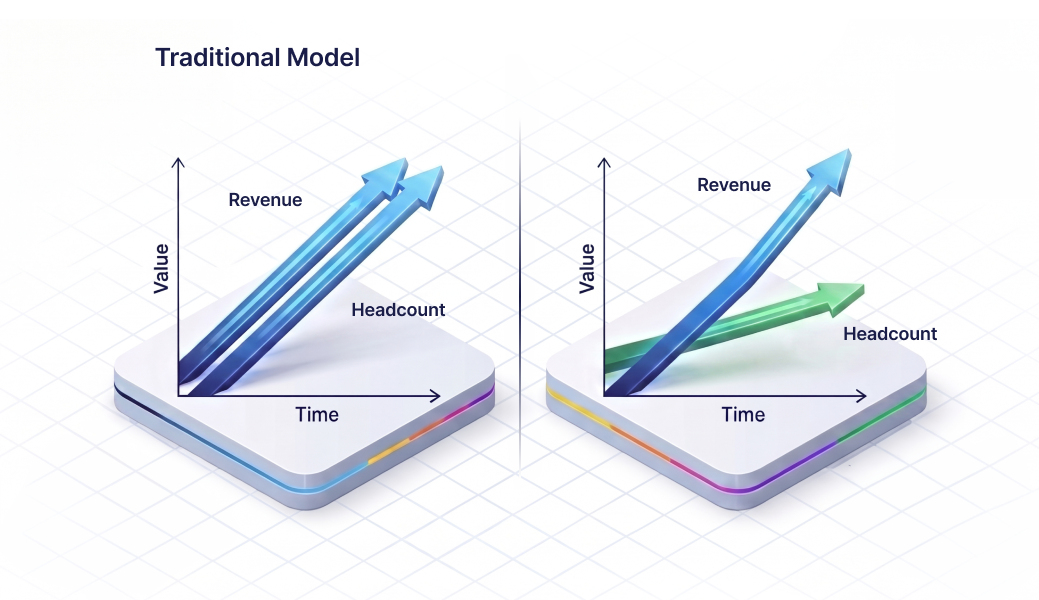
Revenue growth in staffing creates organizational pressure that doesn't scale in a straight line: more clients bring more requisitions, recruiters, and management overhead. With the hiring surge building and the complexity of open roles increasing, this pressure is arriving on a timeline most firms haven't planned for.
The traditional staffing growth model ties headcount to every stage of that chain. Breaking that cycle takes a different kind of investment: redesigning how the work itself gets done, so growth doesn't require adding headcount at every step.
The Key Insight
Doubling revenue over the next three years without doubling headcount is reliant on how the operating model is designed around the technology already in place. Two firms running identical technology can produce dramatically different outcomes depending on how they've designed the work. A staffing firm that treats digital workers as:
- tools gets incremental efficiency.
- members of the team, with defined roles, measurable outcomes, and continuous improvement get exponential capacity.
The operating foundation deserves the same scrutiny as any technology it supports.
Our Recommendation
A features checklist won't tell you what you need to know. What matters is whether your TRM system can support where the firm is headed: doubling revenue without doubling headcount.
The TRM System Scorecard
- Does it unify data across the firm, or does it create a new silo?
- Can its outputs, match quality, adoption, data accuracy, be measured against clear metrics?
- Does it scale as the firm grows, or will the firm outgrow it within a year or two?
- Does it make your team's judgment easier to exercise, or does it require them to work around it?
If you answered yes to all four, your system clears the bar, it has the infrastructure for the long run. If you answered no to even one, that's the specific gap to close before you scale further.
The Traditional Staffing Growth Model and Its Capacity Ceiling
Staffing firms typically scale along the same chain: clients, requisitions, recruiters, managers, each link adding to the one before it. Each stage adds cost in direct proportion to revenue, which means margin doesn’t improve as the firm gets bigger, it just gets recreated at a larger scale. Eventually, the firm hits a ceiling where hiring and training new recruiters to keep pace with growth, becomes its own operational strain, and revenue growth starts costing more to sustain than it returns. This is what happens when AI consumption, software licensing, and recruiter allocation all scale in lockstep with revenue. Breaking that proportionality, getting more placement throughput per dollar of AI spend, per software seat, and per recruiter hour, is how margin improves as the firm grows.
What a Hybrid Staffing Team Looks Like
A hybrid team splits the work by what each side does best. Human recruiters focus on the parts of the job that depend on judgment and relationships: reading a candidate's fit beyond a resume, navigating a client's unstated priorities, or closing a placement. Digital workers absorb the volume work covered throughout this guide, qualification screening, interview scheduling, status updates across systems, redeployment matching, running continuously and consistently at consumption cost rather than salary cost. Coordinated workflows are what connect the two: a shared data layer where recruiters and digital workers are drawing from and updating the same candidate and client records, rather than each working from a different version of the truth.
Evaluating a TRM System as a Scalable Operating Foundation
A system purchased to solve one immediate problem, faster scheduling, or better candidate search, tends to reach its limits the moment the firm's next growth stage needs something the system wasn't built for.
A foundation-level system is evaluated differently: against whether it can support sourcing, qualification, placement, redeployment, and reporting as the firm scales, and not just the single function it was purchased to fix. That distinction is what separates a tool a firm will outgrow from infrastructure a firm can keep growing into. Some capabilities belong in the enterprise system. Others are better served by targeted builds that address workflow-specific needs. The evaluation criteria are the same either way: will this still work when placement volume doubles?
"If your placement volume doubled next year, which part of your current operating model would break first, your headcount, your data, or your technology?"